








What Is the Median of a Triangle Formula Proof and Solved Examples
A line segment joining a triangle vertex to the middle of the other side, bisecting that side, is referred to as the median of a triangle in geometry. There are three medians in every triangle, one from each vertex.
At the centroid of the triangle, these medians cross. The median of a triangle is a line segment that connects a vertex to the midpoint of the side that is opposite to that vertex. The median (AD) in the example below divides BC into two equal portions, resulting in BD = DC. This answers, what is a median in geometry?
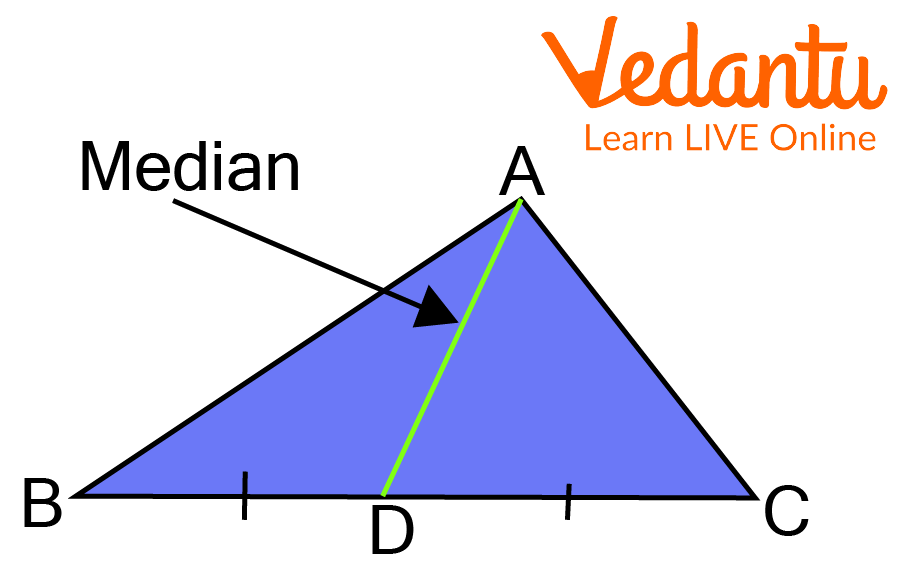
Median of a Triangle
Properties of Median of a Triangle
A few properties of median of a triangle are listed below:
A line segment from a triangle's vertex to the middle of its opposite side is said to be the triangle's median.
It divides the opposing side into two equal portions by cutting it in half.
A triangle is further divided into two triangles with the same area by its median.
Any triangle's three medians meet at a single point, regardless of its size or shape.
Three medians, one from each vertex, exist for each triangle. The triangle's centroid is formed by the intersection of three medians.
The centroid is the point of concurrency of medians of the triangle.
The Altitude of a Triangle
A line segment making a straight angle (90°) from a triangle's vertex to its opposite side is considered the triangle's altitude. Depending on the type of triangle, an altitude may be inside or outside the triangle. Each triangle has three altitudes, one from each vertex, which all come together at the triangle's orthocenter.
How to Find the Median of a Triangle
The median formula geometry is given as follows.
The first median of a triangle formula is calculated using the median of a triangle theorem, where the triangle's median is $m_{a}$, its sides are $\mathrm{a}, \mathrm{b}$, and $\mathrm{c}$, and the median is established on the side ' $a$ '.
$m_{a}=\sqrt{\dfrac{2 b^{2}+2 c^{2}-a^{2}}{4}}$
The second median of a triangle is calculated using the median of a triangle theorem, where the triangle's median is $m_{b}$, its sides are a, b, and $c$, and the median is established on the side ' $b$ '.
$m_{h}=\sqrt{\dfrac{2 a^{2}+2 c^{2}-b^{2}}{4}}$
The third median of a triangle is calculated using the following formula, where the triangle's median is $m_{c}$, its sides are $\mathrm{a}, \mathrm{b}$, and $\mathrm{c}$, and the median is established on side ' $c$ '.
$m_{c}=\sqrt{\dfrac{2 a^{2}+2 b^{2}-c^{2}}{4}}$
Solved Examples
Q1. Calculate the length of the median of the triangle PQR, whose sides are PQ = 3, PR = 4, and QR = 5 units. The median created on the side QR is given as PM.
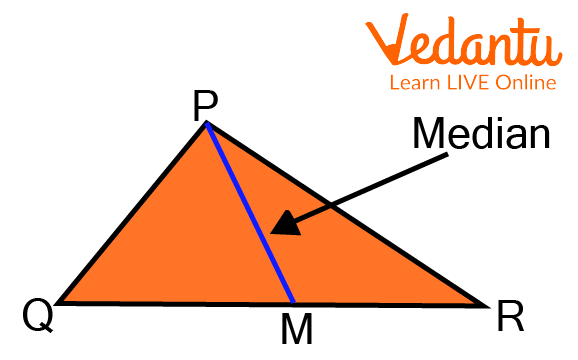
Example to Find the Median
Ans: Here, we have to find a PM. So, we have to use the median of the triangle formula i.e.
$P M=\sqrt{\dfrac{2 P Q^{2}+2 P R^{2}-Q R^{2}}{4}}$
$P M=\sqrt{\dfrac{2(3)^{2}+2(4)^{2}-(5)^{2}}{4}}$
where $P Q=3, P R=4, Q R=5$
$PM=\sqrt{\dfrac{18+32-25}{4}}=\sqrt{\dfrac{50-25}{4}}=\sqrt{\dfrac{25}{4}}=\dfrac{5}{2}=2.5 \text { units. }$
Q2. Determine the length of the median of the triangle ABC, whose sides are given as AB = 10, BC = 8, and AC = 13 units, respectively. The median created on side BC is given as AD where D is the median.
Ans: Here, we have to find AD. So, we have to use the median of the triangle formula i.e.
$A D=\sqrt{\dfrac{2 A B^{2}+2 A C^{2}-B C^{2}}{4}}$
$A D=\sqrt{\dfrac{2(10)^{2}+2(13)^{2}-(8)^{2}}{4}}$
where $A B=10, B C=8, A C=13$
$A D=\sqrt{\dfrac{200+338-64}{4}}=\sqrt{\dfrac{474}{4}}=10.88$ units.
Q3. Triangles have a 28 cm, 45 cm, and 53 cm median. What is the triangle's area?
Ans: We have given the Pythagoras triplet i.e. 28cm, 45cm, 53cm.
Thus, the area of a triangle is equal to $\dfrac{4}{3}$ which is multiplied by the area of the triangle formed by the median.
The area of a triangle is $\dfrac{4}{3} \times \dfrac{1}{2} \times 28 \times 45=840 \mathrm{~cm}^{2}$.
Q4. For the given triangle ABC, G is the centroid and BC = 10 units. Determine the length of BD.
Ans: Given,
$\angle \mathrm{GDC}=90$
$\Rightarrow \mathrm{GD}=18 \times \dfrac{1}{3}=6$
$\Rightarrow \mathrm{BG}=15 \times \dfrac{2}{3}=10$
In BGD,
Using Pythagoras theorem,
$\Rightarrow B G^{2}=G D^{2}+B D^{2}$
$\Rightarrow B D^{2}=100-36=64$
$\Rightarrow B D=8$
$\Rightarrow B C=2 B D=2 \times 8=16$
Area of $\Delta \mathrm{BGD}=\dfrac{1}{2} \times \mathrm{GD} \times \mathrm{BD}$
$=\dfrac{1}{2} \times 8 \times 6=24$ sq.units.
Q5. Two equilateral triangles of side 4 cm each but labelled as △ABC and △LHN are not congruent. True or False?
Ans: Two equilateral triangles with equal sides are always congruent no matter how they are labelled. So the statement is False.
Practice Questions
Q1. Write the formula for the median of a triangle if it is given that there is a triangle MNO and MP is the median?
Ans: $M P=\sqrt{\dfrac{2 M N^{2}+2 M O^{2}-N O^{2}}{4}}$
Q2. Find the length of median AD if we have the coordinates of triangle ABC as A(1,0), B(0,1), C(1,1)
Ans: $\dfrac{\sqrt{5}}{2}$
Q3. Given statement is true or false i.e. point where median meets opposite sides which is the midpoint of that line.
Ans: True
Q4. For any triangle, the centroid is the point of concurrency of the ____________ of the triangle
Ans: Medians
Q5. How many medians do a triangle have?
Ans: Every triangle has 3 medians
Summary
In geometry, the median of a triangle is the line segment that connects one vertex to the middle of the other side, dividing it in half. Each vertex of a triangle has the same number of medians, which all cross at the triangle's centroid. A median cuts any angle at an angle at the vertex of an isosceles or equilateral triangle whose two adjacent sides are of equal length. Since the corresponding elements of congruent triangles are congruent, the medians of congruent triangles are equal if the two triangles are congruent. Students can become well-versed only by practising many examples of the median of a triangle sum.
FAQs on Median of a Triangle Explained with Formula and Properties
1. What is the median of a triangle?
The median of a triangle is a line segment drawn from a vertex to the midpoint of the opposite side. Each triangle has three medians, one from each vertex. A median divides the opposite side into two equal parts and lies completely inside the triangle. Medians are important in coordinate geometry, triangle properties, and centroid calculations.
2. How many medians does a triangle have?
A triangle has three medians, one from each vertex to the midpoint of the opposite side.
- Each median connects a vertex to the midpoint of the opposite side.
- All three medians intersect at a single point called the centroid.
- This property holds true for all types of triangles: scalene, isosceles, and equilateral.
3. What is the centroid of a triangle?
The centroid of a triangle is the point where all three medians intersect. It divides each median in the ratio 2:1, measured from the vertex to the midpoint of the opposite side. The centroid is also called the center of mass or balancing point of the triangle.
4. What is the formula for the length of a median of a triangle?
The length of a median can be found using the formula ma = (1/2)√(2b² + 2c² − a²).
- Here, a is the side opposite the median.
- b and c are the other two sides.
- This formula is derived from Apollonius' Theorem.
5. How do you find the median of a triangle in coordinate geometry?
To find the median in coordinate geometry, first find the midpoint of one side and then join it to the opposite vertex.
- Step 1: Use midpoint formula: ((x₁ + x₂)/2, (y₁ + y₂)/2).
- Step 2: Join this midpoint to the opposite vertex.
- Step 3: Use distance formula if you need the median’s length.
6. What is the difference between a median and an altitude of a triangle?
The median joins a vertex to the midpoint of the opposite side, while the altitude joins a vertex perpendicular to the opposite side.
- A median divides a side into two equal parts.
- An altitude forms a 90° angle with the opposite side.
- Medians meet at the centroid, while altitudes meet at the orthocenter.
7. Do the medians of a triangle divide it into equal areas?
Yes, the medians of a triangle divide it into six smaller triangles of equal area. When all three medians are drawn:
- They intersect at the centroid.
- The triangle is split into six smaller triangles.
- Each small triangle has the same area.
8. What is the ratio in which the centroid divides a median?
The centroid divides each median in the ratio 2:1 from the vertex to the midpoint. This means:
- The segment from the vertex to the centroid is twice the segment from the centroid to the midpoint.
- If the median length is m, then vertex to centroid = (2/3)m.
- Centroid to midpoint = (1/3)m.
9. Can you give an example of finding the length of a median?
Yes, the length of a median can be calculated using the formula ma = (1/2)√(2b² + 2c² − a²).
- Example: Let sides be a = 6, b = 8, c = 10.
- ma = (1/2)√(2(8²) + 2(10²) − 6²)
- = (1/2)√(128 + 200 − 36)
- = (1/2)√292
- = √73.
10. Are the medians equal in all triangles?
No, the medians are not equal in all triangles; they are equal only in an equilateral triangle.
- In a scalene triangle, all three medians have different lengths.
- In an isosceles triangle, two medians may be equal.
- In an equilateral triangle, all medians are equal and also act as altitudes and angle bisectors.
