








How to Measure Area on a Grid and Describe Paths Step by Step with Examples
A math grid is another name for the coordinate plane consisting of a space of small squares, sometimes with an x-axis and y-axis. Each little square is used as a measurement. Every square could measure one unit area or more depending on what is needed and what you decide. Each column or row of squares could also have a unique verbal title, like in the case of bar graphs (where each column has a different name). In this article, we will learn how to measure the area, describe it by using paths on a grid, and count them over a grid.
How to Measure Area?
Measuring area and describing paths on a grid is done using a square-sized box row. These boxes are equal in length and breadth. These can be used for drawing models of things, working out geometry and trigonometry problems, and for making calculations.
Now let us see through an example:
Here in the below image, we can see that the boxes are like graph paper having each of the boxes with equal sides. Let us suppose each box is of 1 unit.
Therefore, there are 35 boxes.
Here, by combining the length, it can be seen that it is 7 units.
And the width is 5 units.
So, we can say that the area of the whole box becomes:
= 7 x 5
= 35 unit2
We can also find the area of the shaded portion. As each box is of 1 unit2.
Since there are 9 shaded boxes.
Hence, the area becomes 9 unit2
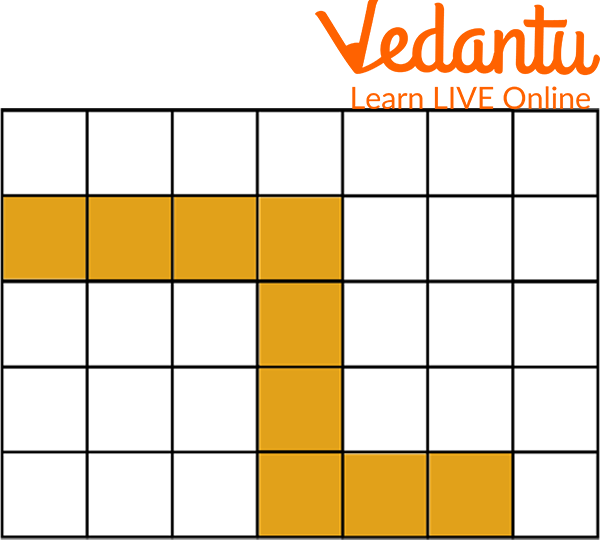
The Area of the Rectangle is the Number of Shaded Unit Squares
Area of Rectangle
Consider a yellow rectangle in the grid with an area of 6 units.
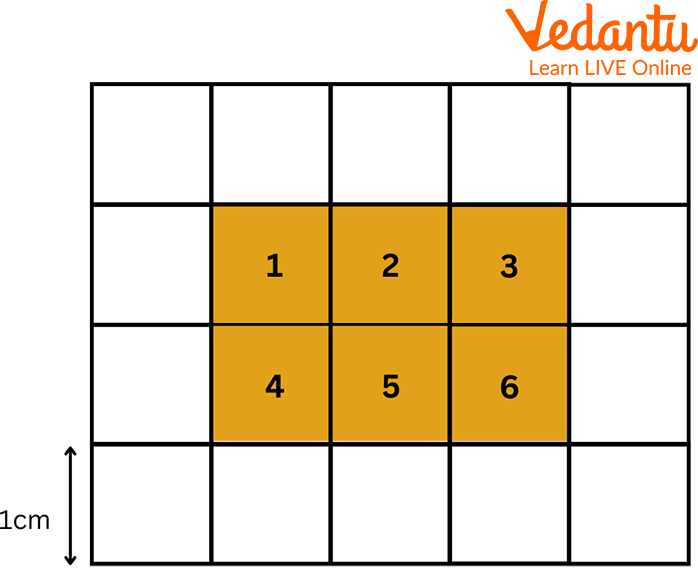
Example
In the above figure, the length of the rectangle is 3 units, and the width is 2 units. The area of a rectangle can be obtained by multiplying its length and width, which is the same as counting the unit squares.
Area of Rectangle = length × width
Therefore, the required area is = 2 x 3
= 6 square units
Area of Square
The coloured square shown below in the grid occupies 25 squares
Therefore, the area of the square will be multiplied by its sides.
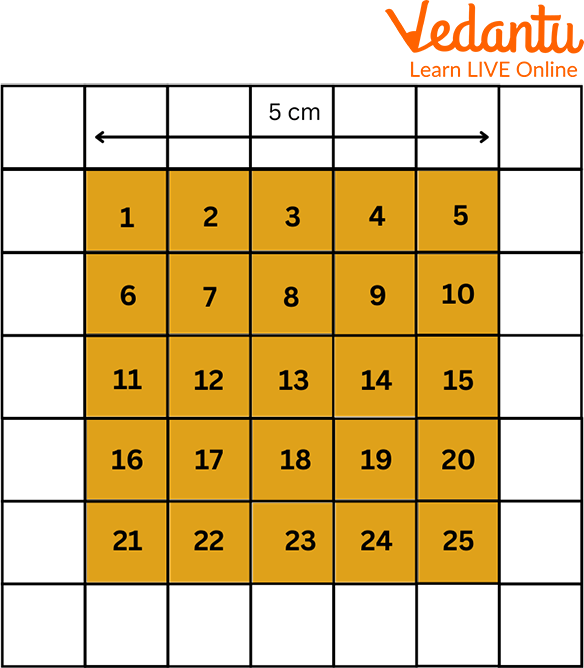
Area of Rectangle
Area Of Square = side × side.
So, the required area is = 5 x 5 = 25 square units
Paths on a Grid
Given Below is an 8 by 8 grid. Let Point A be at the top left corner of the square and point B be in the bottom right corner.
If you are supposed to have only one more down and right and make a unique path in a grid, how many different paths will exist from A to B?
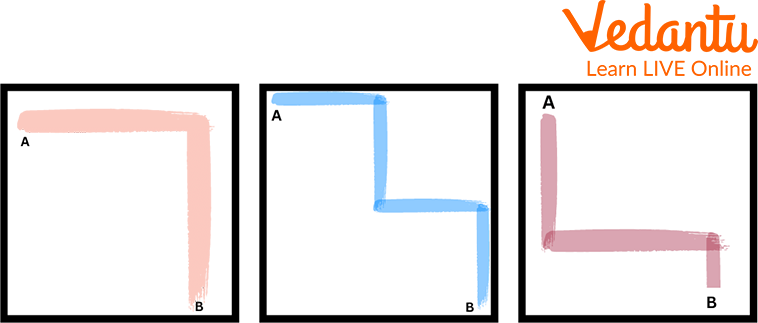
Paths on Grid
Every successful path for an 8x8 grid will involve exactly 7 moves down and 7 moves to the right. The number of decisions to select the right or the down path will determine the total number of paths. This way, we can count all possible paths from top left to bottom right.
Counting Paths
How does one realise the many pathways on a square when three lines go across every way, from point A to point B (from top to bottom)?
The problem, as declared, could be very little unclear as to wherever A and B are and what the rules are.
Making an Orderly List
Let's number the points to make it easier to discuss:
Starting at A=1, you have two choices, 2 or 4, so the possible paths so far are:
1-2
1-4
From 2, there are two choices, 3 or 5; from 4, there are two choices, 5 or 7:
1-2-3
1-2-5
1-4-5
1-4-7
From 3 or 7, there are no more choices; you're forced to go one way. From 5, you have two choices. So here are all the possible paths:
1 - 2 - 3 - 6 - 9
1 - 2 - 5 - 6 - 9
1 - 2 - 5 - 8 - 9
1 - 4 - 5 - 6 - 9
1 - 4 - 5 - 8 - 9
1 - 4 - 7 - 8 - 9
So we have a total of 6 paths (in red, from green A to red B):
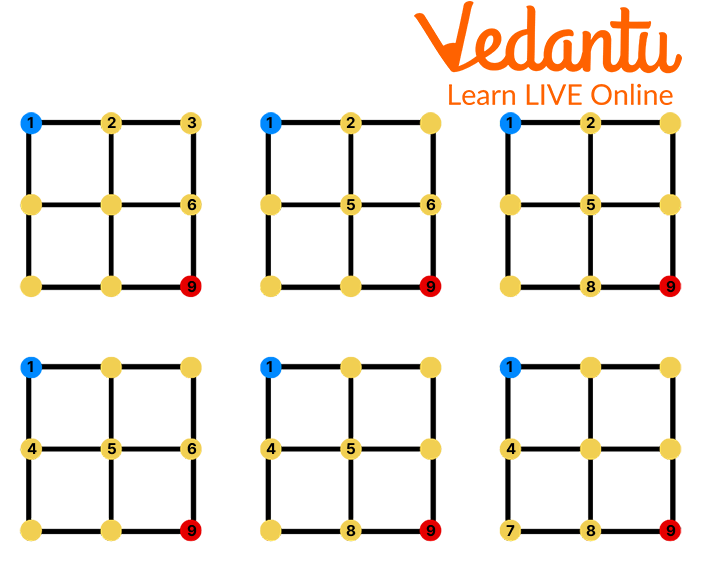
Counting Paths
Solved Examples
Example 1: Find the area of a square with a side of 5 cm.
Solution: Area of a square = side × side.
Here, side = 5 cm
Substituting the values, 5 × 5= 25
Therefore, the area of the square = 25 sq cm.
Example 2: The dimensions of a rectangle are 15 cm and 8 cm. Find its area.
Solution: The area of a rectangle is the product of its length and width, which can be
Given, length = 15cm
Width = 8
Represented by the formula: Area = l × w.
Substituting the given values,
We get area of the rectangle = 15 × 8 = 120 square cm
Practice Questions
Q.1 Maggie's ping pong table is 9 feet long and 5 feet wide. What is the area of the rectangular playing surface of the ping pong table?
28 square feet
36 square feet
45 square feet
54 square feet
Ans. c. 45 square feet
Q 2 The area of a rectangle with a base of 4 inches and a width of 5 inches is
20 square inches.
9 square inches.
18 square inches.
10 square inches.
Ans. a.20 square inches
Summary
In this article, we have learnt about the area and how to find the area of various shapes and figures like squares and rectangles. Then we find their unique path in a grid, easily counting all possible paths from top left to bottom right. We have also solved some problems with them. This article also has a practice module that makes you practice the questions and helps you command the topic easily.
FAQs on Measuring Area and Describing Paths on a Grid in Coordinate Geometry
1. What does measuring area on a grid mean?
Measuring area on a grid means finding the total space inside a shape by counting the number of square units it covers. On square grid paper, each small square represents 1 square unit (for example, 1 cm² if each side is 1 cm).
- Count all complete squares inside the shape.
- Combine partial squares to make whole ones where possible.
- The total number of squares gives the area.
2. How do you calculate the area of a rectangle on a grid?
To calculate the area of a rectangle on a grid, use the formula Area = length × width. Count the number of grid squares along the length and the width.
- Step 1: Count squares along the length.
- Step 2: Count squares along the width.
- Step 3: Multiply the two numbers.
3. How do you find the area of an irregular shape on a grid?
To find the area of an irregular shape on a grid, count full squares and estimate partial squares to get the total number of square units.
- Count all complete squares inside the shape.
- Pair partial squares to form whole squares.
- Add them together for the total area.
4. What is a square unit in grid area measurement?
A square unit is the area of a square with sides of 1 unit, such as 1 cm × 1 cm or 1 m × 1 m. In grid measurement, each small square represents one square unit.
- If sides are 1 cm, the area is 1 cm².
- If sides are 1 m, the area is 1 m².
5. How do you describe a path on a grid?
To describe a path on a grid, state the starting point and list the directions and number of units moved, such as right, left, up, or down.
- Begin at a coordinate point, for example (0,0).
- Describe horizontal movement (right or left).
- Describe vertical movement (up or down).
6. What are coordinates on a grid?
Coordinates on a grid are ordered pairs written as (x, y) that show the exact position of a point. The first number (x-coordinate) shows horizontal movement, and the second number (y-coordinate) shows vertical movement.
- (3,2) means 3 units right and 2 units up.
- (−2,1) means 2 units left and 1 unit up.
7. How do you calculate the total distance of a path on a grid?
To calculate the total distance of a path on a grid, add all the horizontal and vertical movements in units.
- Count units moved right and left.
- Count units moved up and down.
- Add all movements together.
8. What is the difference between area and perimeter on a grid?
The difference between area and perimeter on a grid is that area measures the space inside a shape, while perimeter measures the distance around it.
- Area is counted in square units (e.g., cm²).
- Perimeter is measured in linear units (e.g., cm).
9. Can you give an example of measuring area using coordinates?
Yes, you can measure area using coordinates by finding side lengths from plotted points and applying a formula such as Area = length × width for rectangles.
- Suppose a rectangle has vertices (1,1), (6,1), (6,4), (1,4).
- Length = 6 − 1 = 5 units.
- Width = 4 − 1 = 3 units.
10. What are common mistakes when measuring area on a grid?
Common mistakes when measuring area on a grid include miscounting squares and confusing area with perimeter.
- Ignoring partial squares instead of estimating them.
- Counting boundary lines instead of square spaces.
- Forgetting that area is measured in square units.
