








Definition Properties Differences and Solved Examples of Lines and Line Segments
Have you ever thought about how to measure the length of a line? A line is a figure formed when two points are connected with a minimum distance between them, and both ends extended to infinity. The length of a line can be measured using a ruler. This article gives us complete details about the line and line segment. Reading this article, students will be able to identify the difference between a line and a line segment. This is the most basic topic of geometry, thus, should be at the tips of every child. Let us now begin with the learning about the given topic.
What is a Line?
A line is defined as a one-dimensional figure with no endpoints. In simple words, a line can be defined as a collection of points that can be extended indefinitely.
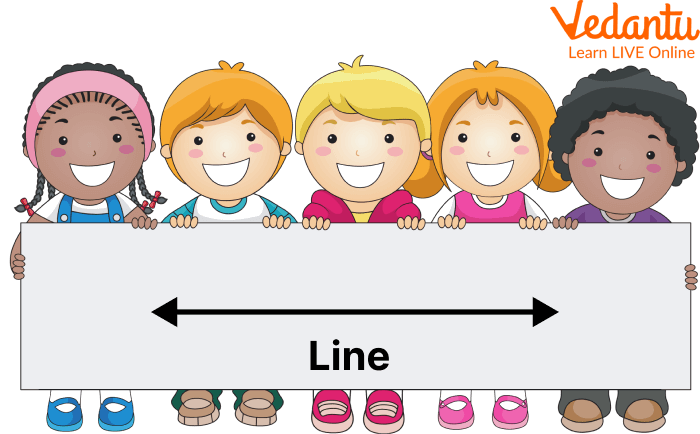
Showing a Line
How long is a Line?
The length of a line is not fixed; it can be extended indefinitely in both directions. The line is measured in terms of units with rules. For example, meters, centimetres, inches etc., i.e., a 5 cm length of a line can be extended in both directions as shown below.
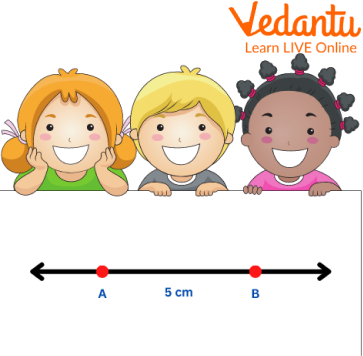
Showing a 5 cm length line
What is a Line Segment?
A line segment is defined as a line with two fixed endpoints that can not be extended in any direction. A line can be converted to a line segment by fixing two points.
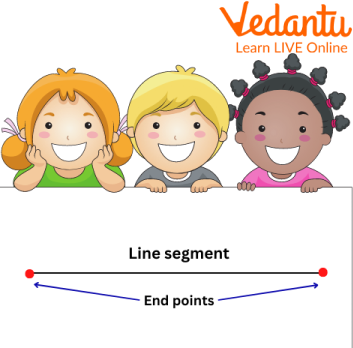
Showing a Line Segment
Length of a Line Segment
The length of a line segment is always fixed, i.e. it can not be changed because it cannot be extended in any direction. Line segment length can be measured in different measurement units, meters, centimeters, inches, etc.
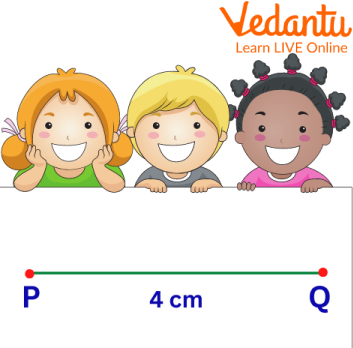
Showing a line segment length of 4 cm
Solved Examples
1. What is the length of the line shown in the image? Note: Measurement in cm
Measure the length of a line by putting the scale over it and noting its value down. Here, the length of the line is 2 inches. Now, it is known that 1 inch = 2.54 cm.
The length of the line in centimetres is converted by multiplying the length of the line by 2.54, i.e. $2.54 \times 2 = 5.08 cm$.
Thus, the length of the line in centimetres is 5.08 cm.
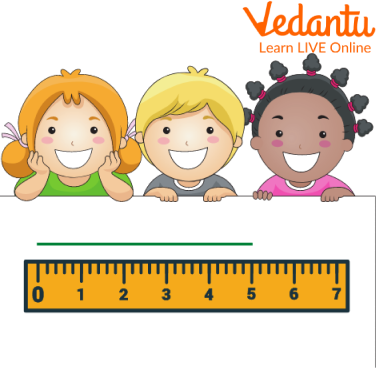
Showing 5.08 cm length of line
Q 2. What is the length of line AB shown in the image?
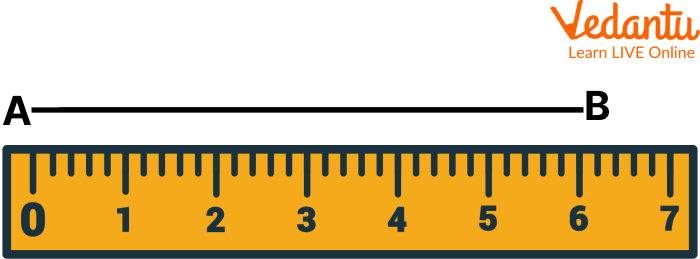
Line AB
Ans: The length of a line AB is measured using the ruler. Put the ruler on the line and mark the point on the scale as per the length of the line for the given line AB mark at 6 cm. Then, note the point, i.e. 6 cm.
Hence, the length of a line is obtained.
Practice Problems
Q 1. Spot the length of the given line segment.
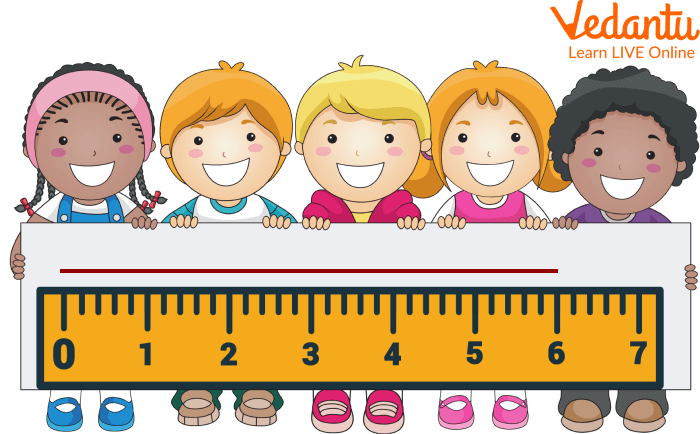
Showing a line segment length
Ans: 6 cm
Q 2. What is the length of the line in centimetres, given that the line is 10 Inches?
Ans: 25.4 cm
Summary
Summing up the article here, with the concept of lines and the lines segments. This writing has covered the topics of line and line segments in an attractive format using simple language and related images. Some solved examples are also given for the clarification of concepts, and related practice problems are specified for students to master the given topic.
FAQs on Lines and Line Segments in Geometry
1. What is a line in geometry?
A line is a straight one-dimensional figure that extends infinitely in both directions without any endpoints. In geometry, a line:
- Has no thickness and no endpoints
- Extends forever in opposite directions
- Is usually represented by arrows on both ends (↔)
- Can be named using two points, such as line AB
2. What is a line segment?
A line segment is a part of a line that has two fixed endpoints and a definite length. Unlike a line, a line segment:
- Has two endpoints
- Has a measurable finite length
- Is written as \( \overline{AB} \)
3. What is the difference between a line and a line segment?
The main difference is that a line extends infinitely, while a line segment has fixed endpoints and a definite length. Key differences include:
- A line has no endpoints and cannot be measured.
- A line segment has two endpoints and can be measured.
- A line is shown with arrows on both ends, while a segment is shown with dots at both ends.
4. How do you find the length of a line segment?
The length of a line segment can be found using the distance formula in coordinate geometry. The formula is √[(x₂ − x₁)² + (y₂ − y₁)²]. Steps:
- Identify the coordinates of the endpoints (x₁, y₁) and (x₂, y₂).
- Substitute into the distance formula.
- Simplify to get the final answer.
5. What are the properties of a line segment?
A line segment has specific geometric properties that distinguish it from other figures. These include:
- It has two endpoints.
- It has a fixed measurable length.
- It is the shortest path between two points.
- It can be horizontal, vertical, or slanted.
6. What is a ray and how is it different from a line segment?
A ray is a part of a line that has one endpoint and extends infinitely in one direction. The difference is:
- A ray has one endpoint and one arrow.
- A line segment has two endpoints.
- A ray extends infinitely, while a segment has a fixed length.
7. How do you draw a line segment?
To draw a line segment, mark two points and connect them with a straight line using a ruler. Steps:
- Mark point A.
- Measure the required length (for example, 6 cm).
- Mark point B at that distance.
- Join A and B with a straight line.
8. Can a line segment be extended?
Yes, a line segment can be extended beyond its endpoints to form a line. When extended on both sides:
- The finite segment becomes an infinite line.
- It no longer has fixed endpoints.
- Its length becomes immeasurable.
9. What is the midpoint of a line segment?
The midpoint of a line segment is the point that divides it into two equal parts. The midpoint formula is ((x₁ + x₂)/2, (y₁ + y₂)/2). Steps:
- Add the x-coordinates and divide by 2.
- Add the y-coordinates and divide by 2.
10. What are real-life examples of lines and line segments?
Lines and line segments appear frequently in everyday life and practical geometry. Examples include:
- A stretched rope represents a line segment.
- The edge of a ruler is a line segment.
- Railway tracks model a line extending far in both directions.
- Road markings often represent straight lines.
