








How to Find LCM Using Prime Factorization and Division Method
"LCM" is an acronym for "least common multiple." The Least Common Multiple (LCM) of two or more numbers is the smallest number that is a multiple of each. This is the mathematical definition of "Least Common Multiple (LCM)," and we will be exploring LCM definition and examples. Sometimes it's hard to tell what the LCM should be, but we've got your back! In this article, we'll show you how to find the LCM of 3 and 4.
Full Form of LCM.
What is Multiple?
Our main focus is on the LCM of 3 and 4 but before directly jumping on that we shall discuss; what is multiple?
The product of two given numbers is called a multiple. A multiple is gained by multiplying any number with other numbers like 1,2,3,4 etc.,
For example, the multiples of 2 are 2, 4, 6, 8, 10, 12,14, and so on…
Multiples of 3 are 3, 6, 9, 12, 15, 18, 21, and so on…
Now that you know what a multiple is, we shall move on to the next thing which is what is a common multiple. A common multiple is a number that is the common multiple of two or more numbers.
For example: The common multiple in the given numbers 2 and 3 is 6 and 12.
Through the above information, we have now idea about the LCM definition and examples.
What is the Definition of LCM?
The definition of LCM is given below:
Now that you know what a multiple is and what a common factor is, it's time to learn what is the least common multiple. The Least Common Multiple is the smallest number that two numbers will divide into. Hence, the LCM of two or more numbers is the smallest number that can exactly divide each of the given numbers.
Examples of LCM
LCM of 5 and 10 is 10.
LCM of 5 and 15 is 15.
LCM of 22 and 24 is 264.
How to Find Least Common Multiple of 3 and 4?
Let us find out the LCM of 3 and 4.
Multiples of 3 are 3, 6, 9, 12, 15, 18, 21, 24, 27, 30, 33, 36, ...... etc.
Multiples of 4 are 4, 8, 12, 16, 20, 24, 28, 32, 36, ...... etc.
If you look closer you will find a common multiple of 3 and 4 that is 12.
Let us have a look at the LCM of 2, 3, and 4.
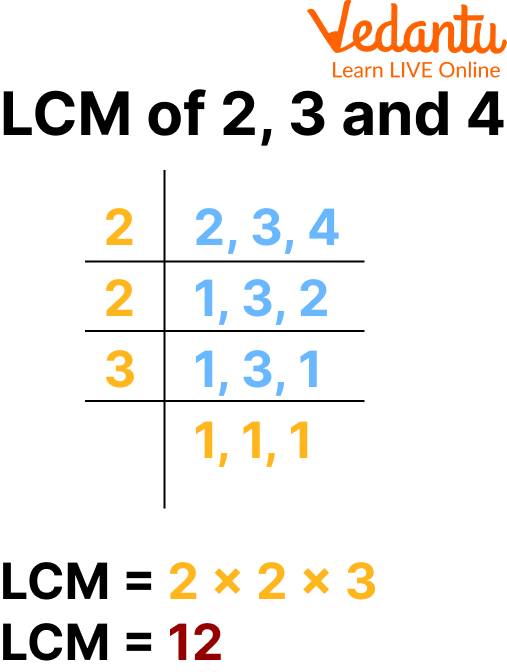
Representation of LCM
How to Find LCM Using Different Methods?
To make you understand better how to find out LCM using different strategies, let us take some LCM examples:
Solved Examples
Q 1. Find out the LCM of 8, 12, and 16 by the factorization method.
Ans: 8= 2x2x2
12= 2x2x3
16= 2x2x2x2
Therefore LCM OF 8, 12, 16 is;
2x2x2x2x3= 48
Q 2. Find out the LCM of 3, 4, and 6 by multiplication method.
Ans: Multiples of 3= 3, 6, 12, 15, 18, 21, 24
Multiples of 4= 4, 8, 12, 16, 20, 24, 28
Multiples of 6= 6, 12, 18, 24, 30, 36, 42
The common multiples of 3,4 and 6 are 12 and 24.
The Least Common multiple of 3, 4 and is 12.
Practice Problems
Q 1. Find the common multiple of 9 and 27.
Ans: 27
Q 2. Find the LCM of 16, 24, and 48 by finding common prime factors.
Ans: 48
Q 3. Find the LCM of 15 and 30 by the prime factorization method.
Ans: 30
Q 4. Find the LCM of 70 and 110 by the long division method.
Ans: 770
Summary
In this chapter, we learned about multiples, what are common multiples and what are least common multiples. LCM of a given number is the smallest number that two numbers will divide into. We also learned different methods to achieve the LCM of given numbers i.e, the prime factorization method, multiplication method, and long division method.
FAQs on LCM Least Common Multiple Explained
1. What is LCM in maths?
The LCM (Least Common Multiple) is the smallest positive number that is a multiple of two or more given numbers. It is the smallest number that all the given numbers divide exactly.
- Multiples of 4: 4, 8, 12, 16, 20...
- Multiples of 6: 6, 12, 18, 24...
2. How do you find the LCM of two numbers?
You can find the LCM of two numbers by using the prime factorization method or listing multiples. Using prime factorization:
- Step 1: Write each number as a product of prime factors.
- Step 2: Take the highest power of each prime.
- Step 3: Multiply them together.
- 8 = 2³
- 12 = 2² × 3
LCM = 2³ × 3 = 24.
3. What is the formula for LCM using HCF?
The formula connecting LCM and HCF (GCD) of two numbers is LCM × HCF = Product of the numbers. Therefore, LCM = (Product of the numbers) ÷ HCF.
Example: Find LCM of 15 and 20.
- HCF of 15 and 20 = 5
- Product = 15 × 20 = 300
4. What is the LCM of 12 and 18?
The LCM of 12 and 18 is 36. Using prime factorization:
- 12 = 2² × 3
- 18 = 2 × 3²
- 2²
- 3²
5. What is the difference between LCM and HCF?
The LCM is the smallest common multiple of given numbers, while the HCF (Highest Common Factor) is the greatest common divisor of those numbers.
- LCM deals with multiples.
- HCF deals with factors.
- LCM is usually greater than or equal to the numbers.
- HCF is less than or equal to the numbers.
- LCM = 24
- HCF = 4
6. How do you find the LCM of three numbers?
To find the LCM of three numbers, use prime factorization and take the highest powers of all prime factors involved.
Example: Find LCM of 4, 6, and 10.
- 4 = 2²
- 6 = 2 × 3
- 10 = 2 × 5
LCM = 2² × 3 × 5 = 4 × 3 × 5 = 60.
7. Why do we use LCM when adding fractions?
We use the LCM of denominators to find a common denominator when adding or subtracting fractions. The LCM ensures the smallest common denominator for easier calculation.
Example: Add 1/4 + 1/6.
- LCM of 4 and 6 = 12
- 1/4 = 3/12
- 1/6 = 2/12
8. What is the LCM of 5 and 7?
The LCM of 5 and 7 is 35 because both numbers are prime and have no common factors other than 1.
- 5 = prime
- 7 = prime
9. Can the LCM of two numbers be smaller than the numbers?
No, the LCM of two positive numbers is always greater than or equal to the larger number. This is because the LCM is a multiple of both numbers.
Example:
- LCM of 3 and 5 = 15 (greater than both)
- LCM of 4 and 8 = 8 (equal to the larger number)
10. What are the common methods to find LCM?
The most common methods to find LCM are the listing method, prime factorization method, and division method.
- Listing method: Write multiples until a common multiple is found.
- Prime factorization method: Use highest powers of prime factors.
- Division method: Divide numbers simultaneously by prime numbers.
