








How to Find the Area and Perimeter of a Triangle Using Different Formulas and Solved Examples
The length of a triangle's three sides together equals its perimeter. The region or surface enclosed by a triangle's form is known as the triangle's area. When we fence the backyard garden or hang Christmas lights around the home, we discover the Perimeter. Similarly, we determine the size of the carpet purchased by measuring the area of the room's floor. We will learn here how to find the area from the perimeter. This article will consider all the points related to the area and perimeter of the triangle. This is going to help you a lot.
What is a Triangle?
Let's remember some key concepts to find triangle area and perimeter:
A triangle is a polygon with three sides.
The vertices are the three points where two sides (the corners) meet.
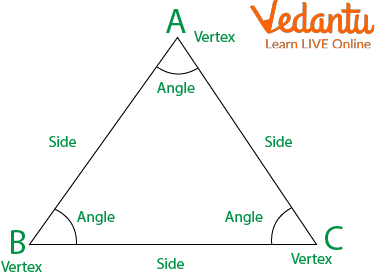
A Triangle
The height is the perpendicular line segment that joins a side with the vertex opposite that side.
Since there are three sides, there are three heights. The three heights intersect at a single point called the orthocentre.
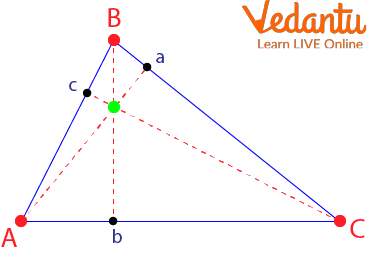
Orthocentre Triangle
The base of a triangle, b, is any of its three sides (usually, the lower side parallel to the horizontal axis is chosen). Once the base is chosen, we will call the height of the triangle h, i.e. the height perpendicular to the base.
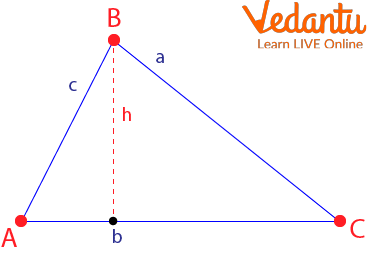
Triangle ABC
Now let’s learn about the area and perimeter of the triangle formula.
The Perimeter of a Triangle
The lengths of a triangle's three sides add up to its perimeter. If the sides of the triangle measure $a, b$, and $c$, then its perimeter is
$P=a+b+c$
Here, P is the perimeter of a triangle.
The semi-perimeter of a triangle is half its perimeter:
$s=\dfrac{a+b+c}{2}$
Calculate the Perimeter of an Isosceles Triangle
On the other hand, isosceles triangles are those in which two of their sides are equal, and one is different, which will be the base. So, in this case, to find the perimeter of the triangle, you must apply the formula that says that you must multiply the value of the side by two and add the length of the base: $P=2 l+b$
The Perimeter of a Right Triangle
The perimeter of a right triangle is the sum of the three sides.
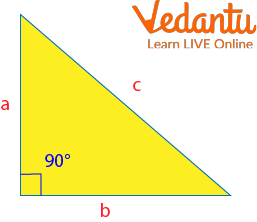
Right-angled Triangle
Thus, $P=a+b+c$
If the two legs ( $a$ and $b$ ) are known, their perimeter can be calculated from them.
This is because, thanks to the Pythagorean theorem, the hypotenuse $(c$ can be expressed as a function of the legs ( $a$ and $b$ ).
$P=a+b+\sqrt{a^2+b^2}$
Area of a Triangle
We have several ways to calculate the area of a triangle: from the base and height or from its sides and semi-perimeter.
The area of a triangle is half the product of its base times its height:
$A=\dfrac{b \times h}{2}$
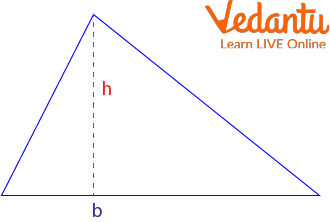
A Triangle with Base b
Also, we can calculate the area from its sides $a, b, c$ and its semi-perimeter $s$ using the following formula, called Heron's formula:
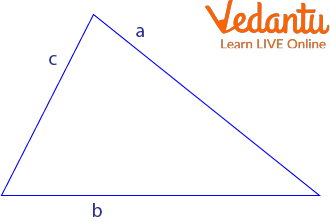
Triangle with Sides a,b,c
$A=\sqrt{s(s-a)(s-b)(s-c)}$
$s=\dfrac{a+b+c}{2}$
Some triangle area and perimeter examples are given below.
Solved Examples
Example 1: Find the perimeter and semi-perimeter of a triangle with sides 3cm, 4cm, and 5cm.
Ans: The perimeter of the right triangle is given by
$P=3+4+5$
$P=12$cm
And its semi-perimeter is given by
$s=\dfrac{3+4+5}{2}$
$s=\dfrac{12}{2}$
$s=6$cm
Example 2: Find the area of the right triangle with sides 3cm, 4cm, and 5cm.
Ans:
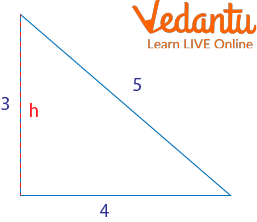
The Triangle Formed
$A=\dfrac{b \times h}{2}$
$A=\dfrac{4 \times 3}{2}$
$A=\dfrac{12}{2}$
$A=6\, \mathrm{cm}^2$
Example 3: Find the area of the right triangle with sides 3cm, 4cm, and 5cm using heron's formula.
Ans: We saw in an example that the semi-perimeter of the right triangle with sides 3cm, 4cm, and 5cm is 6cm
We calculate its area from Heron's formula:
$A=\sqrt{s(s-a)(s-b)(s-c)}$
$A=\sqrt{6(6-3)(6-4)(6-5)}$
$A=\sqrt{6 \times 3 \times 2 \times 1}$
$A=\sqrt{36}$
$A=6 \mathrm{cm}^2$
So, Area is $6 \mathrm{cm}^2$
Practice Questions
Q 1: Calculate the area of the equilateral triangle with side $4 m$.
Ans: $A=6928 m^2$
Q 2: Find the Area of a right-angled triangle whose lengths of the sides other than the hypotenuse are $12 \mathrm{~cm}$ and $5 \mathrm{~cm}$.
Ans: ${30 \mathrm{~cm}^2}$
Summary
In this article, we, first of all, learned about the triangle. Then we learned about the area and perimeter of a triangle formula. i.e. The area of a triangle is given by $A=\dfrac{b \times h}{2}$. Similarly, the perimeter of the triangle is given by $P=a+b+c$. We have also seen Heron's formula to find the area and the perimeter. i.e. $A=\sqrt{s(s-a)(s-b)(s-c)}$ and semi - perimeter $s=\dfrac{a+b+c}{2}$. In the end, we have added some solved examples and practice problems so that you will get the proper command of the topic.
FAQs on Area and Perimeter of a Triangle Explained with Formulas and Applications
1. What is the formula for the area of a triangle?
The formula for the area of a triangle is Area = (1/2) × base × height.
- Base (b) is any one side of the triangle.
- Height (h) is the perpendicular distance from the base to the opposite vertex.
2. What is the formula for the perimeter of a triangle?
The perimeter of a triangle is the sum of all three side lengths, given by P = a + b + c.
- a, b, and c are the three sides of the triangle.
3. How do you find the area of a triangle with three sides given?
You can find the area using Heron’s Formula when all three sides are known: Area = √[s(s − a)(s − b)(s − c)].
- First calculate semi-perimeter: s = (a + b + c)/2.
- Substitute into the formula.
4. How do you calculate the height of a triangle?
The height of a triangle can be calculated using h = (2 × Area) / base.
- First find the area using a known formula.
- Rearrange Area = (1/2) × base × height.
5. What is the area of an equilateral triangle?
The area of an equilateral triangle is Area = (√3/4) × a², where a is the side length.
- All three sides are equal.
- This formula comes from substituting height into (1/2) × base × height.
6. What is the difference between area and perimeter of a triangle?
The area measures the space inside a triangle, while the perimeter measures the total length around it.
- Area is measured in square units (e.g., cm²).
- Perimeter is measured in linear units (e.g., cm).
7. How do you find the area of a right triangle?
The area of a right triangle is (1/2) × base × height, where the base and height are the perpendicular sides.
- Identify the two sides forming the 90° angle.
- Multiply them and divide by 2.
8. Can you find the perimeter if you know the area of a triangle?
You cannot find the perimeter from the area alone unless additional side information is given.
- Area depends on base and height.
- Perimeter depends on all three side lengths.
9. What are the units of area and perimeter of a triangle?
The area of a triangle is measured in square units, and the perimeter is measured in linear units.
- Area units: cm², m², in², etc.
- Perimeter units: cm, m, in, etc.
10. What are common mistakes when calculating area and perimeter of a triangle?
Common mistakes include using the wrong formula or mixing up units when finding area and perimeter of a triangle.
- Forgetting to divide by 2 in Area = (1/2) × base × height.
- Adding only two sides instead of three for perimeter.
- Using non-perpendicular sides as height.
- Mixing units like cm and m.
