








What Is Identifying Numbers And Quantities With Definition and Examples
Identification of numbers is taught at a very early age to kids. In fact, not only numbers but other things that we see in our daily lives are identified to young kids. In simple terms, number identification is the ability to identify any number that corresponds with quantity. The whole process here is also known as number representation or number recognition.
To identify any object or article a visual representation for kids is quite important. They may learn the numbers but may not quantify them. Further in this article, we will talk about counting and matching numbers, printable numbers in circles, a symbol used for counting, numbers with dots for counting, and a few more.
Number Identification and Quantities
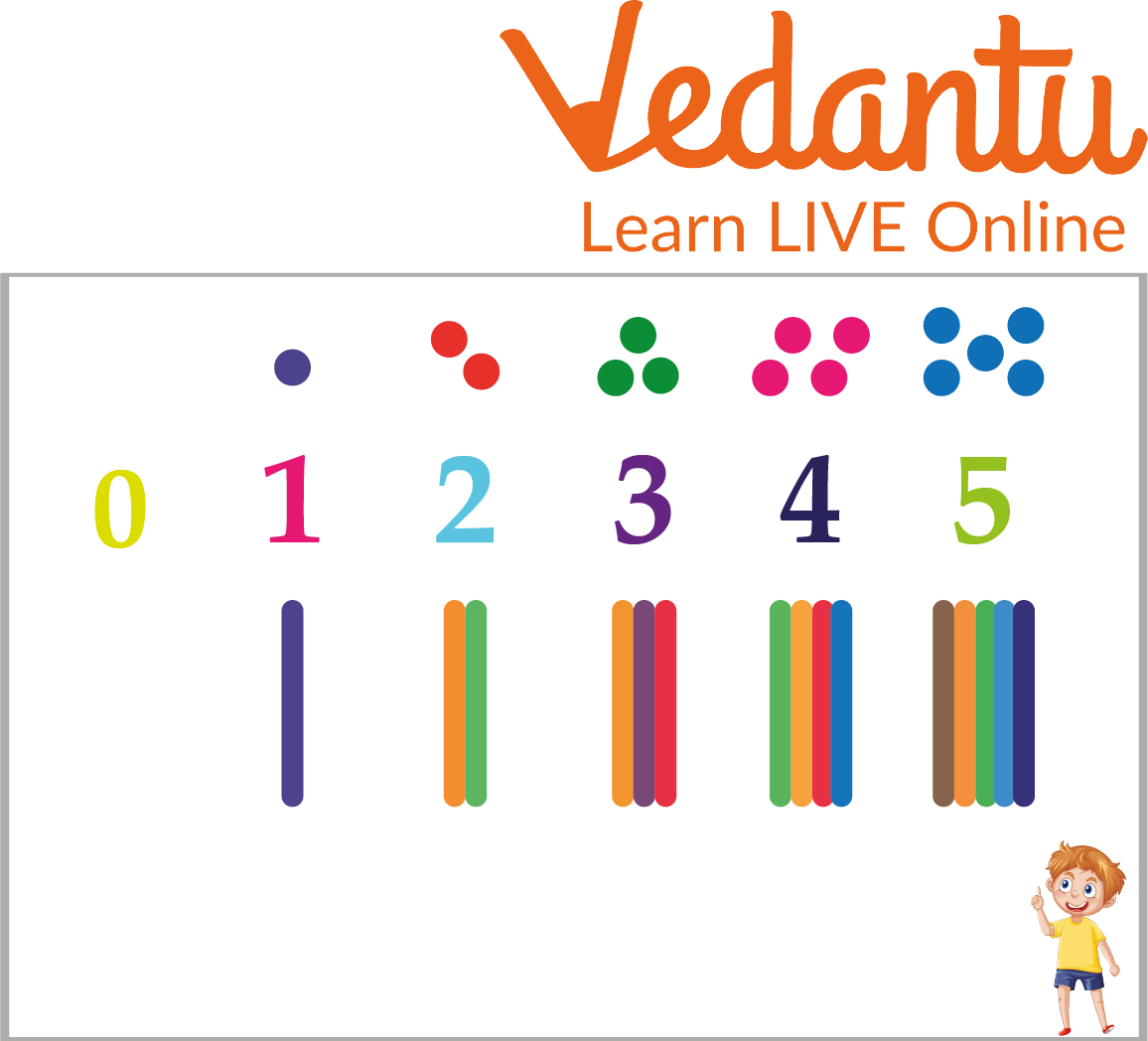
Number identification is the ability to identify the number that corresponds with a quantity. This is also called number representation or number recognition. For example, it is the ability to identify that the symbol “7” refers to the word “seven” and a quantity of seven objects. In this way, numbers should be identified using their quantities so it becomes easier for kids to learn faster.
In fact, there are many activities to help kids identify numbers. Some of the easiest ways are to put numbers everywhere, use a calculator, use magnetic numbers, use an abacus, and many more. In fact, an abacus is the best way to identify numbers with quantity. These are some of the best activities for kids to learn numbers at an early age.
Number identification and quantities
Counting and Matching Numbers
Counting is memorizing numbers in correct order (1, 2, 3, 4, 5…). One-to-one correspondence is the skill of pairing or matching objects so that one object equals one number. That is, when we say, “one,” we count one object and when we say, “two,” we count one more object.
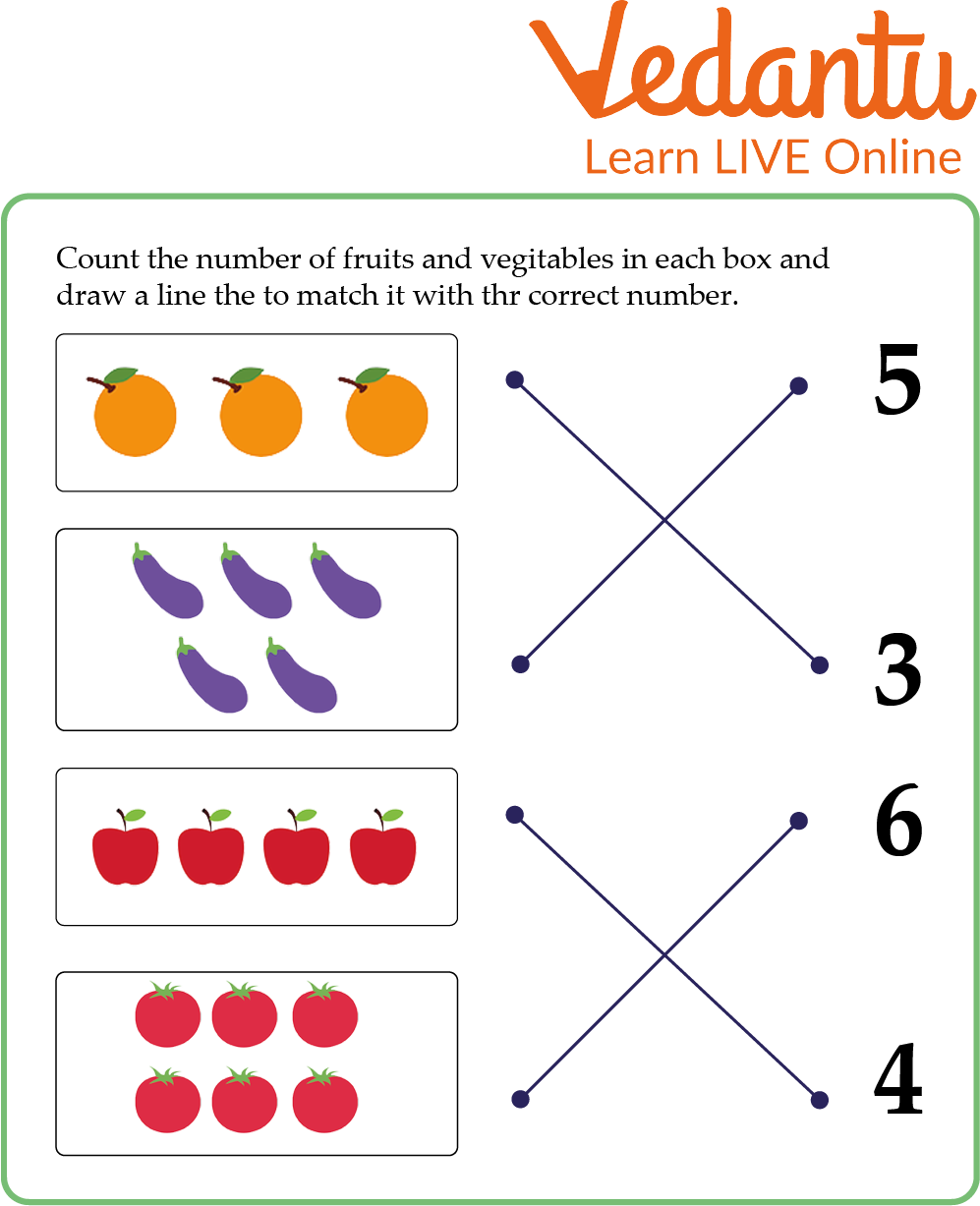
Below is an image where one can see that on one side there are images and on the other side numbers. Interestingly, in the first column there are different fruits but in different quantities. On the other hand, the second column is the numbers column. The kids will be required to match the numbers with the number of fruits given in the first column.
Counting and matching numbers
The answers are already given here so that it becomes easier for the kids to understand.
In the first column, we can see there are three fruits that will match with number 3 in the other column. In the second option of the first column, we can see five fruits which will match with number 5 on the right column. The process will follow in a similar manner for other options as well.
Symbols Used for Counting
Before counting any numbers there are a few things that one should keep in mind. In fact, these things are quite important to know before using numbers. Numbers are divided into variables and constants. To solve any type of numerical problem one must know different numbers. The letter (N) is the symbol used for counting.
Natural Numbers
Natural numbers are counting numbers that begin with 1 and continue to infinity. It is denoted as (N). Example: 1, 2, 3, 4, 5……
Whole Numbers
The letter (W) represents whole numbers. It is the counting of numbers starting from 0 to infinity. Example: 0, 1, 2, 3, ……
Integers
Integers are represented with the English alphabet (Z). An integer can be zero, any positive number to infinity, or a negative number to negative infinity. A few examples of integers are: -5, 0, 1, 5, 8, 97, and 3,043.
These are some of the basics that any kid must know before learning about numbers. In fact, these are quite important to solve any problem in the mathematical world.
Numbers With Dots for Counting
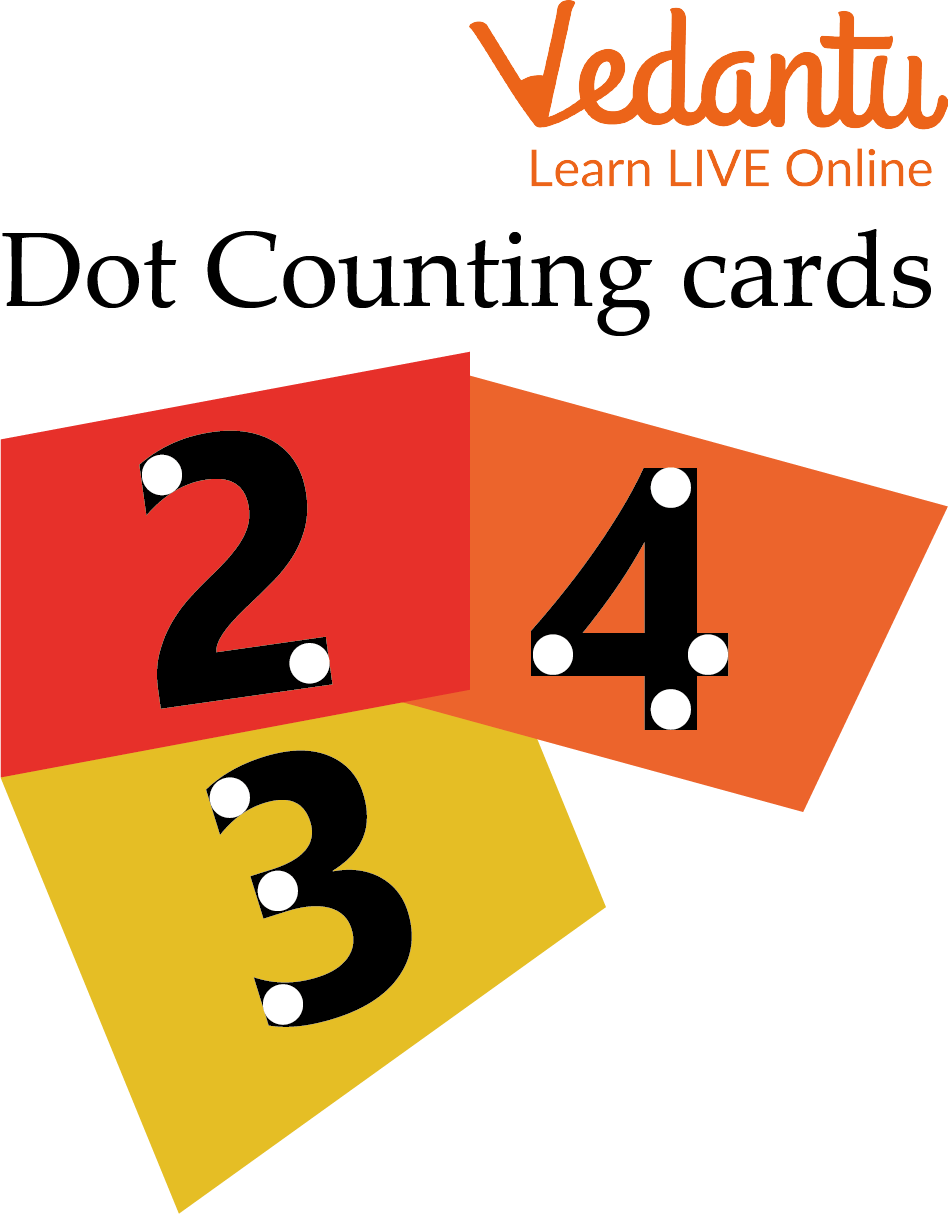
This is a great method for kids to learn new numbers during preschool. In fact, it is one of the most amazing ways to learn numbers and how to write them. There are various printables available for kids in the market. You get printable numbers in a circle book, numbers with dots for counting, numbers for preschool activities, and many more.
Normally, from number 1-10 numbers are hugely printed on this book. Inside these numbers, there are dots that need to be moved from one end to another. This way the kids not only play but learn rapidly how to write and recognize each number.
Numbers with dots for counting
Solved Examples
Q 1. Identify the numbers shown in the image:





Ans: Following are the identified numbers:





Q 2. There is the set of a number named as N. N = {0, 2, 4, 3, 5, 7, 8, 10}.
Identify the following in it:
(a) Natural number
Ans: Natural number: As we know that, natural numbers are those numbers that start with 1 to infinity. Therefore, 2, 4, 3, 5, 7, 8, 10 are the natural numbers.
(b) Whole number
Ans: Whole number: As we know that, whole numbers are those numbers that start with 0 to infinity. Therefore, 0, 2, 4, 3, 5, 7, 8, 10 are the natural numbers.
Practice Questions
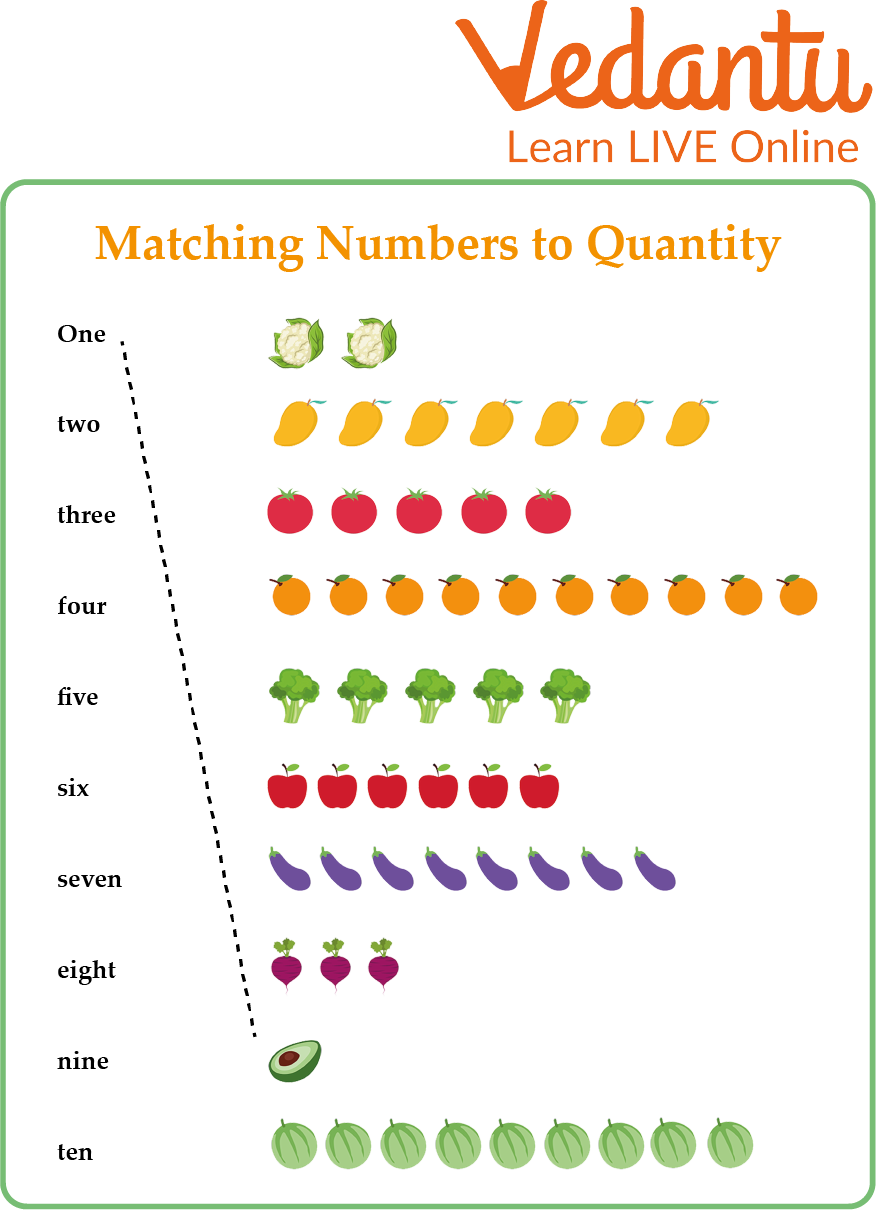
Q 1. Identify and match the correct numbers to their quantity:
Practice Question
Ans: The first is already solved. The answers for rest are given below:
Two- first on the right-hand column
Three- Eighth one on the right-hand column
Four- fifth one on the right-hand column
Five- third on the right-hand column
six - sixth on the right-hand column
Seven- second on the right-hand column
Eight- seventh on the right-hand column
Nine- tenth on the right-hand column
Ten- fourth on the right-hand column
Q 2. Write all the natural numbers between 0 to 25.
Ans: The natural numbers from 0 to 25 are 1, 2, 3, 4, 5, 6, 7, 8, 9, 10, 11, 12, 13, 14, 15, 16, 17, 18, 19, 20, 21, 22, 23, 24.
Summary
Learning something every day should be a habit for everyone since their childhood. In the same way, learning numbers for kids in such methods would surely be fun. In this article, we have learned about identifying numbers and the quantities. The capacity to recognise the number that corresponds to a quantity is known as number identification. We have added some solved examples, which will help to identify different numbers. To get more clarity, we have also added solved questions. Using these methods and activities the kids will never ever forget to recognize numbers.
FAQs on Identifying Numbers And Quantities in Early Mathematics
1. What does identifying numbers and quantities mean in Maths?
Identifying numbers and quantities means recognizing numbers and understanding how much they represent. It involves linking a numeral (like 5) to a quantity (five objects).
- A number is a symbol used to count or measure.
- A quantity tells how many or how much.
- Example: The number 7 represents seven items, such as 7 apples.
2. How do you identify numbers from 1 to 10?
You identify numbers from 1 to 10 by recognizing their symbols and matching them to their correct quantities. Follow these steps:
- Read the numeral (e.g., 4).
- Count objects one by one.
- Match the total count to the numeral.
3. What is the difference between a number and a quantity?
A number is a symbol, while a quantity is the amount it represents.
- Number: A written numeral like 3, 10, or 25.
- Quantity: The actual count or amount of objects.
4. How do you count objects correctly?
You count objects correctly by assigning one number to each object in order without skipping or repeating. Follow these steps:
- Start at 1.
- Point to each object once.
- Say the next counting number each time.
- The last number said is the total quantity.
5. What are counting numbers?
Counting numbers are the natural numbers used to count objects, starting from 1. They are:
- 1, 2, 3, 4, 5, ...
6. How do you compare two quantities?
You compare two quantities by counting each and determining which number is greater, smaller, or equal. Use these symbols:
- > means greater than
- < means less than
- = means equal to
7. Why is zero important when identifying quantities?
Zero is important because it represents a quantity of no objects. If there are no apples in a basket, the quantity is 0. Zero is:
- A whole number.
- Used as a placeholder in larger numbers (like 10, 20).
- Essential for understanding place value.
8. How do you identify the number of objects in a group?
You identify the number of objects in a group by counting each object once and noting the final count. Steps include:
- Arrange objects clearly.
- Count one by one.
- Record the final number counted.
9. What is one-to-one correspondence in counting?
One-to-one correspondence means matching each object with one counting number and only one number. For accurate counting:
- Each object is counted once.
- No object is skipped.
- No object is counted twice.
10. Can you give an example of identifying numbers and quantities?
Identifying numbers and quantities means matching a numeral to the correct count of objects. Example:
- There are 🍎🍎🍎🍎🍎.
- Counting them gives 1, 2, 3, 4, 5.
- The correct number is 5.
