








Step by Step Method to Multiply Fractions with Examples
A fraction is a number that is a component of a whole. By breaking a whole into a number of parts, it is evaluated. If a fraction is expressed as a/b, then a and b are its components, with a serving as the fraction's numerator and b serving as its denominator. For example, if 1/2 is a fractional value then 1 is the numerator and 2 is the denominator and this value represents half of a whole number.

Introduction on how to Multiply Fraction
The product of a fraction by another fraction or an integer or a set of variables is referred to as the multiplication of a fraction.
Multiplication is actually a process of repetition of addition. Look at the image below to understand this. After reading this article one will be able to answer and solve questions like finding the product of fractions, how to multiply unlike fractions, etc.
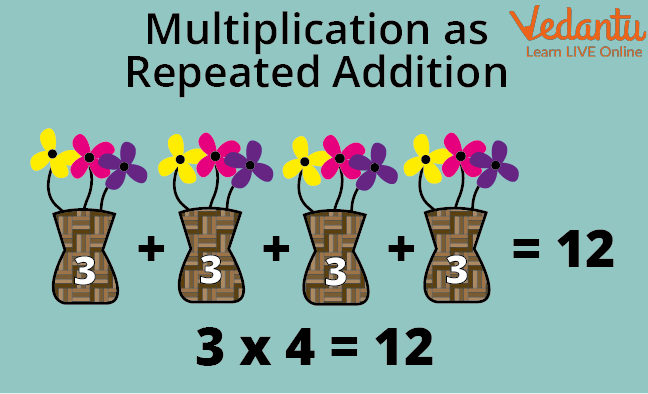
Multiplication as Repeated Addition
How to Multiply Fraction
The steps for multiplication of fractions are as follows:
Multiply the numerator with the numerator
Multiply the denominator with the denominator
Simplify the fractions(reduce the resultant fraction to its lowest term), if required.
Fractional Multiplication
Now, we'll talk about fractional multiplication by whole numbers, fractional numbers, and mixed fractional numbers.
Multiplication of Fraction by a Whole Number
To multiply a fraction with a whole number, first multiply the numerator of the fraction by the whole number and then reduce the fraction to the lowest terms, if required.
Let us multiply 2/3 by 4 to understand the multiplication of fractions by whole numbers. We use the rule of repeated addition to solve it.
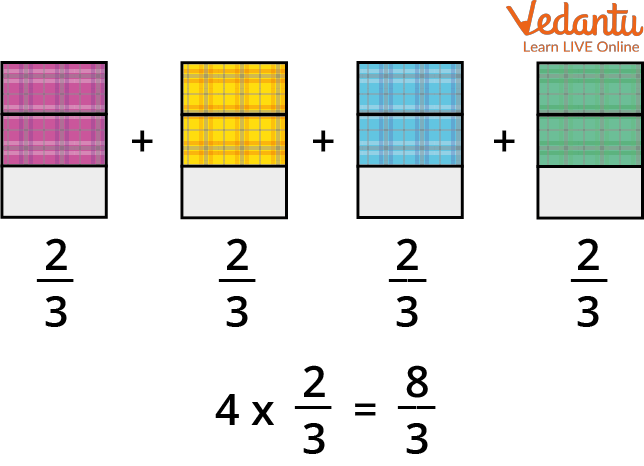
Multiplication of Fraction by a Whole Number
That means, we can say that 2/3 of 4 is 8/3.
Multiplication of Fraction by another Fractional Number
When multiplying two or more fractions, the denominators are multiplied to obtain the product's denominator and the numerators are multiplied to obtain the new numerator of the product.
Let us multiply 1/4 by 1/2 to understand the multiplication of fractions by other fractional numbers.
To do so, first multiply the numerators, 1 by 1, and then multiply the denominators, 4 by 2.

Multiplication of Fraction by another Fractional Number
That means, we can say that 1/4 of 1/2 is 1/8.
Multiplication of Fraction by a Mixed Number
To multiply a fractional number by a mixed number first convert the mixed number into an improper fractional number and then simply apply the rule we discussed above to multiply a fraction with another fractional number. Look at the example given below to understand this concept.
Let’s multiply 6 by 3$\frac{1}{4}$,
To find the product of the fraction and the mixed number, we will first simplify the mixed number 3 ¼ as;
(4 × 3 + 1)/4 = 13/4
Then,
6 × 13/4 = 78/4.
Multiplication of Fractions Examples
Let’s understand the concept better with some more multiplication of fractions examples.
Example 1: Multiply 4 by 2/8.
Ans: Multiply the numerator by 4.
4 × 2 = 8
That means, 4 × 2/8 = 8/8
Now reduce the resultant fraction to its lowest term,
8/8 = 1
Therefore, 4 by 2/8 = 1.
Example 2: Multiply 2/3 by 5/9.
Ans:
Step1. Multiply the numerators,
2 × 5 = 10
Step 2. Multiply the denominators,
3× 9 = 27
Therefore, 2/3 by 5/9 = 10/27.
Example 3: Multiply 2 1/3 by 5 2/5.
Ans:
Step1. Convert the mixed numbers to improper fractions,
(2 × 3+1)/3 × (5 ×5+2)/5 = 7/3 × 27/5
Multiply and simplify;
7/3 × 27/5 = 189/15.
Therefore, 2 1/3 by 5 2/5 = 189/15.
Practice on your own
Q1. Multiply 2/7 by 3.
(Ans. 6/7)
Q2. Multiply 1 1/2 by 4 4/7.
(Ans. 96/14)
Q3. Multiply 5 by 8/10.
(Ans. 4)
Summary
Multiplication of fractions refers to the operation of multiplying one fraction by another fraction, an integer, or a collection of variables. We can easily find the product of fractions by following a simple three-step procedure, first, multiply the numerators then the denominators and finally reduce the product to its lowest term if required.
FAQs on How to Multiply Fractions Easily
1. What is the rule for multiplying fractions?
The rule for multiplying fractions is to multiply the numerators together and multiply the denominators together. The formula is (a/b) × (c/d) = (a × c) / (b × d).
- Multiply the top numbers (numerators).
- Multiply the bottom numbers (denominators).
- Simplify the final fraction if possible.
2. How do you multiply fractions step by step?
To multiply fractions step by step, multiply the numerators, multiply the denominators, and simplify the result. Follow these steps:
- Step 1: Multiply the numerators.
- Step 2: Multiply the denominators.
- Step 3: Simplify the fraction if needed.
- Numerators: 3 × 2 = 6
- Denominators: 4 × 5 = 20
- Result: 6/20 = 3/10 after simplification.
3. How do you multiply fractions with whole numbers?
To multiply fractions with whole numbers, first write the whole number as a fraction over 1 and then multiply normally. A whole number like 5 becomes 5/1.
- Example: 5 × (2/3)
- Rewrite: (5/1) × (2/3)
- Multiply: (5 × 2)/(1 × 3) = 10/3
4. How do you multiply mixed fractions?
To multiply mixed fractions, first convert them into improper fractions, then multiply as usual. Follow these steps:
- Convert mixed numbers to improper fractions.
- Multiply numerators and denominators.
- Simplify the result.
- 1½ = 3/2
- (3/2) × (2/3) = 6/6 = 1
5. Do you need a common denominator to multiply fractions?
No, you do not need a common denominator when multiplying fractions. Unlike addition or subtraction of fractions, multiplication only requires multiplying across.
- Example: (1/4) × (3/5)
- Multiply directly: (1 × 3)/(4 × 5) = 3/20
6. How do you simplify fractions before multiplying?
You simplify before multiplying by canceling common factors between a numerator and a denominator, a process called cross-canceling. This makes calculations easier.
- Example: (2/3) × (9/4)
- Cancel 2 and 4 → 1 and 2
- Cancel 9 and 3 → 3 and 1
- Multiply: (1 × 3)/(1 × 2) = 3/2
7. What happens when you multiply a fraction by zero?
When you multiply any fraction by zero, the result is 0. This follows the zero property of multiplication.
- Example: (5/7) × 0 = (5 × 0)/(7 × 1) = 0/7
- 0/7 simplifies to 0
8. Why is the product of two proper fractions smaller than each fraction?
The product of two proper fractions is smaller because each fraction is less than 1, and multiplying by a number less than 1 makes the result smaller. A proper fraction has a numerator smaller than its denominator.
- Example: (1/2) × (3/4) = 3/8
- 3/8 is smaller than both 1/2 and 3/4
9. Can you give an example of multiplying fractions?
An example of multiplying fractions is (4/5) × (3/7) = 12/35. Here’s how:
- Multiply numerators: 4 × 3 = 12
- Multiply denominators: 5 × 7 = 35
- The fraction 12/35 cannot be simplified further.
10. What are common mistakes when multiplying fractions?
Common mistakes when multiplying fractions include adding instead of multiplying and forgetting to simplify the answer. Watch out for these errors:
- Adding numerators and denominators instead of multiplying.
- Not converting mixed numbers to improper fractions.
- Forgetting to simplify the final fraction.
- Skipping cross-canceling when possible.
