








Steps To Measure Quantity Of Milk In Litres And Millilitres
Imagine there is freezing weather outside, so you have a cup of hot milk. You boiled the milk and started pouring it into a glass. You continued pouring and pouring, even though the glass was full. What was the result then? Milk is being splashed all over the table. What did you learn from this experience? Here, you learned about capacity. Capacity limits how many litres or Mililiters a container would hold. You can put the milk in a container at most its capacity. In this article, we will learn about milk measurement and the milk measurement equipment name.
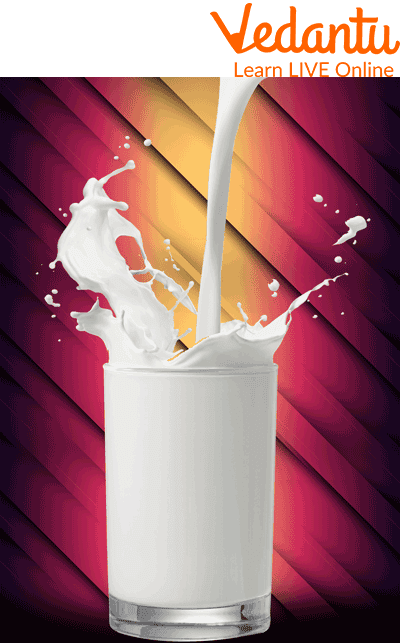
Milk Overflowing from a Glass.
What is Milk Measurement?
The milk measurement is how much milk a vessel contains and its measurement in standard units. We additionally refer to it as the "limit" or the "volume" of the vessel. Let's say below we have 2 containers.

Capacity Comparison of Two Containers
Which container do you think would hold more milk, container 1 or 2? Container 2 as it is bigger than the 1st one. By looking at the size, we can judge that container 2 can hold more. So through this example, it is known that the process of identifying the capacity of any milk in a container is called milk measurement.
Milk Measurement Unit
We measure the milk in litres and millilitres. Litres are represented as l, and millilitres are represented as ml. Litres have greater capacity than millilitres. For example, below is the image of a milk bottle in 500, 250, 200 and 100ml. We could see that 500ml, which is half a litre of a milk bottle, holds more milk than the other three, so this has a greater capacity.
Millilitre and Litre Milk Measurement
A litre is a unit for measuring volume in a metric system 1 litre = 1000 millilitres. If the capacity of a container is 5 litres, it is written as 5 l. The milk measurement unit used by the milkman is litres.
A millilitre is denoted as ml or mL, a unit of volume in the metric system. Also, 1000 millilitres= 1 litre, or 1 cubic centimetre. For measuring a small quantity of milk, millilitres are used. For example, kids' milk bottles have millilitres on them to feed controlled amounts of milk.
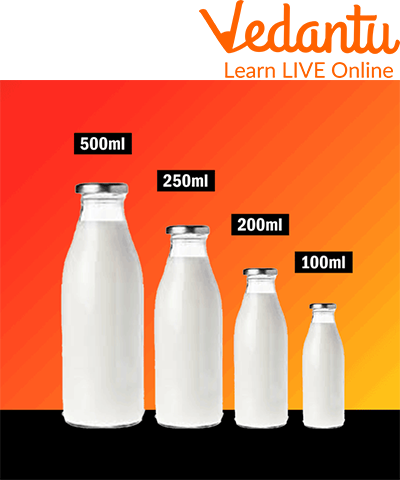
Metric Measurement Comparison of Milk Bottles.
How Do We Do Milk Measurement?
Pitchers: We measure milk by measuring pitchers. The pitcher has markings starting from 100 ml to 700 ml, depending upon size. These are used to put a controlled amount of milk into something and are commonly used in the dairy industry.
Measuring cup: It is a utensil that also comes with markings on them starting from 50 ml. It is widely used To pour controlled amounts of milk for cooking various dairy foods such as pastries, cookies, and chocolates.
Measuring spoons or droppers: This is the smallest measurement used for milk, particularly used in science for conducting experiments that require one or a half tablespoons or even less milk.
Milk Measurement Equipment Name
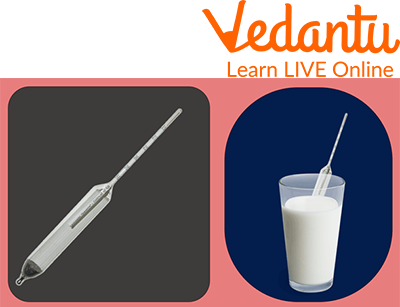
Lactometer
A lactometer could be defined as an instrument or a device used to measure the purity of milk by measuring its density. Density means the creaminess or richness of milk. We could identify how much water is mixed in the milk through this device. To use this device, first dip it into the milk. There is a marking on the lactometer denoted as M, which shows the purity of milk. If your device sinks up to the mark, it means the milk is pure, and if the milk is impure, it will sink above mark M.
Mind-blowing Facts About Milk
The typical American polishes off very nearly 25 gallons of milk a year.
The most prominent measure of milk created in one year was 59,298 pounds by a Holstein cow named Robthom Sue Paddy.
In old societies, milk was considered the 'food of the divine beings.
Cows that are draining eat 100 pounds of feed and drink between 30 and 50 gallons of water daily.
One 8-ounce glass of milk gives eight grams of protein. Milk is a "complete" protein, a blend of amino acids.
Regardless of its rich surface, milk is 85-95% water. The remainder of its volume comes from nutrients, proteins, starches, and fat.
Summary
This article aimed to explain how to use milk measurement to identify the amount of milk in a container. We measure it in standard units, which are litres and millilitres. We also learned how milk is measured using pitchers, cups, and spoons. Furthermore, we learned about using a lactometer to find the purity of milk. By using this device, we can know whether the quality of the milk is good for our health or not. We hope this article has given insights into the measurement of milk.
FAQs on How To Measure The Quantity Of Milk Correctly
1. What is the standard unit used to measure the quantity of milk?
The standard unit used to measure the quantity of milk is the litre (L). Milk is a liquid, so it is measured in units of capacity or volume rather than weight.
- 1 litre (L) = 1000 millilitres (mL)
- Small quantities are measured in millilitres (mL)
- Larger quantities are measured in litres (L)
2. How do you measure the quantity of milk accurately?
You measure the quantity of milk accurately using a measuring cup, measuring jar, or graduated cylinder marked in litres or millilitres.
- Place the measuring container on a flat surface.
- Pour the milk slowly into the container.
- Check the marking at eye level to avoid reading errors.
3. How many millilitres are there in 1 litre of milk?
There are 1000 millilitres (mL) in 1 litre (L) of milk. This is a standard metric conversion used in measuring liquid quantities.
- 1 L = 1000 mL
- 500 mL = 0.5 L
- 250 mL = 0.25 L
4. What is the formula to convert litres into millilitres?
The formula to convert litres into millilitres is Millilitres = Litres × 1000. This formula is used in basic measurement and unit conversion problems.
- Example: Convert 2 L to mL
- 2 × 1000 = 2000 mL
5. How do you convert millilitres into litres?
To convert millilitres into litres, use the formula Litres = Millilitres ÷ 1000. This division converts smaller units into larger units.
- Example: Convert 1500 mL to L
- 1500 ÷ 1000 = 1.5 L
6. Can you give an example of a maths problem on measuring milk?
Yes, a typical maths problem is: If you buy 3 packets of milk each containing 500 mL, what is the total quantity?
- Quantity in one packet = 500 mL
- Total milk = 3 × 500 = 1500 mL
- Convert to litres: 1500 ÷ 1000 = 1.5 L
7. Why is milk measured in litres and not in kilograms?
Milk is measured in litres because it is a liquid and liquids are measured by volume, not by weight. Kilograms measure mass, while litres measure capacity.
- Litres (L) measure liquid volume
- Kilograms (kg) measure mass
8. What measuring tools are used to measure milk at home?
Common measuring tools used to measure milk at home include measuring cups, measuring jugs, and graduated containers. These tools have markings in millilitres and litres.
- Measuring cup for small quantities
- Measuring jug for larger quantities
- Marked bottles for quick estimation
9. What is the difference between litre and millilitre?
The difference between litre and millilitre is that a litre is a larger unit of volume, while a millilitre is a smaller unit, where 1 L = 1000 mL.
- Litre (L) is used for larger quantities of milk.
- Millilitre (mL) is used for smaller quantities.
10. How do you add and subtract quantities of milk in litres and millilitres?
To add or subtract quantities of milk, first convert them into the same unit, then perform the calculation.
- Example: Add 1 L 500 mL and 750 mL
- Convert 1 L 500 mL to millilitres: 1500 mL
- Add: 1500 + 750 = 2250 mL
- Convert back to litres: 2250 ÷ 1000 = 2.25 L
