








How to Read a Protractor Scale to Measure Degrees with Examples
Protractors are useful, clear plastic tools for everyday life; we all have seen the protractor in the geometry box. They can be used for measuring different types of angles. It is a device used to measure and plot angles from 0 to 180 degrees, clockwise and anticlockwise. It has a straight edge with one or more semicircles on the edges.
The protractor has a scale usually marked with degrees or radians (any angle in minutes). It can be used for measuring angles in a plane and three-dimensional space. The protractor scale can measure angles to find the area of a triangle, the volume of a cylinder, and so on. We will be looking at a protractor scale, a scale in maths, how to read a protractor and how to use a protractor with examples in this article.
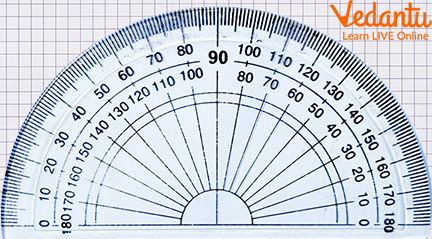
A Common Protractor
What Is a Protractor?
A protractor is a type of measuring tool that helps us find angles. It has two parts, a straightedge and a curved ruler. A line on the protractor represents the angle we are trying to find. Protractors are used in many different maths problems.
A general protractor consists of an inner and outer scale, graduated from 0 degrees to 180 degrees. It is a tool that helps us draw a line or shape using two different angles. It’s beneficial in teaching kids how to use angles and draw shapes. The tool is also helpful for artists, engineers, architects, and many more who need to measure angles. They use different kinds of protractors for accurate measurement of angles.
360-degree Protractor
A 360-degree protractor is a tool used to measure angles in a circle. It has a flat and circular surface and can be used for drawing circles. It is also used in geometry.
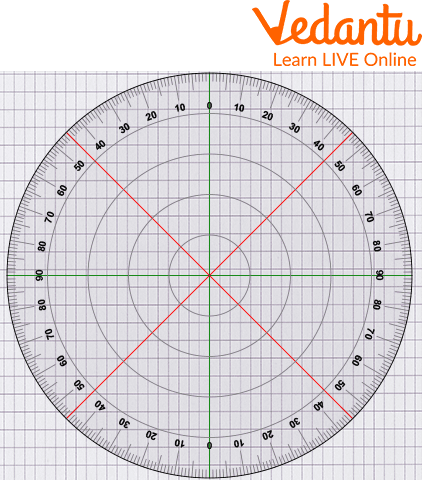
A 360-degree Protractor
What is Scale in Maths?
Scale in Mathematics is a range of levels or numbers used to measure numbers. Here, it is simply the angle marking from 0 degrees to 180 degrees in a general protractor.
How to Read and Use a Protractor
While measuring through a protractor, the measure is usually in degrees. If the angle is on the left side of the protractor, we use the outer edge measurement, and if the angle is on the right side of the protractor, we use the inner edge measurements.
The steps to measure and read the angle are as follows:
Step 1: Place the protractor's centre on the angle's vertex.
Step 2: Superimpose one side of the angle with the zero line of the protractor.
Step 3: The angle equals the number of degrees crossed on the protractor.
Let us look at an example to read and measure the angle of 60 degrees.
Step 1: Align the protractor with the ray OB as shown below. Start reading from the $0^{\circ}$ mark on the bottom-right of the protractor.
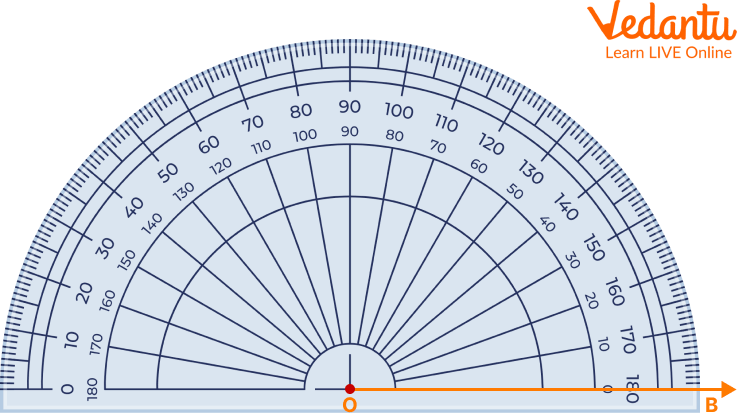
Reading the Protractor
Step 2: The angle measure is the number on the protractor that coincides with the second ray. Measure the angle using the number on the lower arc of the protractor.
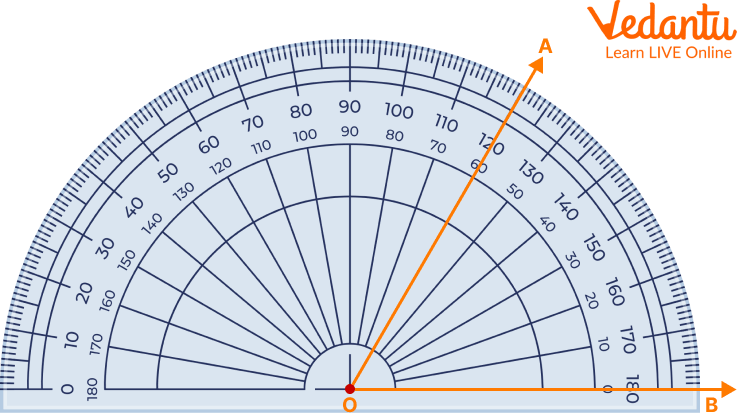
Protractor Showing an Angle 60 Degree
Therefore, $\angle A O B=60^{\circ}$. Since the measure is greater than $0^{\circ}$ and lesser than $90^{\circ}$, we can say that $\angle A O B$ is an acute angle.
This way, we can read and use the protractor to measure the angle.
Solved Example
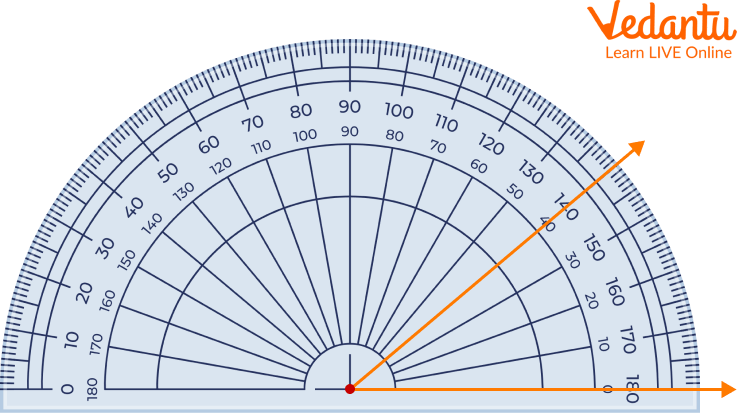
Q1. Find the measure of the angle given in the picture below.
Solved Example
Ans: First, place the protractor's centre perfectly on the line.
Now, look at the inner scale of the right side.
Then, check the angle passing through the line.
We get 40 degrees as the answer.
Practice Questions
Identify the angle measures.
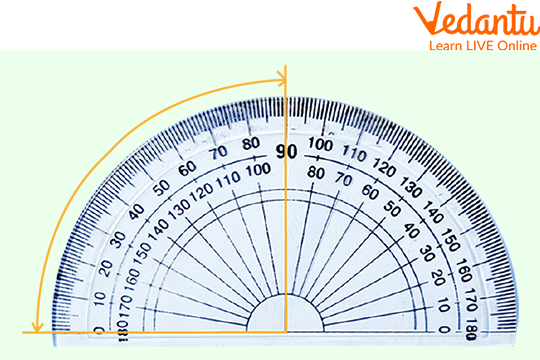
1. The measure of the angle is _____ degrees.
Ans:
Practice Questions
Ans: 90 degrees
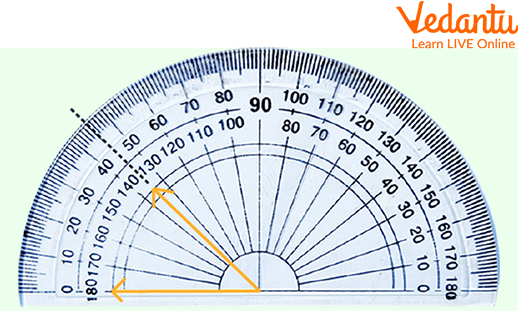
2. The measure of the angle is _____ degrees.
Practice Question
Ans: 135 degrees
Summary
A protractor is a measuring instrument for measuring angles, typically made of transparent plastic or glass. Some protractors are simple half-discs or full circles. More advanced protractors, such as the bevel protractor, have one or two swinging arms, which can be used to help measure the angle. A protractor is a great tool for measuring angles in various mathematical problems.
They are also excellent for use in geometry, measuring the slope of a line, and calculating different volumes and areas. There are two types of protractors: semi-circular (0 degrees to 180 degrees) and circular (0 degrees to 360 degrees). Engineers use these to create technical designs for different construction sites.
FAQs on Protractor Scale and Measuring Angles Accurately
1. What is a protractor scale?
A protractor scale is the numbered marking on a protractor used to measure angles in degrees from 0° to 180°. It helps in measuring and drawing angles accurately in geometry.
- The scale is usually marked in degrees (°).
- Most protractors have two scales: an inner and an outer scale.
- It is commonly used in Maths to measure acute, obtuse, and straight angles.
2. How do you read a protractor scale correctly?
To read a protractor scale correctly, align the baseline with one arm of the angle and read the degree where the other arm crosses the scale.
- Place the midpoint of the protractor at the vertex.
- Align one arm of the angle with 0° on the correct scale.
- Read the number where the second arm intersects the scale.
- Choose the inner or outer scale depending on the starting point.
3. Why does a protractor have two scales?
A protractor has two scales to allow angle measurement in both clockwise and anticlockwise directions. The inner and outer scales both run from 0° to 180° but in opposite directions.
- This avoids flipping the protractor.
- It ensures accurate measurement regardless of angle orientation.
- You select the scale that starts at 0° on the aligned arm.
4. What is the range of a protractor scale?
The range of a standard semicircular protractor scale is 0° to 180°. This allows measurement of acute, right, obtuse, and straight angles.
- Acute angle: less than 90°
- Right angle: 90°
- Obtuse angle: between 90° and 180°
- Straight angle: 180°
5. How do you measure an angle using a protractor scale?
To measure an angle using a protractor scale, place the center at the vertex and read the degree marking where the second arm crosses the scale.
- Step 1: Mark the vertex clearly.
- Step 2: Align one arm with 0°.
- Step 3: Ensure the baseline is straight.
- Step 4: Read the degree value at the other arm.
6. How do you draw an angle using a protractor scale?
To draw an angle using a protractor scale, mark the required degree on the scale and join it to the vertex.
- Draw a base line.
- Place the protractor’s midpoint at one end.
- Mark the required angle, such as 45°.
- Draw a line from the vertex through the mark.
7. What is the difference between the inner and outer scale on a protractor?
The inner and outer scales on a protractor measure the same degrees but run in opposite directions. Both scales go from 0° to 180°.
- The outer scale increases left to right.
- The inner scale increases right to left.
- You choose the scale that begins at 0° on the aligned arm.
8. What are the common mistakes when reading a protractor scale?
The most common mistake when reading a protractor scale is choosing the wrong scale or misaligning the vertex. This leads to incorrect angle measurement.
- Not placing the midpoint exactly at the vertex.
- Reading from the wrong (inner or outer) scale.
- Ignoring small tick marks between major numbers.
- Tilting the protractor instead of aligning it flat.
9. Can a protractor measure angles greater than 180°?
A standard semicircular protractor cannot directly measure angles greater than 180°. It only measures up to a straight angle.
- To measure a reflex angle, first measure the smaller angle.
- Then subtract from 360°.
- For example, if the smaller angle is 110°, the reflex angle is 360° − 110° = 250°.
10. Why is the protractor scale measured in degrees?
The protractor scale is measured in degrees (°) because a full rotation is divided into 360° in geometry. Degrees are the standard unit for measuring angles in Maths.
- A full circle equals 360°.
- A straight line equals 180°.
- A right angle equals 90°.
