








Steps to Convert a Fraction into a Decimal with Division Method and Examples
Can you determine what percentage of a cake is pastry? And is a rupee's decimal component the paisa? You'll experience lots of examples of fractions and decimals in usage every day. Let's learn about their characteristics and mathematical operations,such as multiplication and division, in the following part.
Fraction to Decimal
An Introduction to Fractions and Decimals
The process of changing a number expressed as p/q, where p and q are whole numbers and q is not equal to zero, into a decimal form can be described as the process of either changing the denominator to a power of 10 or using the long division method. In this post, we will examine various methods for converting fractions to decimals.
Let’s Convert Fraction to Decimal
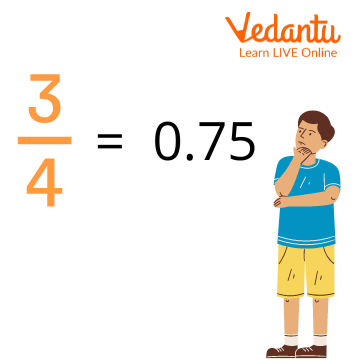
Convert Fraction to Decimal
By applying a few simple procedures, you may quickly convert a fraction to a decimal:
Using a calculator
Using a calculator, divide the numerator by the denominator to convert a fraction to a decimal. The value of the fraction expressed as a decimal number will be the outcome.
Not Using a Calculator
Long division is used to solve the problem.
How to Convert Fraction to a Decimal?
How to Convert Fraction to Decimal
The following are two ways to convert a fraction to a decimal:
Method of long division
By changing the fraction's denominator to a power of 10
Long Division to Convert a Fraction to a Decimal
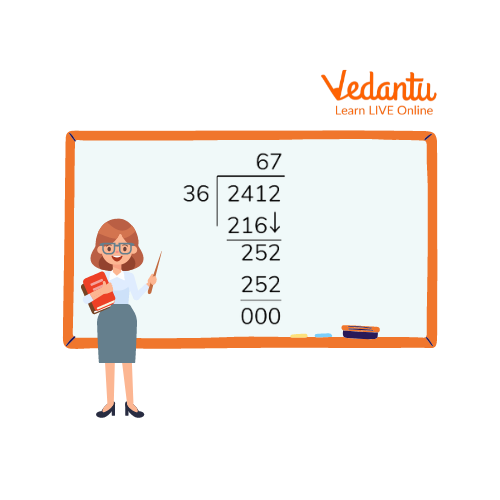
Long Division to Convert Fraction to Decimal
We utilise the long division method to change a number from its fractional form, p/q, into its decimal form. In this situation, we divide the denominator by the numerator.
Following are fraction to decimal steps-
Put 4/19 in decimal form.1.First, think of the fraction 4/19 as having a dividend of 4 and a divisor of 19 in the denominator.
After putting the decimal (.), multiply 19 by another integer such that the result is less than or equal to 40.
The remaining number is 2, and the digit that appears in the quotient is 2.
In order for the result to be less than or equal to 20, multiply 19 by a number.
Now that the quotient has an additional digit of 1, making it 0.21, the remaining number is 1.
Continue in this manner until the quotient has at least three decimal places or 0 as the remainder.
Change the Numerator to Convert a Fraction to a Decimal
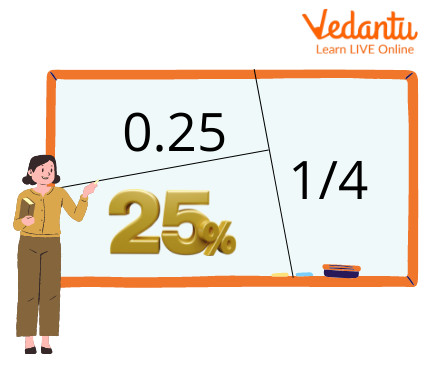
Change Numerator to Convert Fraction to Decimal
The following are the fraction to decimal steps using the denominator approach.
Decimalise 7/8, for example.
To get a power of 10 in the denominator, we must first come up with a number that we may multiply the denominator and numerator by.
The denominator, in this case, is 8. (125 divided by 8) = 1000.
Now divide the denominator by the same number as the numerator, which is 125. By dividing the fraction's numerator by 125, we arrive at 7 x125 = 875.
Once the multiplication procedure is complete, we get a denominator that is a power of 10, or 875/1000. Put a decimal point before the number of places in the denominator that are equivalent to zeros.
So, 875/1000 equals 0.875.
Solved Examples

Example Time
Following is an example of how to turn a remainder into a decimal-
1. Suppose you are to divide 15 by 8.
Solution: Now 15/8 gives a quotient of 1 and a remainder of 7.
The remainder of 7 is converted into a decimal as: =(7/8)*100 = 87.5/100 = 0.875.
So the result of 15/8 = 1.875.
Following is a example of converting mixed fractions into a decimal-
2. Convert the mixed number 7 (¼) to a decimal.
Solution: Convert the fraction to a decimal: Divide 1 by 4
1 ÷ 4 = 0.25
Add 0.25 to the whole number 7:
7 + 0.25 = 7.25
Practice Time
Practice Time
1. Find the fraction, if its decimal value is 0.6 and the denominator is 75.
Ans: 3/375
2. The correct decimal representation of the fraction 14/25 is____.
Ans: 0.56
Let’s Summarise
In this article, we learnt the method of expressing a fraction using a group of common denominators, such as 1/10 and 1/100. The benefit of decimals is that addition, subtraction, and comparison operations are simple because they all have common denominators. Both fractions and decimals are used to describe components of a whole. The concept of a fraction is simpler.
FAQs on How To Convert Fraction Into Decimal Step by Step Guide
1. How do you convert a fraction into a decimal?
To convert a fraction into a decimal, divide the numerator by the denominator.
- Step 1: Take the numerator (top number).
- Step 2: Divide it by the denominator (bottom number).
- Step 3: Write the result as a decimal.
2. What is the formula to convert a fraction to a decimal?
The formula to convert a fraction to a decimal is Decimal = Numerator ÷ Denominator.
- If the division ends, it is a terminating decimal.
- If it continues forever, it is a repeating decimal.
3. How do you convert a proper fraction into a decimal?
To convert a proper fraction into a decimal, divide the numerator by the denominator since the numerator is smaller.
- Example: 2/5 → 2 ÷ 5 = 0.4.
- Example: 7/8 → 7 ÷ 8 = 0.875.
4. How do you convert an improper fraction into a decimal?
To convert an improper fraction into a decimal, divide the numerator by the denominator even if the numerator is larger.
- Example: 9/4 → 9 ÷ 4 = 2.25.
- Example: 7/3 → 7 ÷ 3 = 2.333… (repeating).
5. What is a terminating decimal when converting fractions?
A terminating decimal is a decimal number that ends after a finite number of digits. It occurs when the denominator has only 2 and/or 5 as prime factors.
- Example: 1/2 = 0.5
- Example: 3/8 = 0.375
6. What is a repeating decimal in fraction to decimal conversion?
A repeating decimal is a decimal that continues forever with a repeating pattern of digits. It occurs when the denominator has prime factors other than 2 or 5.
- Example: 1/3 = 0.333…
- Example: 2/7 = 0.285714…
7. How do you convert a mixed fraction into a decimal?
To convert a mixed fraction into a decimal, convert it to division form or separate the whole number and fraction.
- Example: 2 1/2 = 2 + (1 ÷ 2)
- 1 ÷ 2 = 0.5
- Total = 2.5
8. Can you convert a fraction to a decimal without long division?
Yes, you can convert some fractions to decimals by making the denominator 10, 100, or 1000.
- Example: 3/5 → Multiply by 2/2 → 6/10 = 0.6.
- Example: 7/20 → Multiply by 5/5 → 35/100 = 0.35.
9. Why do some fractions not convert into exact decimals?
Some fractions do not convert into exact decimals because their denominators contain prime factors other than 2 or 5.
- Example: 1/3 = 0.333…
- Example: 5/6 = 0.8333…
10. What are common mistakes when converting fractions into decimals?
A common mistake when converting fractions into decimals is dividing in the wrong order or misplacing the decimal point.
- Always divide numerator ÷ denominator, not the other way around.
- Add zeros if needed during long division.
- Check if the answer should be less than or greater than 1.
