








What Are Fractional Numbers Definition Types and Solved Examples
Fraction is a very important part of our everyday life. We use it in our daily life without knowing it, like if we have a cake and we cut it into slices, while following a recipe, while dividing a pizza, and in many other actions.
But if you don't know anything about fractions then don't worry. In this article we are going to learn what fractional numbers are, will also see some fractional number examples, properties of fractional numbers, and many other interesting things which are related to fractional numbers. We are going to learn all these things in an enjoyable way so you don't get bored while learning so let's get started.
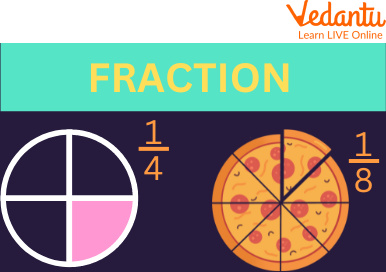
Fraction
What are Fractional Numbers?
Before coming to the fractional number we need to understand what fraction means.
So a fraction is defined as a part of the whole.
If we take a piece of chocolate from the whole then it's also a fraction like if we say in a whole piece of chocolate there are 8 pieces and if we take one from it then it's $\dfrac{1}{8}$ here 1 is the numerator and 8 is the denominator.
The numerator is the part that we take and the denominator is the actual whole number from which we take it.
We use fractional numbers every time when we take a part from the whole.
So with the help of a fractional number, we explain the fraction. That is the total number of parts we had used from the whole.

Numerator and Denominator
Types of Fraction
Proper fraction- It's a fraction where the numerator is always less than the denominator. Like $\dfrac{8}{11}$, $\dfrac{7}{9}$, $\dfrac{6}{9}$
So in this every numerator is less than the denominator.
Improper fraction- It's the fraction where the numerator is always more than the denominator. Like $\dfrac{5}{3}$, $\dfrac{7}{5}$, $\dfrac{3}{1}$.
So in this, every numerator is greater than the denominator.
Mixed fraction- It's a combination type of fraction in which there is a part of an integer and a proper fraction. Like $5 \dfrac{7}{8}$, $6 \dfrac{1}{4}$,
So in this there is a combination of both integers and the proper fraction.
Properties of Fraction
Associative property- It's applied to fraction numbers also. But only in addition and multiplication. Like if we interchange the place of fractional numbers while adding or multiplying the answer remains the same.
Commutative property- It's applied to fractional numbers too but only in the case of addition and multiplication of fractions.
Identity property- the identity element for the fractional addition is zero "0", and for fractional multiplication is 1.
Inverse property- here the inverse of $\dfrac{a}{b}$ is $\dfrac{b}{a}$, where a and b are non-zero numbers.
Distributive property- fraction follows the distributive property.
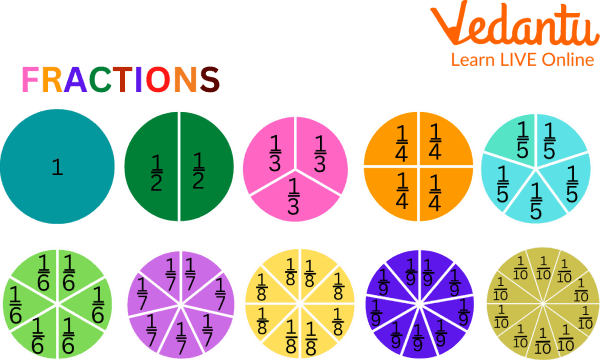
Fractions
Rules for Simplification of Fraction
First rule says that if we divide the fraction from another fraction then we need to reciprocate the second fraction and then multiply it with the first fraction.
Second rule is for the multiplication of fractions. So the second rule says that if we multiply two fractional numbers then the numerator and the denominator both are multiplied with the numerator and denominator of the second fraction and after that we simplify the fraction.
And the third rule is for addition or subtraction of fractional numbers. It says that before adding or subtracting a fractional number we need to make sure that the denominator is equal because the addition or subtraction is possible to fractional numbers if their denominator is the same.
Solved Example
Q1. In a fruit basket, there are 13 fruits, 5 of which are mango. How can we express the number of mangoes as a fraction?
Ans: $\dfrac{5}{13}$
Where 5 is the number of mangoes
And 13 is the total number of fruits which were there in the basket.
Q2. Tanishka spends $\dfrac{1}{3}$ of her money her parents give her on a toy and she also spends $\dfrac{1}{9}$ of her money on candies. Calculate what fraction of payment will Tanishka spend?
Ans: Find the common denominator
So we will write $\dfrac{1}{3}$ as $\dfrac{3}{9}$
Now we calculate;
$\dfrac{3}{9}+\dfrac{1}{9}=\dfrac{4}{9}$
= $\dfrac{4}{9}$
So Tanishka spends $\dfrac{4}{9}$ of her money.
Q3. An apple is cut into two parts. You need to write its fraction.
Ans: $\dfrac{1}{2}$
Practice Questions
Q1. It takes Neha $\dfrac{1}{2}$ hour to wash, comb her hair and to put on her beautiful clothes, and she takes $\dfrac{1}{4}$ hour to have her breakfast. How much time does it take Neha to be ready for her school?
Ans. $\dfrac{3}{4}$ of an hour
Q2. Naman ate $1 \dfrac{1}{4}$ pizzas and Tanya ate $1 \dfrac{2}{3}$ pizzas. How much more pizza did Tanya eat than Naman?
Ans. Tanya ate $\dfrac{5}{12}$ of the pizza more than Naman.
Summary
So in this article we learned about fractions in a very easy and enjoyable way. We learned here about what fractions are, what are the properties of fraction, what the rules of fraction, what are some of its types and we also now understand how we use it in our everyday life without knowing it. We understand that fractions are very important to understand because we use it on a daily basis while taking apart from the whole we are doing fraction. With the help of this article we had cleared our concept related to the fraction.
FAQs on Understanding Fractional Numbers in Maths
1. What is a fractional number?
A fractional number is a number that represents a part of a whole and is written in the form a/b, where b ≠ 0. In a fraction:
- a is the numerator (number of parts taken).
- b is the denominator (total equal parts).
2. What are the types of fractional numbers?
The main types of fractional numbers are proper, improper, and mixed fractions. These include:
- Proper fraction: Numerator is less than denominator (e.g., 3/5).
- Improper fraction: Numerator is greater than or equal to denominator (e.g., 7/4).
- Mixed fraction: A whole number with a fraction (e.g., 1 3/4).
3. How do you simplify a fraction?
To simplify a fraction, divide the numerator and denominator by their greatest common divisor (GCD). Steps:
- Find the GCD of the numerator and denominator.
- Divide both by the GCD.
- GCD of 8 and 12 is 4.
- 8 ÷ 4 = 2 and 12 ÷ 4 = 3.
4. How do you add fractional numbers?
To add fractional numbers, first make the denominators the same, then add the numerators. Steps:
- Find the least common denominator (LCD).
- Rewrite each fraction with the LCD.
- Add the numerators and keep the denominator same.
- LCD of 4 and 6 is 12.
- 1/4 = 3/12 and 1/6 = 2/12.
- 3/12 + 2/12 = 5/12.
5. How do you subtract fractional numbers?
To subtract fractional numbers, make the denominators equal and then subtract the numerators. Steps:
- Find the least common denominator (LCD).
- Rewrite both fractions with the LCD.
- Subtract the numerators.
- LCD of 6 and 4 is 12.
- 5/6 = 10/12 and 1/4 = 3/12.
- 10/12 − 3/12 = 7/12.
6. How do you multiply fractional numbers?
To multiply fractional numbers, multiply the numerators together and the denominators together. Formula: (a/b) × (c/d) = (ac)/(bd).
- Multiply numerators.
- Multiply denominators.
- Simplify if possible.
- (2 × 3)/(3 × 5) = 6/15.
- Simplified form is 2/5.
7. How do you divide fractional numbers?
To divide fractional numbers, multiply the first fraction by the reciprocal of the second fraction. Formula: (a/b) ÷ (c/d) = (a/b) × (d/c).
- Keep the first fraction same.
- Flip the second fraction (take reciprocal).
- Multiply and simplify.
- 3/4 × 5/2 = 15/8.
- Final answer is 15/8 or 1 7/8.
8. How do you convert an improper fraction to a mixed number?
To convert an improper fraction to a mixed number, divide the numerator by the denominator. Steps:
- Divide numerator by denominator.
- Quotient is the whole number.
- Remainder becomes the new numerator.
- 11 ÷ 4 = 2 remainder 3.
- Mixed number is 2 3/4.
9. What is the difference between fractions and decimals?
The main difference is that fractions are written as a/b while decimals are written using a decimal point. Key differences:
- Fraction: 3/4
- Decimal: 0.75
10. How do you compare two fractional numbers?
To compare two fractional numbers, make their denominators the same or convert them to decimals. Method 1 (Common Denominator):
- Find the least common denominator (LCD).
- Rewrite fractions with the LCD.
- Compare numerators.
- LCD is 15.
- 2/3 = 10/15 and 3/5 = 9/15.
- Since 10/15 > 9/15, 2/3 is greater than 3/5.
