








Definition properties rules and solved examples of addition
One of the arithmetic operations in mathematics is addition. You must have added at least once before. For example, your parent may offer you an apple in the morning and another apple in the evening. You have eaten a total of 2 apples in one day. How can one get the total? The only way to do this is by adding. As a result, you must add 1 to 1 to obtain the amount.
What is Addition?
The addition is not just a process of adding numbers. It is also a foundation for numerous math operations, ranging from simple concepts like “two plus three equals five” to more complex topics like algebraic expressions.
One addition fact is that addition can be defined as the sum of two or more addends.
Example: 2 + 3 = 5
How to Add Numbers?
In addition, the place value of the numbers is given more importance. Here, the place value is expressed as ones and tens. To add numbers, we need to arrange them column-wise according to their place values. Each digit is individually added. The answer is known as their total, and they are known as addends.
There are two methods for adding two digits. The first two are the "without regrouping" approach and the "regrouping" method, both referred to as carrying forward.
The sums from 1 + 1 to 9 + 9 are addition facts. Children must learn these 81 sums since they are the foundation for the rest of elementary mathematics. The full list of addition facts is provided below:
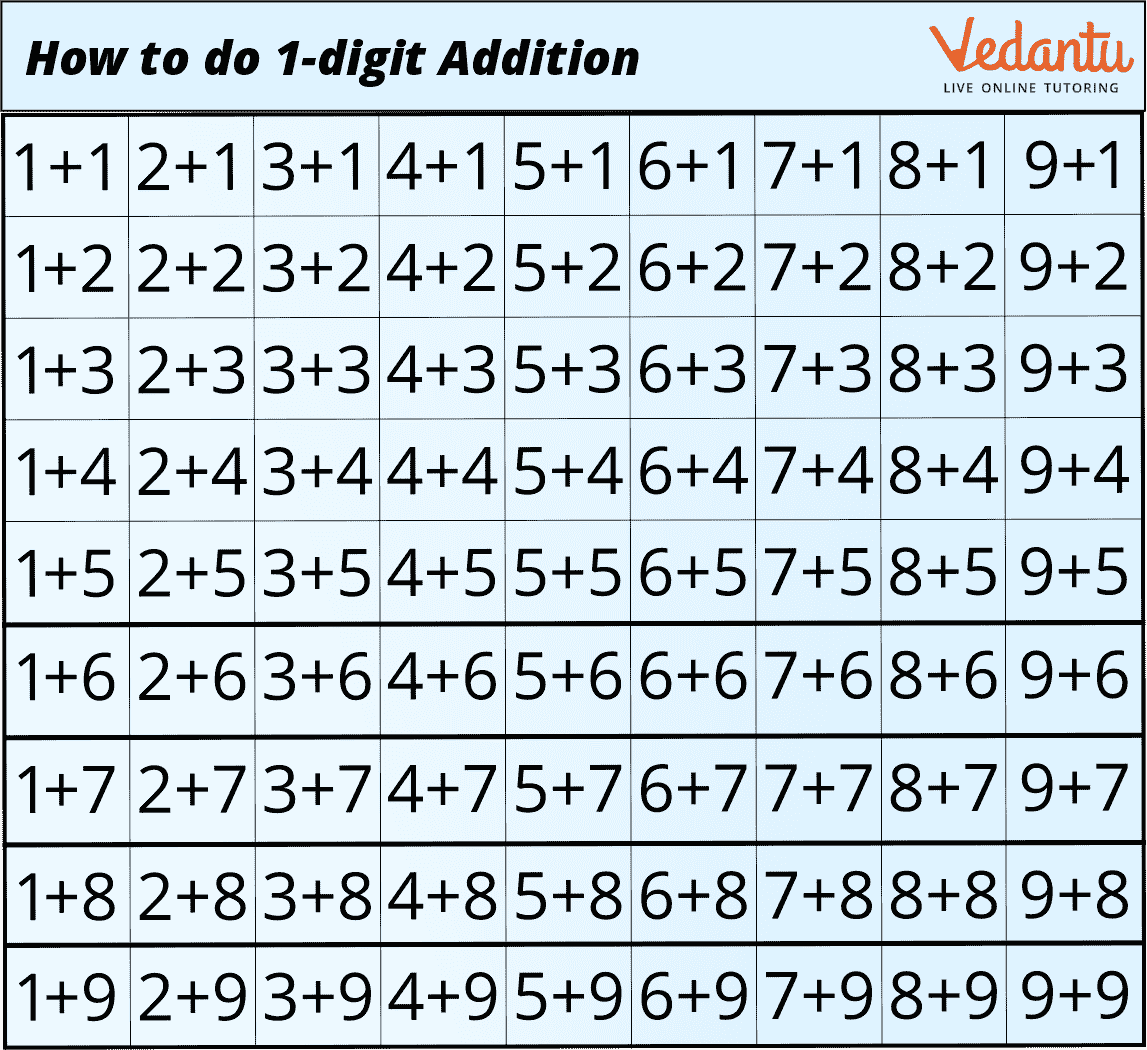
Add 1-digit Numbers
Basic Facts About Addition:
The addition of 1-digit numbers can be done horizontally.
Example : 2+3 =5
The addition of zero to any number does not change the sum.
Example : 5 + 0= 5
If we add one to any number, it gives the after that number as a sum.
To determine the missing addend, Subtract the given addend from the final answer (sum).
Solved Numericals:
Example 1: Find out the missing numbers -
1 + 5 = _
4 + _ = 7
_ + 3 = 3
Ans: a. 6
b. 3
c. 0
Example 2: Solve the following sums and match them with the correct answer.
Column A Column B
4 + 5 4
6 + 2 7
3 + 1 9
5 + 2 8
Ans: a . 4 + 5 = 9
b . 6 + 2 = 8
c . 3 + 1 = 4
d . 5 + 2 = 7
Example 3: Find the sum of the following numbers -
2 + 7 =
1 + 4 =
6 + 3 =
1 + 0 =
Ans: a. 9
b. 5
c. 9
d. 1
Example 4: Fill in the missing numbers -
6 + _ = 7
_ + 3 = 9
7 + _ = 0
1 + _ = 8
Ans: a. 1
b. 6
c. 0
d. 7
Conclusion:
This article taught us about adding 1 - digit numbers with solved numerals. Adding numbers is a fundamental mathematical process combining two or more numerical values. This operation is used in our daily lives; some simple examples include calculating money, calculating time, counting students in a class, and so on.
FAQs on Facts About Addition in Mathematics
1. What is addition in Maths?
Addition in Maths is the process of combining two or more numbers to find their total or sum. It is one of the four basic arithmetic operations.
- The numbers being added are called addends.
- The result is called the sum.
- Example: 3 + 5 = 8.
2. What is the symbol used for addition?
The symbol used for addition is the plus sign (+). It is placed between numbers to show they are being added together.
- Example: 7 + 4
- Here, “+” tells us to combine 7 and 4.
- The result is 11.
3. What are the basic properties of addition?
The main properties of addition are the commutative, associative, and identity properties. These rules make calculations easier.
- Commutative Property: a + b = b + a (Example: 2 + 5 = 5 + 2)
- Associative Property: (a + b) + c = a + (b + c)
- Identity Property: a + 0 = a
4. How do you add two numbers step by step?
To add two numbers, align their place values and add from right to left, carrying over if needed.
- Step 1: Write numbers vertically by place value.
- Step 2: Add the ones digits.
- Step 3: Carry over if the sum is 10 or more.
- Step 4: Add the tens, hundreds, and so on.
- 27
- +15
- = 42
5. What is the identity element in addition?
The identity element in addition is 0 because adding 0 to any number does not change its value. This is called the additive identity property.
- a + 0 = a
- Example: 9 + 0 = 9
6. What is the difference between addition and subtraction?
Addition combines numbers to find a sum, while subtraction finds the difference between numbers. They are inverse operations.
- Addition example: 6 + 4 = 10
- Subtraction example: 10 − 4 = 6
7. Can you give an example of addition with negative numbers?
Yes, when adding negative numbers, follow the sign rules to find the correct sum.
- Positive + Positive: Add normally (3 + 4 = 7)
- Negative + Negative: Add and keep the negative sign (−2 + −5 = −7)
- Positive + Negative: Subtract and keep the sign of the larger number (7 + −3 = 4)
8. What is repeated addition?
Repeated addition is adding the same number multiple times, which is the basis of multiplication.
- Example: 4 + 4 + 4 = 12
- This can be written as 3 × 4 = 12.
9. How is addition used in real life?
Addition is used in real life to calculate totals, sums, and combined quantities. It helps in everyday problem-solving.
- Adding prices while shopping
- Calculating total marks in exams
- Counting money or items
10. What are some common mistakes in addition?
Common mistakes in addition include place value errors and forgetting to carry over when the sum exceeds 9.
- Not aligning numbers by place value
- Forgetting to add the carried digit
- Sign errors when adding negative numbers
