








How to Find the Factors of 169 Using Prime Factorization and Division Method
Natural numbers that can divide the number 169 into equal parts are known as its factors. The product of two natural numbers is 169, then the 2 numbers are the required factors. 169 is the perfect square of 13, since, $13\times 13=169$ and 13 is an odd prime number. Also, 169 is a composite number. The pair factors of the number 169 can be expressed in positive form or negative form. For example, the pair factors of the number 169 are represented as $\left ( 1,169 \right )$ or $\left ( -1,-169 \right )$. We multiply the pair of negative numbers, such as multiplying $-1$ and $-169$, and we will get the original number.
Finding the Factors of 169
A factor of 169 is another integer that can divide the integer without leaving any remainder i.e. zero remainder. Therefore, the way you find and list all of the factors of 169 is to go through every number up to and including 169 and check which numbers result in an even quotient (that means no decimal place).
Below are all of the factors of 169:
$169 \div 1 = 169$
$169 \div 13 = 13$
$169 \div 169 = 1$
All of these factors can be used to divide 169 by and get a whole number. The full list of positive factors for 169 are $1, 13$, and $169.$
Prime Factors of 169 : Prime Factorisation
Prime factorisation or prime factor decomposition is the process of finding which prime numbers can be multiplied together to get the original number.
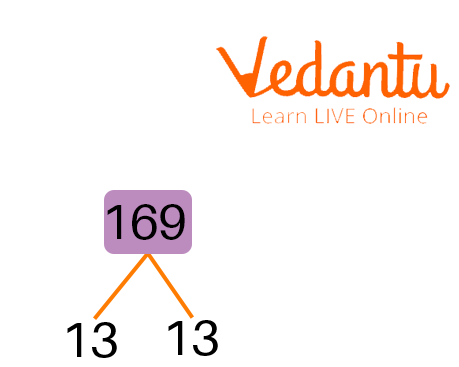
Factor Tree of 169
The prime factors are: $13 \times 13$ or also written as $\left \{ 13,13 \right \}$
Written in exponential form: $13^{2}$
Pair Factors of 169
Two numbers, when multiplied together, equal 169 make for the pair factors of the number. The list of all the 169 factor pairs is provided below. We can see that when we multiply all the factor pairs together, we get 169.
$1 \times 169 = 169$
$13 \times 13 = 169$
$169 \times 1 = 169$
All Factors of 169
The factors of 169 are numbers that when divided by 169, leave zero as remainders. Those that can divide 169 exactly i.e. factors are $1, 13, 169$.
Solved Examples
Example 1: There are 169 fruits to be divided among 13 children. Using the factors of 169, calculate the number of fruits each child gets.
Solution: From the factors of the number 169, we know that $169 = 1 \times 13 \times 13$
$\therefore 169 = 13 \times 13$
Therefore, when there are $13$ children, each child will get $13$ fruits.
Example 2: Find the highest common factors of 13 and 169.
Solution: The prime factorisation of $13$ and 169 is given by
$13 = 1 \times 13$
$169 = 1 \times 13 \times 13$
To find the HCF, we multiply the factors which are common to both $13$ and 169.
$HCF\left ( 13,169 \right )=1 \times 13 = 13$
Practise Questions
1. What is the LCM of 169 and $196$?
33153
33124
22341
32431
Ans: B
2. What is the square root of 169?
13
14
12
16
Ans: A
Conclusion
In this article, we learnt that the factors of 169 are numbers that, when divided by 169, leave zero as remainders. The number 169 has a total of 3 factors: $1, 13, 169$. Its prime factors are $13 \times 13$. The factors in pair for 169 are $\left ( 1,169 \right )$, $\left ( 13,13 \right )$ and $\left ( 169,1 \right )$. You will now be able to factor 169, we hope this article was helpful.
FAQs on Factors of 169 Explained with Factor Pairs and Proof
1. What are the factors of 169?
The factors of 169 are 1, 13, and 169. A factor is a number that divides another number exactly without leaving a remainder.
- 169 ÷ 1 = 169
- 169 ÷ 13 = 13
- 169 ÷ 169 = 1
2. Is 169 a prime number?
No, 169 is not a prime number because it has more than two factors. A prime number has exactly two factors: 1 and itself.
- Factors of 169: 1, 13, 169
- Since 13 also divides 169, it is a composite number.
3. Why is 169 a perfect square?
169 is a perfect square because it is equal to 13 × 13. A perfect square is a number obtained by multiplying a whole number by itself.
- 13 × 13 = 169
- So, 169 = 13²
4. What is the prime factorization of 169?
The prime factorization of 169 is 13 × 13 or 13². Prime factorization means expressing a number as a product of prime numbers.
- 169 ÷ 13 = 13
- 13 is a prime number
5. How do you find the factors of 169?
You can find the factors of 169 by dividing it by numbers from 1 up to its square root, which is 13.
- Step 1: Divide 169 by 1 → 169 (factor pair: 1, 169)
- Step 2: Divide 169 by 13 → 13 (factor pair: 13, 13)
- Step 3: Stop at 13 since it is the square root
6. What are the factor pairs of 169?
The factor pairs of 169 are (1, 169) and (13, 13). Factor pairs are two numbers that multiply together to give the original number.
- 1 × 169 = 169
- 13 × 13 = 169
7. What is the square root of 169?
The square root of 169 is 13. The square root of a number is a value that, when multiplied by itself, gives the original number.
- 13 × 13 = 169
8. How many factors does 169 have?
The number 169 has 3 positive factors. These factors are 1, 13, and 169.
- 1 and 169
- 13
9. What are the negative factors of 169?
The negative factors of 169 are -1, -13, and -169. A negative factor also divides the number exactly but results in a negative quotient.
- -1 × -169 = 169
- -13 × -13 = 169
10. What is the sum of the factors of 169?
The sum of the positive factors of 169 is 183. To find the sum, add all its factors:
- 1 + 13 + 169 = 183
