








What Is a Fact Family in Math Definition Rules and Solved Examples
Introduction to Fact Family Maths
The idea of a fact family or families of facts is one of the more frequent topics introduced in first-grade maths. Fact family maths helps your kids discover the relationships between numbers and the reasoning behind addition and subtraction. An interesting way to organise the study of maths facts is through Fact Family. A group of mathematical operations or equations produced using the same set of numbers is referred to as a fact family multiplication. The relationship between the three numbers is demonstrated by the fact of family. There are four addition and subtraction statements made using three numbers in an addition and subtraction fact family.
What is a Fact Family?
Fact family definition states that a series of equations or calculations involving the same three integers. Fact family's definition begins with two numbers joining together, just like a family. Say, for example, that 1 and 2 eventually cross paths. Then, they combine to form 3. There seems to be their initial family picture: 1 + 2 = 3.
Furthermore, we can change the numbers we're adding and still come up with the same total. Therefore, 1, 2, and 3 might alternatively be arranged as follows: 2 + 1 = 3.
Similarly, numbers might have various relationships with one another at certain times, just like people in families have. A subtraction sentence can have the numbers 3, 2, and 1.
We may begin by subtracting 2 from 3 using the same three fact family members, giving us this image of the three numbers.
3 - 2 = 1
Of course, we could also reduce 3 by 1 to get 2: 3 - 1 = 2.
Fact Families Multiplication and Division
A collection of connected arithmetic facts using the same three integers is referred to as a fact family multiplication. Division, the inverse or opposite operation of multiplication, can likewise be included in the fact family of division. The fact family would include four equations, for instance, if 2, 5, and 10 were used: 2 x 5 = 10, 5 x 2 = 10, 10 ÷ 5 = 2.
Fact family multiplication continues to improve your child's understanding of how numbers relate to one another in maths since students may have used fact families while learning addition and subtraction. The commutative property of fact family multiplication, which states that 2 x 5 is the same as 5 x 2, is highlighted through fact families.
Fact Family Examples
Some fact family examples are assigned to the students that are based on the fact family definition:
Example 1: Use the numbers 9, 4, and 5 to build an addition and subtraction, fact family.
Solution: We know that four addition and subtraction statements were produced using 9, 4, and 5 and form an addition and subtraction fact family as shown below:
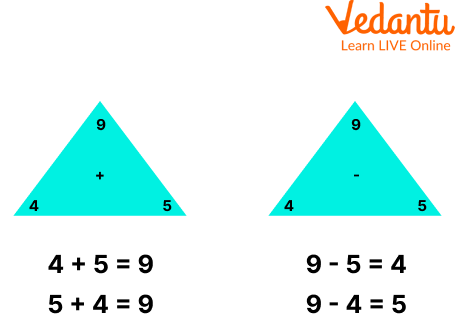
Addition and Subtraction fact family
Example 2: Example 1: Use the numbers 12, 4, and 3 to build a multiplication and division fact family.
Solution: We know that four multiplication and division statements were produced using 12, 4, and 3 and form a fact family multiplication and division as shown below:
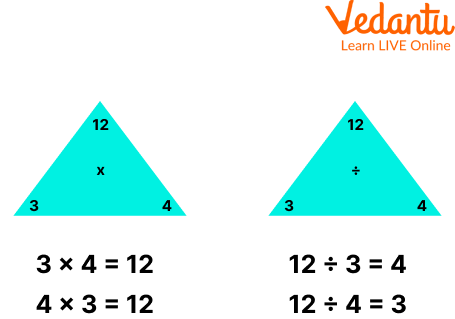
Fact families multiplication and division
Practice Problems
Q1. Which mathematical operation is NOT a member of the group of fact family you can construct using the numbers 8, 5, and 13?
(a) 8 + 5
(b) $8 \times 5$
(c) 13 - 5
(d) 13 - 8
Ans. (b) $8 \times 5$
Q2. Which digit from this 9 +_ _ _ = 18 family of facts is missing?
(a) 8
(b) 9
(c) 27
(d) 6
Ans. (b) 9
Q3. What comes next in the addition of a family of 8 and 40?
Ans. 48
Summary
So far we have discussed what a fact family is. Fact family definition is a group of three numbers that together make four mathematical operations utilising one operator and its inverse. Because addition and multiplication operations are commutative—a fancy way of saying that the order of their arguments doesn't matter, families are a result. The fact of family demonstrates the connections between the numbers. This article explains the addition, subtraction, multiplication and division fact families with fact family examples. A strong understanding of four basic maths operations and their connections will be developed by solving the practice problems provided in this article progressively.
FAQs on Fact Family in Math Explained with Simple Examples
1. What is a fact family in math?
A fact family in math is a group of related addition and subtraction facts (or multiplication and division facts) that use the same set of numbers. It shows how numbers are connected through inverse operations.
- For example, the numbers 3, 4, and 7 form a fact family.
- Addition facts: 3 + 4 = 7 and 4 + 3 = 7
- Subtraction facts: 7 − 3 = 4 and 7 − 4 = 3
2. How do you write a fact family?
To write a fact family, use three related numbers to create two addition and two subtraction equations (or two multiplication and two division equations).
- Step 1: Identify three related numbers (e.g., 5, 8, 13).
- Step 2: Write two addition facts: 5 + 8 = 13 and 8 + 5 = 13.
- Step 3: Write two subtraction facts: 13 − 5 = 8 and 13 − 8 = 5.
3. What is an example of a fact family?
An example of a fact family is the set of numbers 6, 2, and 12 in multiplication and division.
- Multiplication: 6 × 2 = 12
- Multiplication: 2 × 6 = 12
- Division: 12 ÷ 6 = 2
- Division: 12 ÷ 2 = 6
4. Why are fact families important in math?
Fact families are important because they help students understand the relationship between numbers and inverse operations like addition and subtraction.
- They build strong number sense.
- They show how addition relates to subtraction.
- They improve mental math and fact fluency.
5. What is the difference between addition and multiplication fact families?
The difference is that an addition fact family uses addition and subtraction, while a multiplication fact family uses multiplication and division.
- Addition family example: 4, 9, 13 → 4 + 9 = 13 and 13 − 4 = 9.
- Multiplication family example: 3, 5, 15 → 3 × 5 = 15 and 15 ÷ 3 = 5.
6. How many equations are in a fact family?
A complete fact family has four related equations.
- Two addition and two subtraction facts, or
- Two multiplication and two division facts.
7. Can zero be used in a fact family?
Yes, zero can be used in an addition and subtraction fact family.
- Example with 0, 9, and 9:
- 0 + 9 = 9
- 9 + 0 = 9
- 9 − 0 = 9
- 9 − 9 = 0
8. How do fact families help with subtraction?
Fact families help with subtraction by showing that subtraction is the inverse of addition.
- If you know 5 + 6 = 11,
- Then you also know 11 − 5 = 6 and 11 − 6 = 5.
9. What grade level learns fact families?
Fact families are typically introduced in 1st and 2nd grade as part of early arithmetic learning.
- 1st grade: Addition and subtraction fact families within 20.
- 2nd grade: More advanced number combinations and introduction to multiplication concepts.
10. What is a multiplication and division fact family?
A multiplication and division fact family is a set of four related equations using the same three numbers to show inverse operations.
- Example with 4, 3, and 12:
- 4 × 3 = 12
- 3 × 4 = 12
- 12 ÷ 4 = 3
- 12 ÷ 3 = 4
