








How to Write Decimals in Expanded Form Using Place Value with Solved Examples
The expanded form of decimals is a notation for the decimal numbers, which is the mathematical expression to represent the sum of the values of each digit in the number. We use the place value system to write the expanded form of any number. In mathematics, the value of each digit can be written in expanded form by showing the number as a sum of each digit multiplied by its place value.
In this article, we will learn about the place value system which will help us to understand the expanded form of a decimal.
Place Value System
The place value in the place value system refers to the value of a digit in a number. The value for each number is calculated using the position of the number. Starting from right to left, we can understand the notations used in the place value with the help of an example. The place value chart, which is used in the expanded form, is given below.

Let’s take the number 152. For this number, the place value chart is drawn below.
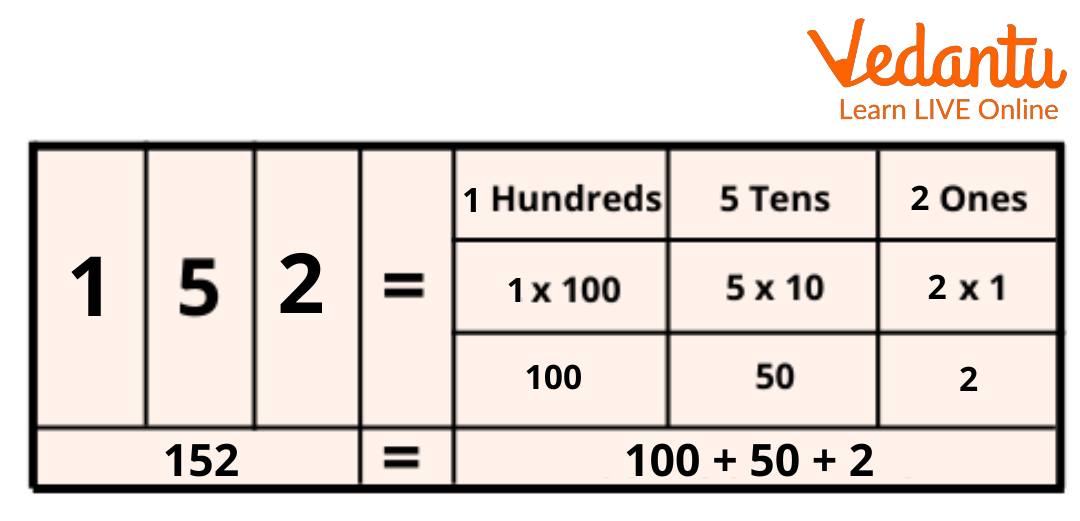
Place Value Chart of 152
Hence, the expanded form of the number 152 is 100 + 50 + 2.
In the same way, when we want to write the expanded form of a decimal or fractional number, it is written with a base 10-multiple denominator which is represented by the power of 10. For example, we can take the decimal number 3.482. In the expanded form, it is written as follows.

The Place Value Chart of 3.482
Hence, the expanded form of the decimal number 3.482 is as follows:
= 3 + \[ \frac{4}{10} + \frac{8}{100} + \frac{42}{1000} \]
= 3 + 0.4 + 0.08 + 0.002
Uses of the Expanded Form of Decimals
The scope of the expanded forms of decimals lies in some areas where accuracy and precision are needed.
The concept of the expanded form is helpful in comprehending the value of a number and the numeric value of a quantity.
Do You Know?
Mathematician Archimedes was the inventor of a decimal positional system for Sand Reckoner to show large numbers which were multiples of 10.
For trade purposes, weights in the ratios of \[ \frac{1}{20} , \frac{1}{10} , \frac{1}{5} , \frac{1}{2} \] and multiples of 10 were used in the Indus Valley Civilization.
In ancient China, Rod calculus used bamboo strips with the decimal system for mathematical operations like multiplication during 305 BC.
Conclusion
The expanded form of a number helps us to understand the number better. In this article, the expanded form of decimals is explained through examples. It is difficult to understand a large number but when it is written in the expanded form, we can understand it easily because of its place value.
FAQs on Understanding Expanded Form of Decimals in the Place Value System
1. What is expanded form of decimals?
The expanded form of decimals is a way of writing a decimal number as the sum of its place values. It shows the value of each digit based on its position in the place value system.
- Example: 45.67 = (4 × 10) + (5 × 1) + (6 × 0.1) + (7 × 0.01)
- This can also be written as 40 + 5 + 0.6 + 0.07
2. How do you write a decimal number in expanded form?
To write a decimal in expanded form, multiply each digit by its place value and add the results. Follow these steps:
- Step 1: Identify the place value of each digit.
- Step 2: Multiply each digit by its place value.
- Step 3: Add all the products.
3. What is the place value system in decimals?
The place value system in decimals shows the value of digits based on their position relative to the decimal point. Each place is 10 times larger to the left and 10 times smaller to the right.
- Left of decimal: Ones, Tens, Hundreds
- Right of decimal: Tenths (0.1), Hundredths (0.01), Thousandths (0.001)
4. What is the difference between place value and face value in decimals?
The face value of a digit is the digit itself, while the place value depends on its position in the number.
- Example: In 6.4, the face value of 4 is 4.
- Its place value is 4 × 0.1 = 0.4.
5. Can you give an example of expanded form with decimals?
Yes, an example of expanded form with decimals is writing 12.305 as the sum of its place values.
- 12.305 = (1 × 10) + (2 × 1) + (3 × 0.1) + (0 × 0.01) + (5 × 0.001)
- This equals 10 + 2 + 0.3 + 0 + 0.005
6. How do you identify tenths, hundredths, and thousandths in decimals?
You identify tenths, hundredths, and thousandths by counting places to the right of the decimal point.
- First place right: Tenths (0.1)
- Second place right: Hundredths (0.01)
- Third place right: Thousandths (0.001)
7. Why is expanded form important in learning decimals?
Expanded form is important because it clearly shows the value of each digit in a decimal number. It helps learners:
- Understand the place value system
- Compare decimal numbers correctly
- Perform addition and subtraction of decimals accurately
8. How do you convert expanded form back to standard decimal form?
To convert expanded form to standard decimal form, add all the place value parts together.
- Example: 4 + 0.7 + 0.05 = 4.75
- Combine whole number and decimal parts carefully.
9. What are common mistakes when writing decimals in expanded form?
Common mistakes in writing expanded form of decimals include incorrect place values and ignoring zeros.
- Placing digits in the wrong decimal position
- Forgetting that each place is divided by 10
- Ignoring zero placeholders like in 8.04
10. How does the place value system help in comparing decimal numbers?
The place value system helps compare decimals by aligning digits according to their positions.
- Step 1: Line up decimal points.
- Step 2: Compare digits from left to right.
- Step 3: The first larger digit determines the greater number.
