








How to Find Equivalent Ratios Using the Multiplication Method
Equivalent ratios are the kind of ratios that remain the same when we compare them. We compare multiple ratios alongside each other to check whether they are equivalent or not. It can be shown easily by an example, i.e. $1:2$ and $2:4$ are equivalent ratios. We can find the two equivalent ratios by using multiplication and division as tools.
If we want to get a ratio that is equivalent to an already given ratio, we need to multiply or divide both of the terms of the given ratio by the same non-zero number.
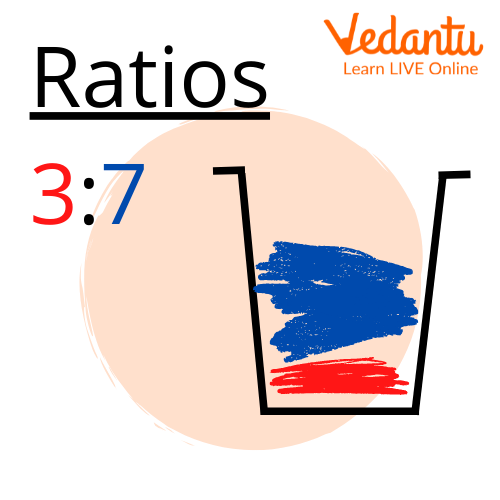
Ratios
Equivalent Ratios and Equivalent Fractions
In order to find the equivalent ratios of a given ratio, we write the ratio as a fraction and then multiply and divide for them to be compared. The ratio can also be expressed as a fraction. Let a:b, be a ratio, then a/b can be the fraction form. It can also be compared to two or more equivalent ratios in the form of equivalent fractions.
How Do We Find the Equivalent Ratios of a Given Ratio?
The step-by-step process to find the equivalent ratios of a given ratio is given below:
We can find the two equivalent ratios by using multiplication and division as tools
If we want to get a ratio that is equivalent to an already given ratio, we need to multiply or divide both of the terms of the given ratio by the same non-zero number.
In order to find the equivalent ratios of a given ratio, we write the ratio as a fraction and then multiply and divide for them to be compared.
Ratio Multiplication
Ratio multiplication is the mathematical operation of multiplying two ratios or more by one another. Let’s understand it by examples.
Solved Examples
Example 1. Give two equivalent ratios of $6:16$
Ans: It begins with finding the equivalent ratio of $6:16$ by using multiplication.
The first step is to represent the ratio as a fraction, = $6/16$
Now we multiply it by the same number.
$=\dfrac{6 \times 2}{16 \times 2}=\dfrac{12}{32}=12: 32$
(one equivalent ratio),
So, $12:32$ is an equivalent ratio of $6:16$.
We can also find the equivalent ratio of $6:16$ by using division.
Here also, the first step is to represent the ratio as a fraction,
$=\dfrac{6}{165}=\dfrac{6 \div 2}{16 \div 2}=\dfrac{3}{8}=3: 8$
(another equivalent ratio)
So, 6: 165 is an equivalent ratio of $3:8$.
We can see that the equivalent ratios of $6:16$ are $12:32$ and $3:8$.
Example 2. Find the two equivalent ratios of $4:5$
Ans: It begins with finding the equivalent ratio of $4:5$ by using multiplication.
The first step is to represent the ratio as a fraction.
$=\dfrac{4}{5}$
Now, we multiply it by the same number.
$=\dfrac{4 \times 2}{5 \times 2}=\dfrac{8}{10}=8: 10$ is one equivalent ratio.
In order to find another equivalent ratio, we multiply again with another number.
The first step is to represent the ratio as a fraction.
$=\dfrac{4}{5}$
Now, we multiply it by the same number.
$\dfrac{4 \times 3}{5 \times 3}=\dfrac{12}{15}$ is another equivalent ratio
We can see that the equivalent ratios are $4:5$, $8:10$, and $12:15$.
Note: We can see that the division method was not applied in this case to get the answer in integer form, which is due to the G.C.F. of 4, and 5 is 1. Hence, 4 and 5 is not divisible by any other number other than 1.
Example 3. If the ratio is $11:13$ find its equivalent ratios.
Ans: It begins with finding the equivalent ratio of $11:13$ by using multiplication.
The first step is to represent the ratio as a fraction.
$=\dfrac{11}{13}$
Now we multiply it by the same number.
$=\dfrac{11 \times 2}{13 \times 2}=\dfrac{22}{26}=22: 26$ is the equivalent ratio.
Equivalent Ratio of 8:15
Now, let’s see the equivalent ratio of 8:15. Below are the step to find out the ratio:
In order to find the equivalent ratios of 8:15 by multiplication, we must multiply the numbers by 2, i.e. 8x2 : 15x2
Therefore, the equivalent ratio now is 16:30.
Practice Questions
Q1. Write the equivalent ratio of 3:9
Ans: 6:18
Q2. Write the equivalent ratio of 7:8
Ans: 14:16
Q3. Write two equivalent ratios for 5:7
Ans: 10:14 and 15:21

Finding an Equivalent Ratio
Summary
Ratios that are identical when compared are referred to as equivalent ratios. To determine whether two or more ratios are equivalent, they can be put side by side. An equivalent ratio is, for instance, 1:2 and 2:4. These ratios remain the same even after being changed via mathematical tools. The ratios can be represented using a fraction and thus modified by these tools. There can be multiple equivalent ratios based on the change in values and the tool used.
FAQs on Equivalent Ratio Explained with Clear Concepts
1. What is an equivalent ratio in maths?
An equivalent ratio is a ratio that represents the same relationship between two quantities even though the numbers are different. Equivalent ratios are formed by multiplying or dividing both terms of a ratio by the same non-zero number.
- For example, 2:3 and 4:6 are equivalent ratios.
- Both represent the same proportional relationship.
- Because 2 × 2 = 4 and 3 × 2 = 6, the ratios are equal.
2. How do you find equivalent ratios?
You find equivalent ratios by multiplying or dividing both parts of a ratio by the same non-zero number.
- Step 1: Take a given ratio, for example 3:5.
- Step 2: Choose a number (e.g., 2).
- Step 3: Multiply both terms: 3 × 2 : 5 × 2 = 6:10.
3. What is the formula for equivalent ratios?
The formula for equivalent ratios is a:b = (a × k):(b × k), where k ≠ 0.
- a and b are the original terms.
- k is the same non-zero number.
- This follows the rule of proportionality.
4. How do you check if two ratios are equivalent?
Two ratios are equivalent if their cross products are equal.
- For ratios a:b and c:d, check if a × d = b × c.
- Example: 2:3 and 4:6 → 2 × 6 = 12 and 3 × 4 = 12.
5. Can you give an example of equivalent ratios?
An example of equivalent ratios is 5:8 and 15:24.
- Multiply both terms of 5:8 by 3.
- 5 × 3 = 15 and 8 × 3 = 24.
- So the equivalent ratio is 15:24.
6. What is the difference between equivalent ratios and equal fractions?
The difference is that equivalent ratios compare quantities, while equal fractions represent parts of a whole.
- Ratios are written as a:b.
- Fractions are written as a/b.
- However, equivalent ratios and equal fractions follow the same multiplication rule.
7. Why do equivalent ratios work?
Equivalent ratios work because multiplying or dividing both terms by the same number does not change the proportional relationship.
- This is based on the property of equality.
- If both quantities scale equally, the comparison remains constant.
- It is similar to multiplying a fraction by 1.
8. How are equivalent ratios related to proportions?
Equivalent ratios form a proportion when two ratios are equal.
- A proportion is written as a:b = c:d.
- If the ratios are equivalent, their cross products are equal.
- Example: 3:4 = 6:8.
9. What are some real-life examples of equivalent ratios?
Real-life examples of equivalent ratios appear in scaling, recipes, and maps.
- If a recipe uses 2 cups of flour for 3 cups of sugar, doubling gives 4:6.
- On a map, 1 cm:5 km is equivalent to 2 cm:10 km.
- In speed, 60 km in 1 hour equals 120 km in 2 hours.
10. What are common mistakes when finding equivalent ratios?
A common mistake when finding equivalent ratios is multiplying only one term instead of both terms.
- Both parts must be multiplied or divided by the same non-zero number.
- Another error is adding instead of multiplying.
- For example, 2:5 cannot become 4:7 by adding 2 to both terms.
