








Definition formula and examples of edges vertices and faces in 3D shapes
We see a number of things of different sizes and shapes in our day to day life such as ice-cream cones, balls, boxes and door mats etc. These objects are identified by different characteristic properties. These properties are length, breadth, diameter, perimeter, vertex, edges, faces etc. Edges of any shape are defined as “The line segment that joins two vertices and it acts as an interface between two faces.” In the following diagram, an edge of a square is shown.
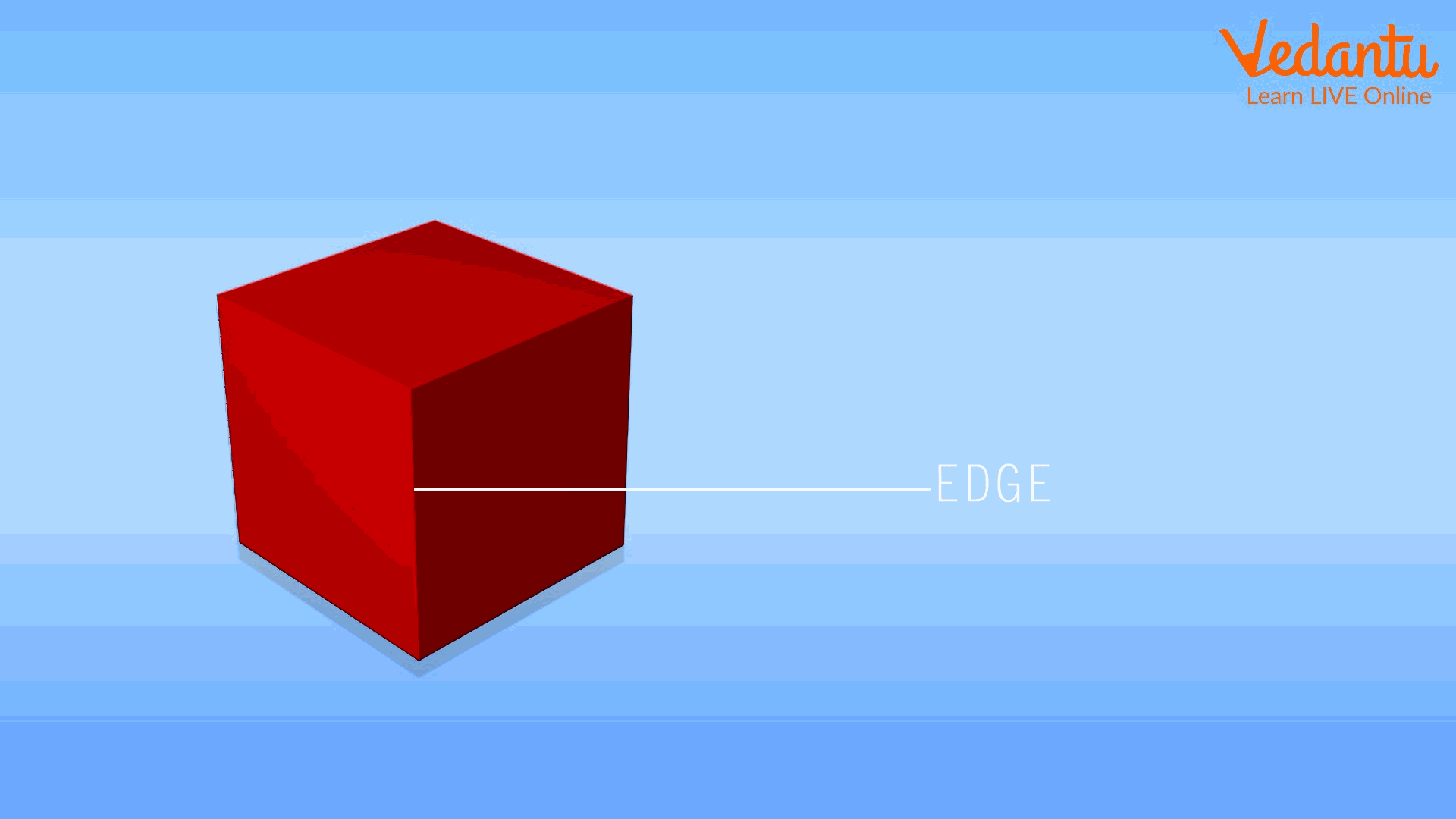
Edge of a Square
What are Vertices and Faces?
A vertex of any shape is a point of contact or meeting point of two or more edges. Hence we can say that vertices are the corner points of a shape. The vertex of a pentagon is shown in the figure below.
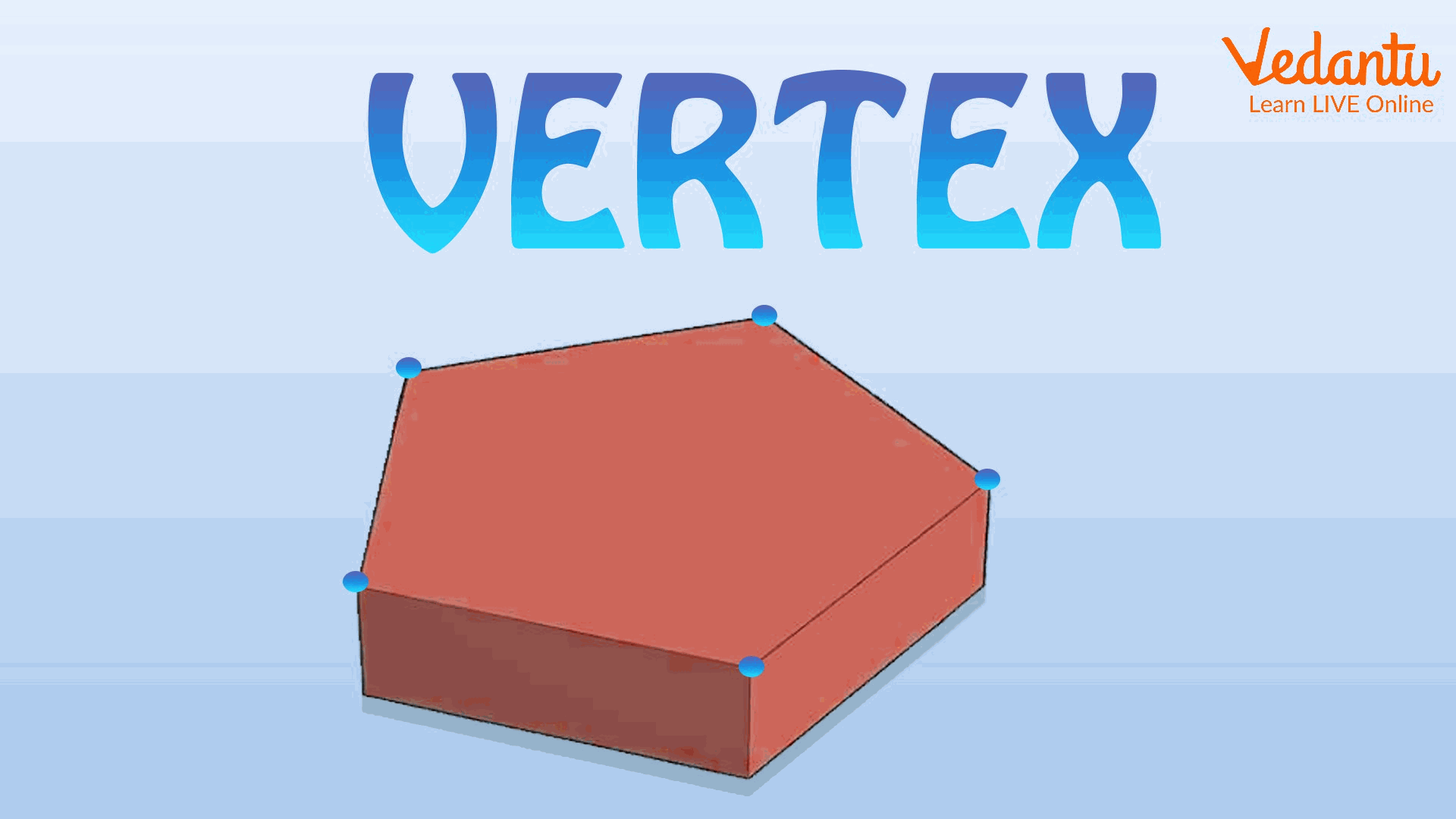
Vertices of a Pentagon
.
The face of any solid object is any of the individual flat surfaces. The tetrahedron has four faces which are shown below. One face you can not see in the 2-D figure.
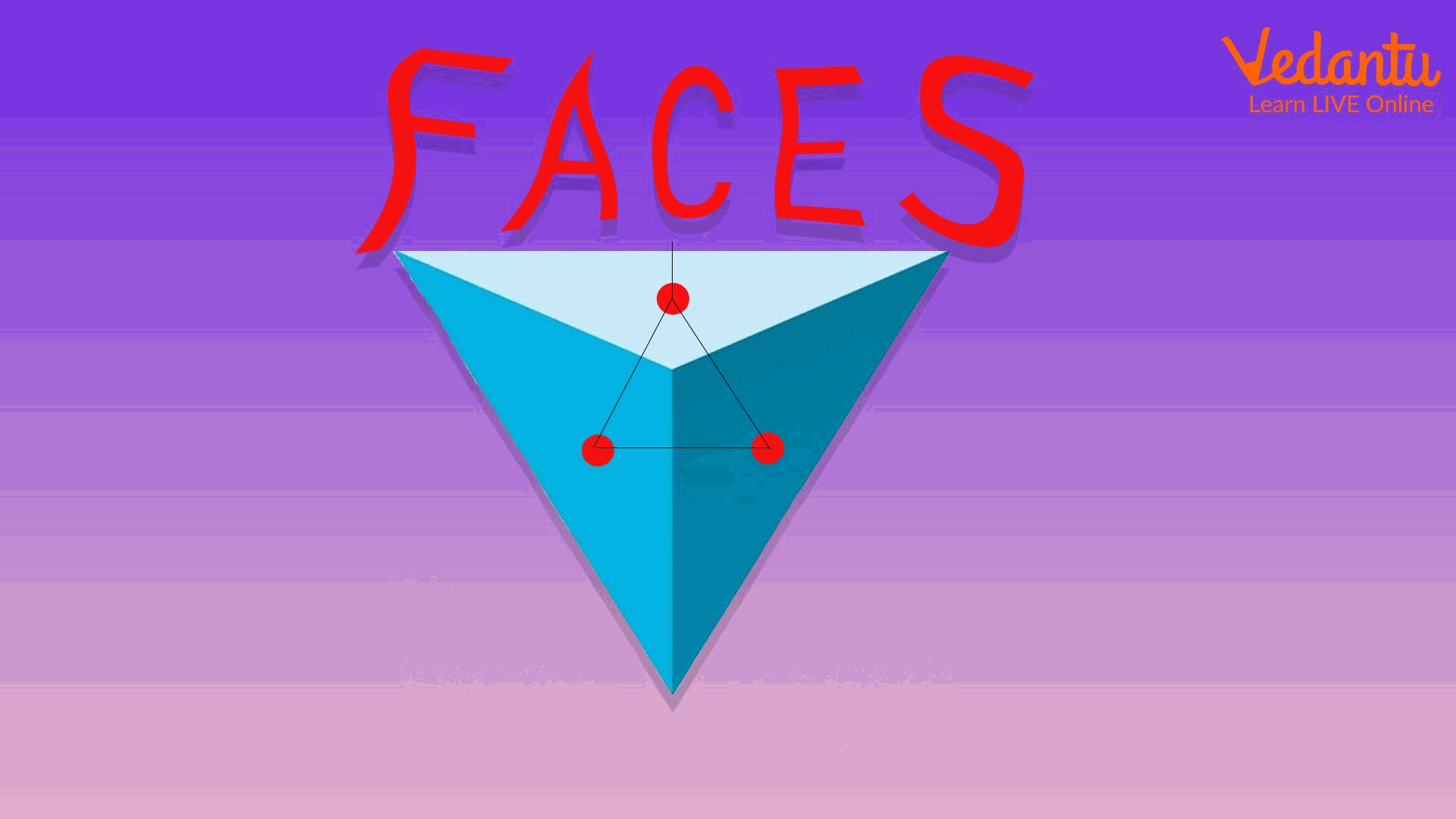
Faces of a Tetrahedron
Euler's Formula
The relationship between vertices, edges and faces is given by Euler’s Formula. The Euler’s Formula for many solid shapes is given as : F + V − E = 2
Where F = Number of Faces
V= Number of Vertices
E= Number of Edges
Let’s apply this formula to the cube to verify it. We know that a cube has 6 faces, 8 vertices, and 12 edges
So F=6, V=8 and E=12 then putting these values in the equation we get,
6 + 8 − 12 = 2
2 = 2
Hence the formula is verified.
Numbers of Edges, Vertices and Faces in Different Solids
The number of edges, vertices and faces in different three-dimensional solids are given below.
Conclusion
After reading the above article students will learn basic about what are edges, vertices and faces of any solid. We also learned an interesting relationship between the three of them by learning Euler's formula. This formula holds good for closed solids which have flat faces and straight edges but cannot be used for cylinders as they have curved edges.
FAQs on Edges Vertices and Faces in Different Solids
1. What are edges, vertices, and faces in solid shapes?
An edge is a line segment where two faces meet, a vertex is a corner point where edges meet, and a face is a flat surface of a solid shape.
- Faces: Flat surfaces of a 3D solid.
- Edges: Line segments formed by the intersection of two faces.
- Vertices: Points where two or more edges meet.
2. How many edges, vertices, and faces does a cube have?
A cube has 6 faces, 12 edges, and 8 vertices.
- Faces: 6 equal square faces
- Edges: 12 equal edges
- Vertices: 8 corner points
3. What are the number of faces, edges, and vertices in a cuboid?
A cuboid has 6 faces, 12 edges, and 8 vertices.
- Faces: 6 rectangular faces
- Edges: 12 edges
- Vertices: 8 corners
4. How many faces, edges, and vertices does a triangular prism have?
A triangular prism has 5 faces, 9 edges, and 6 vertices.
- Faces: 2 triangular + 3 rectangular faces
- Edges: 9 total edges
- Vertices: 6 corner points
5. What are the faces, edges, and vertices of a square pyramid?
A square pyramid has 5 faces, 8 edges, and 5 vertices.
- Faces: 1 square base + 4 triangular faces
- Edges: 4 base edges + 4 side edges
- Vertices: 4 base corners + 1 apex
6. How many edges, vertices, and faces does a cylinder have?
A cylinder has 3 faces, 2 edges, and 0 vertices.
- Faces: 2 circular flat faces + 1 curved surface
- Edges: 2 circular edges
- Vertices: None
7. Does a sphere have edges, vertices, or faces?
A sphere has 0 edges, 0 vertices, and 1 curved surface.
- No flat faces
- No edges
- No vertices
8. What is Euler’s formula for faces, edges, and vertices?
Euler’s formula states that for any polyhedron, F + V − E = 2.
- F = Number of faces
- V = Number of vertices
- E = Number of edges
9. How do you count edges, vertices, and faces in a solid?
To count edges, vertices, and faces, carefully observe and list each element without double-counting.
- Step 1: Count all flat surfaces (faces).
- Step 2: Count all line segments where faces meet (edges).
- Step 3: Count all corner points (vertices).
10. What is the difference between a face and an edge in 3D shapes?
A face is a flat surface of a 3D solid, while an edge is the line segment where two faces meet.
- Faces are 2-dimensional surfaces.
- Edges are 1-dimensional line segments.
- Vertices are 0-dimensional points where edges meet.
