








How To Understand Division As Repeated Subtraction With Solved Examples
One of the four fundamental arithmetic operations, or how numbers are combined to create new numbers, is division. The additional operations are multiplication, addition, and subtraction. The technique of repeatedly subtracting one number from another until the final result is zero is known as division. This method is frequently used and seen when dividing numbers and is an effective technique to teach division to younger grades. To further understand the concept, let's study more about repeated subtraction, how to divide using repeated subtraction, and how to solve a few problems.
Division is a Process of Repeated Subtraction
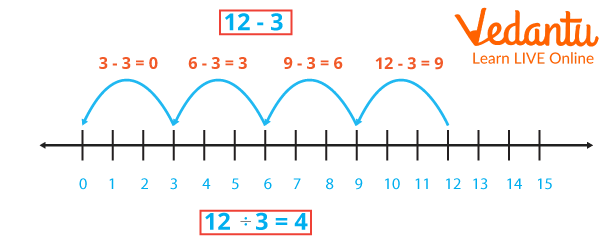
Division is the Process of Repeated Subtraction
The act of repeatedly subtracting the same number from a large number until the final result, or remainder, is zero or less, is referred to as repeated subtraction. Another name for this procedure is division. In other words, repeated subtraction is the process of subtracting the same number from the other number until the remainder is zero or until it is smaller than the original number. This operation can also be written in the form of division. As in an illustration \[12 - 3 = 9,9 - 3 = 6,6 - 3 = 3,3 - 3 = 0\] . This indicates that the number has been deducted five times, and the division form is\[12 \div 3 = 4\]. Thus Repeated Subtraction is Called Division.
Dividing 1 Digit Number
Take the dividend's first digit starting from the left in step one. Verify that this digit exceeds or is equal to the divisor.
Next, divide it by the divisor, and write the result as the quotient on top.
Subtract the outcome from the digit, and then write the difference below.
Decrease the dividend's subsequent digit (if present).
Carry out Step 4 again.
From the given image, we can understand how to divide 1 Digit Number.
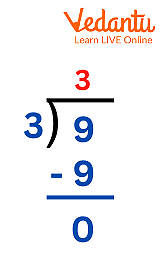
Example of How to divide 1 Digit Number
Division by Repeated Subtraction
Similar to how repeated addition is used to solve multiplication problems, repeated subtraction can be used to address difficulties with division. Dividend, divisor, quotient, and remainder are the four components of division that are taken into account when dividing any integer.
The procedures for division by iterative subtraction are as follows:
Take note of the dividend and divisor. Dividend and divisor both refer to an amount that must be divided; the dividend is the amount that the divisor divides.
Subtract the divisor once again using that number after obtaining the difference.
If you don't get a result that is less than the divisor or zero, keep trying to subtract.
The quantity of times the subtraction procedure is finished is referred to as Quotient.
The remainder is the amount that remains after subtracting a number.
Examples for Dividing 1 Digit Number
Example 1: Use the repeated subtraction method to divide 120 by 15.
120 divided by 15 is the dividend.
Repeatedly subtract 15 from 120.
\[\begin{array}{l}120 - 15 = 105\\105 - 15 = 90\\90 - 15 = 75\\75 - 15 = 60\\60 - 15 = 45\\45 - 15 = 30\\30 - 15 = 15\\15 - 15 = 0\end{array}\]
Here, 15 is removed eight times from 120, leaving 0 as the remainder. Thus, the quotient is \[120 \div 15 = 8\] , which is 8.
Example 2: Bella needs to provide 8 apples to each of her friends out of the 48 she has on hand. How many buddies can you divide 48 apples equally among?
Given that Dividend = 48 and Divisor = 8,
Using the method of repeated subtraction,
\[\begin{array}{l}48 - 8 = 40\\40 - 8 = 32\\32 - 8 = 24\\24 - 8 = 16\\16 - 8 = 8\\8 - 8 = 0\end{array}\]
Therefore, 48 is taken away six times from 8, leaving behind 0.
Bella can therefore distribute 48 apples among her six buddies.
Example 3: Divide 60 by 10 by the process of Repeated Subtraction.
For \[60 \div 10\],
\[\begin{array}{l}60 - 10 = 50\\50 - 10 = 40\\40 - 10 = 30\\30 - 10 = 20\\20 - 10 = 10\\10 - 10 = 0\end{array}\]
Thus, \[60 \div 10 = 6\].
FAQs on Division As Repeated Subtraction Explained Clearly
1. What does division as repeated subtraction mean?
Division as repeated subtraction means that division is the process of subtracting the same number again and again until zero (or a remainder) is reached. In this method:
- The number being divided is called the dividend.
- The number we subtract each time is the divisor.
- The number of times we subtract is the quotient.
2. How do you solve division using repeated subtraction?
To solve division using repeated subtraction, keep subtracting the divisor from the dividend until you reach zero or a number smaller than the divisor. Follow these steps:
- Start with the dividend.
- Subtract the divisor.
- Count each subtraction.
- Stop when the remaining number is less than the divisor.
15 − 5 = 10 (1)
10 − 5 = 5 (2)
5 − 5 = 0 (3)
The quotient is 3.
3. Can you give an example of division as repeated subtraction?
Yes, division as repeated subtraction can be shown by subtracting the divisor multiple times to find the quotient. Example: 20 ÷ 4.
- 20 − 4 = 16 (1)
- 16 − 4 = 12 (2)
- 12 − 4 = 8 (3)
- 8 − 4 = 4 (4)
- 4 − 4 = 0 (5)
4. Why is division considered repeated subtraction?
Division is considered repeated subtraction because it finds how many times one number can be subtracted from another. Instead of grouping directly, we remove equal groups step by step. For example, in 18 ÷ 6, subtracting 6 repeatedly (18 − 6 − 6 − 6 = 0) shows that 6 fits into 18 exactly 3 times.
5. What is the formula for division as repeated subtraction?
The formula for division using repeated subtraction is Dividend = Divisor × Quotient + Remainder. This means:
- The dividend is the original number.
- The divisor is the number subtracted each time.
- The quotient is the number of subtractions.
- The remainder is what is left at the end.
6. What is the difference between division and repeated subtraction?
The difference is that division is the operation, while repeated subtraction is one method used to perform division. Division can also be done using multiplication facts or long division, but repeated subtraction explains the concept step by step. For example, 24 ÷ 6 = 4 can be solved quickly using multiplication (6 × 4 = 24) or by subtracting 6 four times.
7. How do you find the remainder using repeated subtraction?
To find the remainder using repeated subtraction, subtract the divisor until the remaining number is smaller than the divisor. That remaining number is the remainder. Example: 19 ÷ 4.
- 19 − 4 = 15 (1)
- 15 − 4 = 11 (2)
- 11 − 4 = 7 (3)
- 7 − 4 = 3 (4)
8. Is division always repeated subtraction?
Division is conceptually repeated subtraction, but it is not always practically solved by repeated subtraction. For small numbers, repeated subtraction works well, but for large numbers, methods like long division or multiplication facts are faster and more efficient.
9. How is division as repeated subtraction related to multiplication?
Division as repeated subtraction is related to multiplication because division is the inverse operation of multiplication. If a × b = c, then c ÷ b = a. For example, since 5 × 4 = 20, repeatedly subtracting 5 from 20 four times gives 0, so 20 ÷ 5 = 4.
10. What are common mistakes when using repeated subtraction for division?
Common mistakes in division by repeated subtraction include miscounting the number of subtractions and stopping too early. Watch out for:
- Forgetting to count each subtraction correctly.
- Stopping before the number becomes smaller than the divisor.
- Confusing the divisor and dividend.
