








What is the divisibility rule of 2 with definition steps and examples
One of the fundamental operations in mathematics is division. When something is divided, it refers to its separation or sharing into equal portions. The division is the inverse operation of multiplication, just as subtraction is the opposite operation of addition. The slash (/), the horizontal line (-), or the division sign ( ÷ ) can all be used to represent division.
Divisibility Criteria
We use divisibility criteria to determine whether or not a number is divisible by another. In each case, we apply a different criterion to verify divisibility.
Divisibility Rules
Divisibility criteria make it easy to solve a very large number of divisions.
Divisibility criteria are methods used to check whether or not a number is divisible by another. For different numbers, we use different criteria. For example, For 2 divisibility rule, the number just needs to be even, to be divisible by 5, the number must have a unity of 5 or 0. There are different divisibility criteria for each number between 2 and 10.
Divisibility by 2
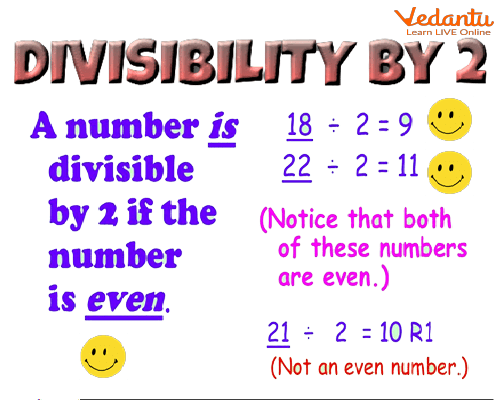
The criterion of divisibility test of 2. Understanding what are the criteria for determining the numbers that are divisible by 2.
Divisibility by 2
Identifying a number that is a divisibility of 2 is quite easy. Let's analyse this number: it is the first of the prime numbers and it is the only prime number that is even.
At the beginning of the study of numerical sets, the teacher teaches us that an even number can always be written as twice another number. Let's look at numbers divisible by 2 examples:
26 = 2 × 13
28 = 2 × 14
36 = 2 × 18
100 = 2 × 50
Given this fact, we can say that for numbers divisible by 2, it is enough that it be an even number.
But how do you identify an even number? If we answer this question, we will be determining the conditions for identifying a number divisible by 2. However, this is an answer that everyone knows, it is something that we learned in our first contact with numerical sets.
“ Even number is one whose last digit is an even number ”. That is, they are the numbers ending in 0, 2, 4, 6, and 8.
Therefore, the criterion of divisibility by the number 2 occurs in observing if the last digit is even.
However, the number two will not divide all numbers, so it is important to understand the rest of the divisibility test of 2.
Some divisible by 2 examples:
13 0 → is divisible by 2, as it ends in 0;
540 6 → is divisible by 2 as it ends in 6;
123 1 → is not divisible by 2, as it ends in 1;
1,293.02 3 → is not divisible by 2 as it ends in 3.
Solved Examples
Q1. Check if 268 is divisible by 2.
Ans: Given, 288 is a number.
If the last digit of 268 is 8 which is divisible by 2, then 288 is also divisible by 2.
The last digit of 268 is 8, which is divisible by 2, such that;
8/2 = 4
Hence, 268 satisfies the divisibility of 2 .
Q2. Is 780 divisible by 2?
Ans: Yes, 780 is divisible by 2 as the unit's place digit is 0.
Practice on Your Own
Q1. Check if 197 is divisible by 2 or not.
Ans: 197 is not divisible by 2.
Q2. Which of the following integers is divisible by two, and why?
14 77 46 80 99 26 33 48
Ans: 14 is divisible by 2 as the last digit is an even number.
77 is not divisible by 2 as the last digit is an odd number.
46 is divisible by 2 as the digit in the unit’s place is 6.
80 is divisible by 2 as the last digit is zero.
99 is not divisible by 2 as the last digit is an odd number.
26 is divisible by 2 as the digit at the unit's place is an even.
33 is not divisible by 2 as the number ends with an odd number.
48 is divisible by 2 as the last digit is an even number.
Summary
The numbers 0, 2, 4, 6, and 8 may all be divided by two. Consequently, multiples of two and integers that finish with 0 are divisible by two. We are aware that even numbers are those that are multiples of 2. As a result, we may state that any even integer is divisible by two.
Numbers like 1, 3, 5, 7, and 9 that end in an odd number cannot be divided by 2.
FAQs on Divisibility of 2 Rule Explained with Examples
1. What is the divisibility rule of 2?
A number is divisible by 2 if its last digit is 0, 2, 4, 6, or 8. This rule works because 2 is a factor of 10, so only the units digit determines divisibility.
- If the last digit is even, the whole number is divisible by 2.
- If the last digit is odd (1, 3, 5, 7, 9), it is not divisible by 2.
- Example: 246 ends in 6, so it is divisible by 2.
2. How do you check if a number is divisible by 2?
To check divisibility by 2, look only at the units digit of the number. Follow these steps:
- Step 1: Identify the last digit.
- Step 2: If it is 0, 2, 4, 6, or 8, the number is divisible by 2.
- Step 3: If it is 1, 3, 5, 7, or 9, it is not divisible by 2.
3. Why does the divisibility rule of 2 work?
The divisibility rule of 2 works because our number system is based on 10, which is divisible by 2. Any number can be written as 10 × (whole number) + last digit.
- 10 × any number is always divisible by 2.
- So divisibility depends only on the last digit.
- If the last digit is even, the entire number is divisible by 2.
4. What are examples of numbers divisible by 2?
Numbers divisible by 2 are called even numbers. Examples include:
- 2, 4, 6, 8
- 10, 24, 56
- 102, 1,000, 5,678
5. What is the difference between even and odd numbers in terms of divisibility by 2?
An even number is divisible by 2, while an odd number is not divisible by 2. The difference is based on the last digit:
- Even numbers end in 0, 2, 4, 6, or 8.
- Odd numbers end in 1, 3, 5, 7, or 9.
6. Is zero divisible by 2?
Yes, 0 is divisible by 2 because 0 ÷ 2 = 0, which is a whole number. Since division results in an integer with no remainder, zero satisfies the definition of divisibility by 2. Also, 0 is considered an even number.
7. Can negative numbers be divisible by 2?
Yes, a negative number is divisible by 2 if its last digit is even. Divisibility rules apply to both positive and negative integers.
- Example: −8 ÷ 2 = −4, so −8 is divisible by 2.
- Example: −15 is not divisible by 2 because it ends in 5.
8. What is the smallest number divisible by 2?
The smallest positive number divisible by 2 is 2. Since 2 ÷ 2 = 1, it is the first positive even number. In the set of whole numbers, 0 is also divisible by 2, but among positive integers, 2 is the smallest.
9. How is divisibility by 2 used in prime factorization?
Divisibility by 2 is used to find factors by repeatedly dividing even numbers by 2. In prime factorization:
- Step 1: Check if the number is even.
- Step 2: Divide by 2 until the result is odd.
10. What are common mistakes when applying the divisibility rule of 2?
A common mistake is checking all digits instead of just the last digit when testing divisibility by 2. Remember:
- Only the units digit matters.
- Do not add digits together (that rule applies to 3 or 9).
- Negative numbers follow the same rule.
