








What Are the Dimensions of a Square Formula Properties and Solved Examples
Have you ever wondered what a square is or how it looks? Squares are a shape with four equal sides and angles, where the space contained within them is all of the same sizes. The term "square" is a geometric shape that can be used to describe any rectangle or rhombus. Squares are easy to draw and are a common shape in our environment. The dimensions of a square are its length and width. Here you will find the dimensions of a square, you will learn about square sides and how to calculate the area of a square.

Picture of chess
Square Sides
A square is a four-sided closed two-dimensional (2D) shape. A square's four sides are all equal and parallel to one another. The basic shape of a square is depicted below. So, here the question arises, how many sides square have? From the below figure, it is clear now that there is a total of 4 sides in a square. Square sides are as follows: PQ, QS, SR, RP.
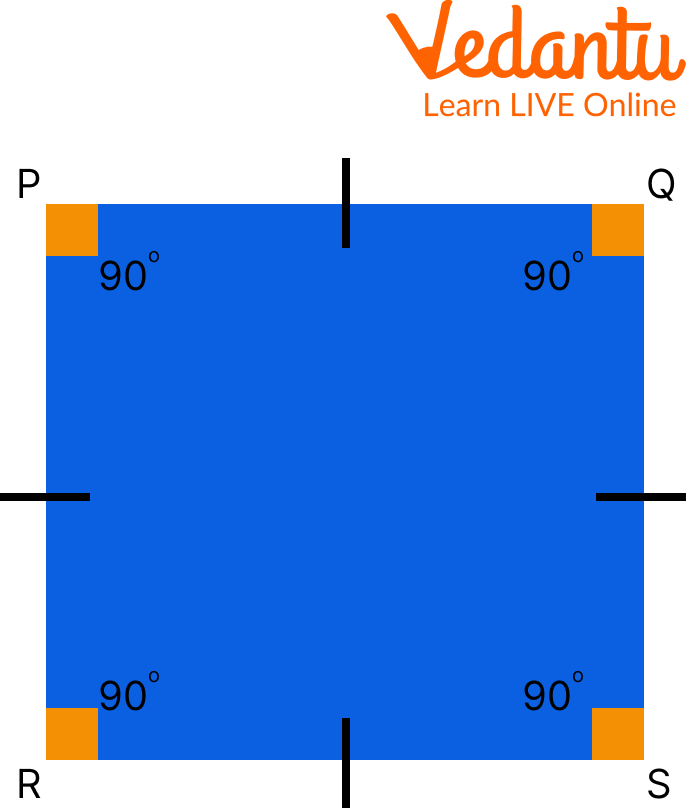
Square
What is the Area of Square?
A square's area is the amount of space it takes up. Chessboards, square wall clocks, and other square shapes are examples. The space occupied by these things can be calculated using the area of a square formula. In the below heading we will learn about how to calculate the area of a square.
How to Calculate Area of a Square?
To find the area of a square, first, calculate one side of the square (all sides of the square are equal ). then multiply by itself to get the area of the square. Hence, $\text { Area }=(\text { Side })^{2}$
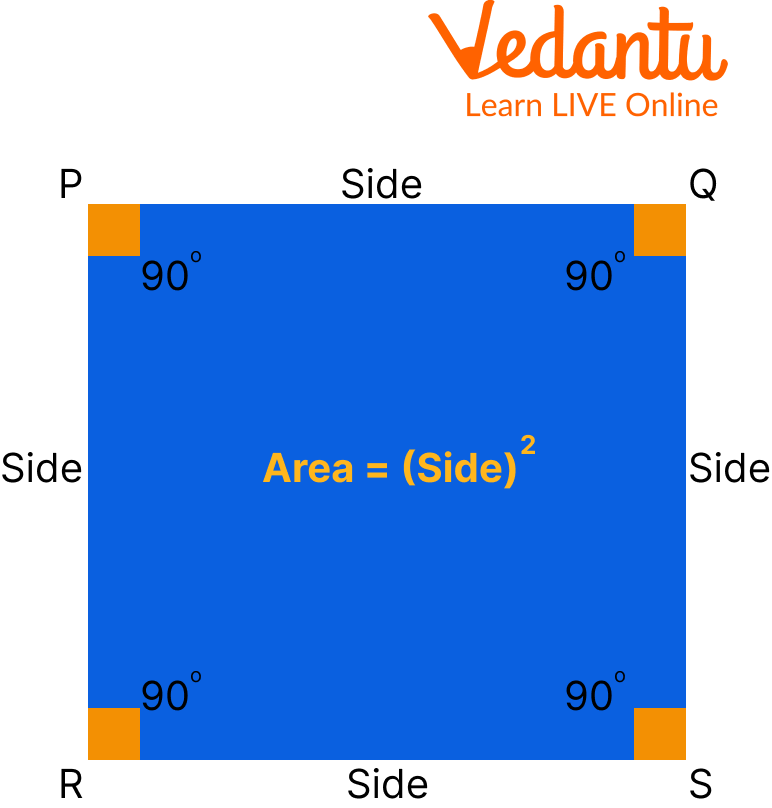
Area of Square
Similarly, we may calculate the area of any other form based on its sides, such as a rectangle, parallelogram, triangle, or polygon.
Example 1. Calculate the area of the square whose length of square sides is 20m.
Ans: Given, length of square sides(a) = 20m
The area of the square is given by: $a \times a=a^{2}$
$\text { Area }=20 \mathrm{~m} \times 20 \mathrm{~m}=400 \mathrm{~m}^{2}$.
Example 2. Find the area of the square whose length of diagonals is 10 cm.
Ans: First we find the side length of square(a)
Length of diagonal is given by formula = d
Diagonal of square $(\mathrm{d})=\sqrt{ 2}a$
Length of diagonal $=10 \mathrm{~cm}$
Now, Area of the square $=\mathrm{a}=\dfrac{(\mathrm{d})^{2}}{2}$
$\Rightarrow \dfrac{(\mathrm{d})^{2}}{2}=\dfrac{100}{2} =50\mathrm{~cm}^{2}$
Example 3. Calculate the area of a square whose side is $11 \mathrm{~cm}$.
Ans: Given that, side $=11 \mathrm{~cm}$
Area of square is given by $=11 \times 11=121 \mathrm{~cm}^{2}$
Dimensions of a Square
To determine the dimensions of a square, its area or perimeter must be specified.
Let us assume a square has a surface area of 36 square feet. First, write down the square area Formula: A = x2, where "A" represents the area and "x" represents one of the side lengths. Because the square has four equal sides, you only need to find one dimension. Work out the area equation. It will appear as 36 = x2. To find the dimension of the square, you must first isolate "x", Take the square root of 36 to cancel out the square sign on the right side of the equation. The answer to the square root problem is 6 . The final answer is x = 6, which means that each dimension of the square is 6 m.
Using the perimeter, calculate the dimensions of the square. The perimeter of the square in this case will be 20 m. Write the perimeter equation for a square down: P = 4t, where "P" represents the perimeter and "x" represents the side dimension. Work out the perimeter equation. It will seem as follows: 20 = 5x. Divide each side of the equation by 4 , and write down the result: x = 4. The final result is x = 5, indicating that the square dimensions are 4 m each.
Practice Questions
Q 1. Find the area of the square whose side is $14 \mathrm{~m}$.
Ans: $196 \mathrm{~m}^{2}$.
Q 2. Find the side of the square whose area is $225 \mathrm{~m}^{2}$.
Ans: $15 \mathrm{~m}$.
Summary
A square is a plane figure with four equal straight sides and four right angles. It is also a regular polygon, meaning that all of its sides and angles are equal. The area of a square is the space inside the perimeter or boundary of the square. The dimensions of a square are its length and width, which are always the same. We have also learned about the area of square, i.e. Area = (Side)2. In the end we have learned to find the dimensions of the square, using the perimeter and area of the square.
FAQs on Dimensions of a Square Explained with Formulas and Concepts
1. What are the dimensions of a square?
The dimensions of a square are equal in length and width, meaning all four sides have the same measurement. A square has:
- 4 equal sides
- 4 right angles (90° each)
- Length = Breadth = Side
2. How do you find the side length of a square?
The side length of a square can be found using its area or perimeter.
- From area: Side = √Area
- From perimeter: Side = Perimeter ÷ 4
3. What is the formula for the area of a square?
The area of a square is calculated using the formula Area = side × side = s². This means you multiply the side length by itself. Example: If side = 6 cm, then Area = 6 × 6 = 36 cm².
4. What is the formula for the perimeter of a square?
The perimeter of a square is given by the formula Perimeter = 4 × side. Since all four sides are equal, you multiply one side by 4. Example: If side = 7 m, then Perimeter = 4 × 7 = 28 m.
5. How do you find the diagonal of a square?
The diagonal of a square is found using the formula Diagonal = side × √2. This comes from the Pythagoras theorem. Example: If side = 5 cm, then Diagonal = 5√2 ≈ 7.07 cm.
6. Are the length and width of a square the same?
Yes, in a square, the length and width are always equal. Unlike rectangles, where length and breadth can differ, a square has equal dimensions on all sides. If the length is 9 cm, the width is also 9 cm.
7. What is the difference between the dimensions of a square and a rectangle?
The main difference is that a square has all sides equal, while a rectangle has only opposite sides equal.
- Square: Length = Width
- Rectangle: Length ≠ Width (in most cases)
- Both have 4 right angles
8. How do you calculate the dimensions of a square from its perimeter?
To calculate the dimensions of a square from its perimeter, divide the perimeter by 4. The formula is Side = Perimeter ÷ 4. Example: If the perimeter is 40 cm, then Side = 40 ÷ 4 = 10 cm, so the dimensions are 10 cm × 10 cm.
9. How do you calculate the dimensions of a square from its area?
To calculate the dimensions of a square from its area, take the square root of the area. The formula is Side = √Area. Example: If the area is 81 m², then Side = √81 = 9 m, so the dimensions are 9 m × 9 m.
10. What are the properties related to the dimensions of a square?
The key properties related to the dimensions of a square describe its equal sides and right angles.
- All four sides are equal
- All interior angles are 90°
- Diagonals are equal and bisect each other at right angles
- Area = s² and Perimeter = 4s
