








What Are Counting Strategies Formula Types and Solved Examples
Counting numbers are the natural numbers that can be used in counting. They start from 1, and the series continues as 1, 2, 3, 4, and so on. Zero is not included in counting numbers because we cannot count 0. Teaching counting strategies to kids can be challenging, but they need to learn how to count properly. One way to help teach counting is to use objects, such as beads, counting bears, or popsicles. You can also use a number line or a chart with numbers written out. With simple techniques, you can make learning to count enjoyable and uncomplicated and encourage a love towards numbers in your child. In this article, we will learn the counting strategy in addition and some of its examples.
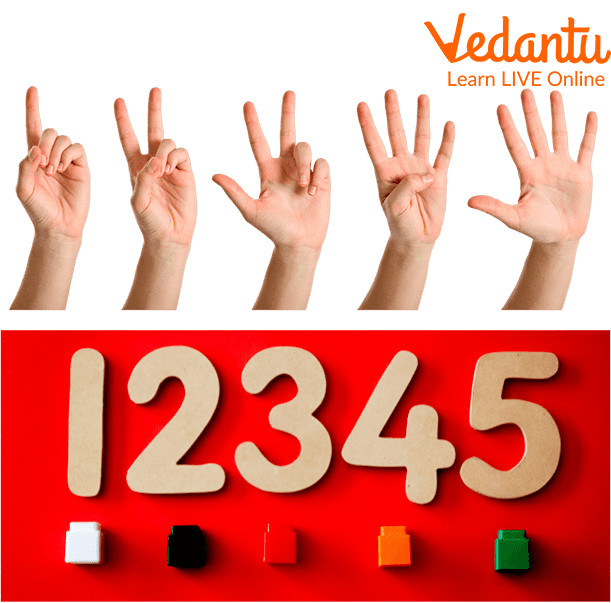
Counting of Numbers
What is Counting?
Counting is the process of expressing the number of elements or objects that are given. Counting numbers include natural numbers that can be counted and are always positive. Counting is essential in daily life because we need to count the number of hours, days, money, etc. Numbers can be counted and written in words like one, two, three, four, and so on.
Counting Strategies and Examples
One way to help kids learn to count is to introduce counting strategies and examples. A few different strategies can be used, each a little different. Also, we will see counting strategies examples to understand them better.
One strategy is to count by one. This means that kids count one number at a time. They start with one and go up to the number they are counting.

Kid Doing Counting
Another counting strategy for kindergarten is to count by using the number toys. Here kids will have some numbers and they have to count them or arrange them.

A Toy Having Different Numbers
A third counting strategy is to count each row by using Abacus. With this strategy, kids have to count each row. Here kids can also learn about different colours along with counting. This strategy will be very helpful for the kids.

Counting by Using Abacus
All of these counting strategies can help kids learn how to count. They can use these strategies to count anything, from numbers to objects. When kids are comfortable using these counting strategies, they can count anything they come across!
Solved Example for Counting Strategy on Addition
Q 1. Count and add the finger’s shown in the image by a boy.

Boy With His Fingers Showing Counting
Ans: Here, from the above image, we can see that a boy is showing some numbers with his hand. Here on the left side, he is showing 2 fingers, so keep the count as 2. Now on the right side, he is showing 1 finger. i.e., keep the count as 1. Hence, the total sum for this will be:
2 + 1 = 3
Q 2. Count the number of fingers shown.

Count the Finger
Ans: Here, from the above image, we can see two hands showing some numbers. On the left side, the hand shows 5 fingers, so keep the count as 5. Now on the right side, the hand shows 4 fingers. i.e., keep the count as 5. Hence, the total sum for this will be:
4 + 5 = 9
Practice Problem
Q 1. Count the number of boxes shown in the image.

Counting
Ans: 6
Q 2. Add and count the given numbers and objects.
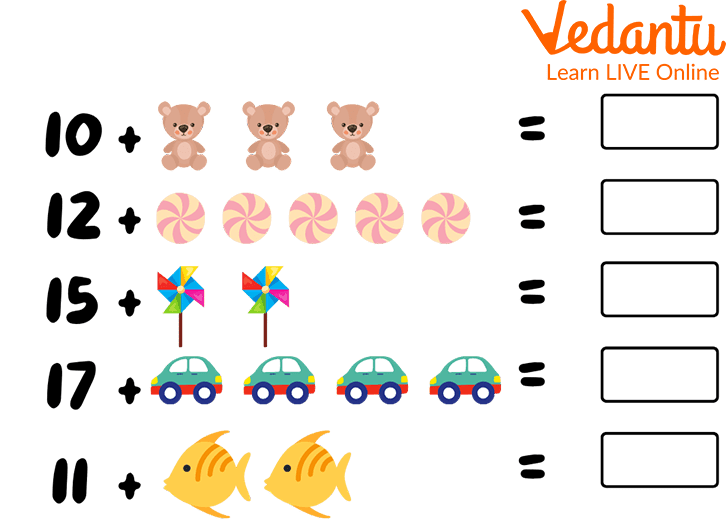
Numbers and Objects
Ans:
10 + 3 = 13
12 + 5 = 17
15 + 2 = 17
17 + 4 = 21
11 + 2 = 13
Summary
Many students are taught counting strategies in school, but not all students prefer the same counting strategy. Some students prefer counting by ones, and some prefer to learn counting by objects such as Abacus. Letting students choose their preferred counting strategy can help them be more successful in mathematics. Although arithmetic abilities can be introduced to your child sooner, kindergarten and first grade are traditionally where educators introduce counting principles to children. Your kid may use the skills you teach them as a base to build on when kindergarten instructors introduce arithmetic topics to them.
FAQs on Counting Strategies in Probability and Combinatorics
1. What are counting strategies in mathematics?
Counting strategies are systematic methods used to determine the number of possible outcomes in a situation without listing them all. In mathematics, counting strategies help solve problems involving arrangements, selections, and combinations.
- They include methods like the fundamental counting principle, permutations, and combinations.
- They are widely used in probability and combinatorics.
- They help avoid mistakes when counting large sets of possibilities.
2. What is the fundamental counting principle?
The fundamental counting principle states that if one event can occur in m ways and another independent event can occur in n ways, then both events can occur in m × n ways.
- Formula: Total outcomes = m × n
- Example: If you have 3 shirts and 4 pants, total outfits = 3 × 4 = 12.
- This principle extends to more than two events by multiplying all possibilities.
3. How do you use a tree diagram for counting?
A tree diagram is used to visually list all possible outcomes of sequential events in an organized way.
- Start with one branch for each option of the first event.
- From each branch, draw sub-branches for the next event.
- Count the final branches to find the total number of outcomes.
4. What is the difference between permutations and combinations?
The difference is that permutations consider order, while combinations do not consider order.
- Permutation formula: nPr = n! / (n − r)!
- Combination formula: nCr = n! / [r!(n − r)!]
- Example: Choosing 2 letters from A, B, C:
- Permutations: AB and BA are different.
- Combinations: AB and BA are the same.
5. How do you calculate permutations?
Permutations are calculated using the formula nPr = n! / (n − r)!.
- n = total number of items
- r = number of items arranged
- 5P3 = 5! / 2! = (5 × 4 × 3) = 60
6. How do you calculate combinations?
Combinations are calculated using the formula nCr = n! / [r!(n − r)!].
- n = total items
- r = items chosen
- 5C2 = 5! / (2!3!) = 10
7. What is factorial in counting strategies?
A factorial is the product of all positive integers from 1 to a given number and is written as n!.
- Formula: n! = n × (n − 1) × ... × 1
- Example: 4! = 4 × 3 × 2 × 1 = 24
- Special rule: 0! = 1
8. How do you solve counting problems step by step?
To solve counting problems, identify the type of situation and apply the correct counting strategy.
- Step 1: Determine if order matters (permutation or combination).
- Step 2: Identify values of n and r.
- Step 3: Apply the correct formula.
- Step 4: Simplify carefully.
- Since order doesn’t matter, use combinations.
- 6C3 = 20.
9. What are some real-life applications of counting strategies?
Counting strategies are used to calculate possible outcomes in real-world decision-making and probability scenarios.
- Arranging seats or schedules (permutations).
- Selecting committees or teams (combinations).
- Calculating probabilities in games and lotteries.
- Computer science algorithms and coding.
10. What are common mistakes in counting strategies?
Common mistakes in counting strategies include confusing permutations with combinations and misusing factorials.
- Forgetting that order matters in permutations.
- Not dividing by r! in combinations.
- Incorrectly calculating factorial values.
- Double-counting outcomes.
