








How To Identify Add And Convert Coins And Currency Notes With Examples
In mathematics, money can be any form of currency, including notes and coins that are used to purchase goods and services. The national currency of India is the rupee (Rs), and all transactions are carried out using this currency. We all deal with money on a daily basis in some capacity, and to reliably manage that money, we often rely on our math skills.
Coins and Currency Notes
The Middle English word currant, which means "in circulation," is where the word currency first appeared. Usually issued by a government and commonly accepted as a method of payment at face value, money comes in the form of coins or paper.
Currency Notes and Coins
Coins: The sizes and shapes of coins occasionally vary. The one-paisa to twenty-paise coins are no longer in circulation. The most common coins in circulation are 50-paise, 1-rupee, 2-rupee, and 5-rupee coins.
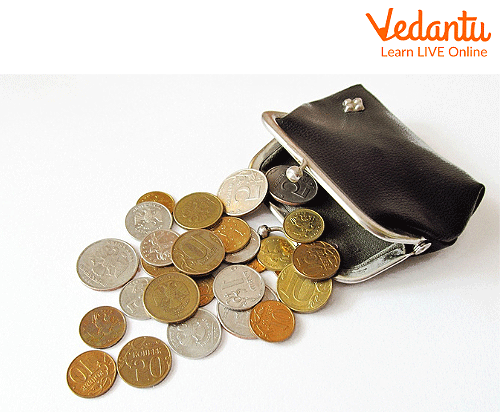
Coins
Currency Notes: These currency notes occasionally alter in terms of their shapes, sizes, and designs. For the 1-, 2-, 5, 50, 100, 200, 500, 2000-rupee denominations, coins and notes are both accepted. Notes for one and two rupees are no longer often found. Notes in the denominations of five, ten, twenty, and fifty rupees are currently available.
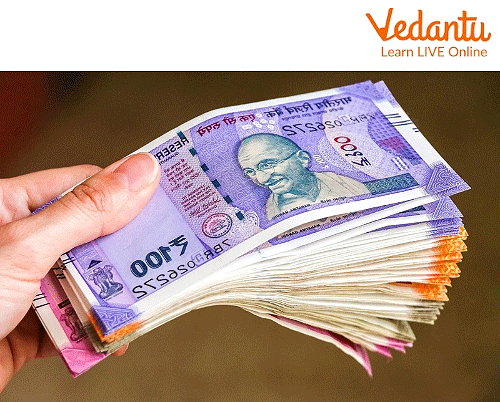
Different Currency Notes
History of Indian Currency Notes and Coins
Money has long since replaced bartering as the principal means of exchanging commodities and services in the modern world. The official money of India is the Rupee. Although there is 100 paise in a rupee, the lowest value coins in circulation as of 2019 are one rupee coins. The Reserve Bank of India has power over currency issuance. The Reserve Bank of India Act, 1934, serves as the basis for the Reserve Bank of India's function in currency control.
Importance of Money in our Daily Life
Money is a type of legal tender, which is an accepted form of payment by the government; in most cases, coins and notes qualify as legal tender.
Both the purchase of products and services as well as the repayment of debts are acceptable.
It may be used to determine the worth of any commodity and provides information on the market price of any manufactured goods. Ex: A pen costs Rs. 5 per unit. (That is, a pen is valued or has a market value of Rs 5)
It serves as a benchmark for postponed payments, that is, for repaying previously borrowed loans and debts.
It must be transportable, i.e., it must be simple to carry and move around.
Conclusion
Any type of currency, including bills and coins used to make purchases of products and services can be referred to as money in mathematics. It may be used to determine the worth of any commodity and provides information on the market price of any manufactured goods.
Indian Money Worksheet for Grade 1 (Solved Questions)
Example 1: How many Will make Rs 10?
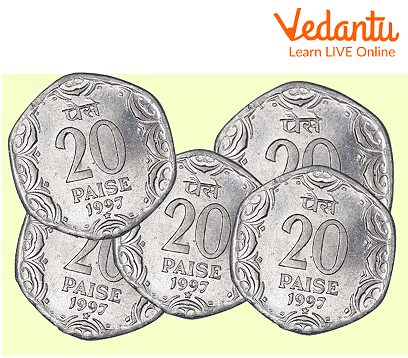
Ans: As we know:
\[\begin{array}{l}1 Rs = 100paise\\10Rs = 1000paise\\5 \times 20paise = 1Rs\\50 \times 20 paise = 10Rs\\\\{\rm{As we know 5, 20 paise coins will make Rs 1}}{\rm{.}}\\{\rm{So, for making 10 Rs we need 50, 20 paise coins}}{\rm{.}}\end{array}\]
Example 2: Which note is this?
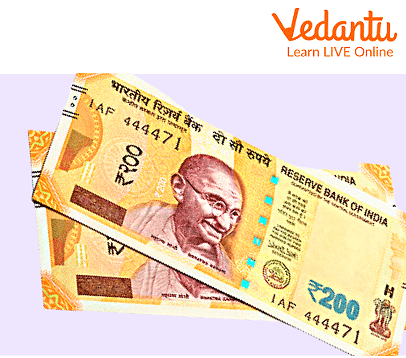
Ans: This is a 200 Rs note.
Example 3: How many Rupees are there in 1 Paise?
Ans: There are 100 paise in 1 Rupees.
FAQs on Understanding Coins And Currency Notes In Mathematics
1. What are coins and currency notes in Maths?
Coins and currency notes are different forms of money used to represent specific monetary values for buying and selling goods. In Maths, they help students understand counting, addition, subtraction, and word problems involving money.
- Coins are metallic money (like ₹1, ₹2, ₹5, ₹10).
- Currency notes are paper money (like ₹10, ₹20, ₹50, ₹100, ₹200, ₹500).
- They are used to learn concepts like total amount, change, and transactions.
2. How do you count money using coins and notes?
To count money, add the values of all coins and currency notes together to find the total amount. Follow these steps:
- Group the same denominations together.
- Add the values of coins first.
- Add the values of notes next.
- Combine both totals to get the final amount.
3. How do you add amounts of money?
To add money, write the amounts in columns by aligning rupees and paise, then add as in normal addition. Steps:
- Write rupees under rupees and paise under paise.
- Add paise first.
- If paise ≥ 100, convert to rupees.
- Add rupees.
4. How do you subtract money to find change?
To find change, subtract the cost price from the amount given using money subtraction. Formula: Change = Amount Given − Cost Price.
- Align rupees and paise properly.
- Borrow if needed.
5. What is the formula to calculate total amount of money?
The formula to calculate total money is Total Amount = Sum of all coins + Sum of all notes. This means you add the values of each denomination together.
- 3 coins of ₹10 = 3 × 10 = ₹30
- 2 notes of ₹50 = 2 × 50 = ₹100
- Total = 30 + 100 = ₹130
6. How do you convert paise into rupees?
To convert paise into rupees, divide the number of paise by 100 because 100 paise = 1 rupee. Formula: Rupees = Paise ÷ 100.
- 250 paise ÷ 100 = ₹2.50
- 75 paise = ₹0.75
7. What is the difference between coins and currency notes?
The main difference is that coins are made of metal while currency notes are made of paper and usually represent higher values.
- Coins: Lower denominations like ₹1, ₹2, ₹5, ₹10.
- Notes: Higher denominations like ₹20, ₹50, ₹100, ₹500.
- Both are legal forms of Indian currency.
8. How do you solve word problems on money?
To solve money word problems, identify the operation needed (addition or subtraction) and calculate carefully. Steps:
- Read the question and note important amounts.
- Decide whether to add (total cost) or subtract (find change).
- Write amounts in column form.
- Calculate the final answer.
9. How do you multiply money amounts?
To multiply money, multiply the numerical value and keep the currency unit the same. Formula: Total Cost = Price × Quantity.
- If one book costs ₹45 and you buy 3 books:
- 45 × 3 = ₹135
10. What are common mistakes when calculating money in Maths?
Common mistakes in money calculations include misplacing decimals and not converting paise correctly. Avoid these errors:
- Not aligning rupees and paise properly.
- Forgetting that 100 paise = 1 rupee.
- Ignoring borrowing in subtraction.
- Not checking the final total.
