








What Is a Coefficient in Algebra with Step by Step Examples
A variable of a single term or the terms of a polynomial is multiplied by a number or an alphabet to produce a coefficient. For instance, the coefficient in the expression \[{\rm{7x}}\] is 7. In the expression \[{\rm{3xy}}\], x's coefficient is \[{\rm{3y}}\].
What is a Coefficient in Math?
A coefficient in mathematics is a value that is multiplied by the variable in a single term or the terms of a polynomial. It can be a number or any symbol that represents a constant value. It is typically a number, however in other expressions a letter might be used instead. In the formula: \[{\rm{a}}{{\rm{x}}^{\rm{2}}} + {\rm{bx}} + {\rm{c}}\], for instance, x is the variable and a and b are the coefficients.
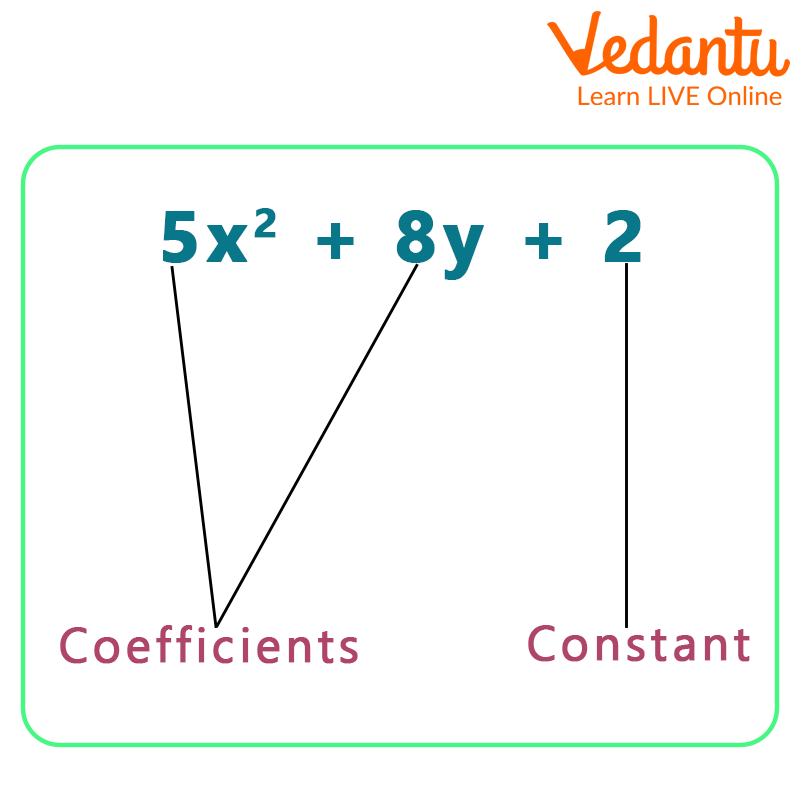
Coefficient in an Equation
Numerical Coefficient with Example:
A set amount multiplied by a variable is what is referred to as a numerical coefficient. Take into account the supplied monomial \[{\rm{7abc}}\]. 7 is the result for the coefficient of multiplying the fixed integer by the variables \[{\rm{abc}}\]. Therefore, the word "\[{\rm{7abc}}\]" has a numerical coefficient of "7."
Coefficient in Algebra:
A multiplier that multiplies two variables.
As an illustration, \[{\rm{6z}}\] stands for 6 times \[z\]. Since z is a variable, 6 is a coefficient.
For variables without a value, the coefficient is 1.
For instance, \[{\rm{x}}\] is really \[{\rm{1x}}\].
Coefficient of a Term
Follow the instructions below to determine a term's coefficient for a variable:
Step 1: Enclose the variable and its corresponding power, whose coefficient we are determining.
Step 2: Ignore that variable and take into account any other numbers or variables it was used with. The coefficient will then be that.
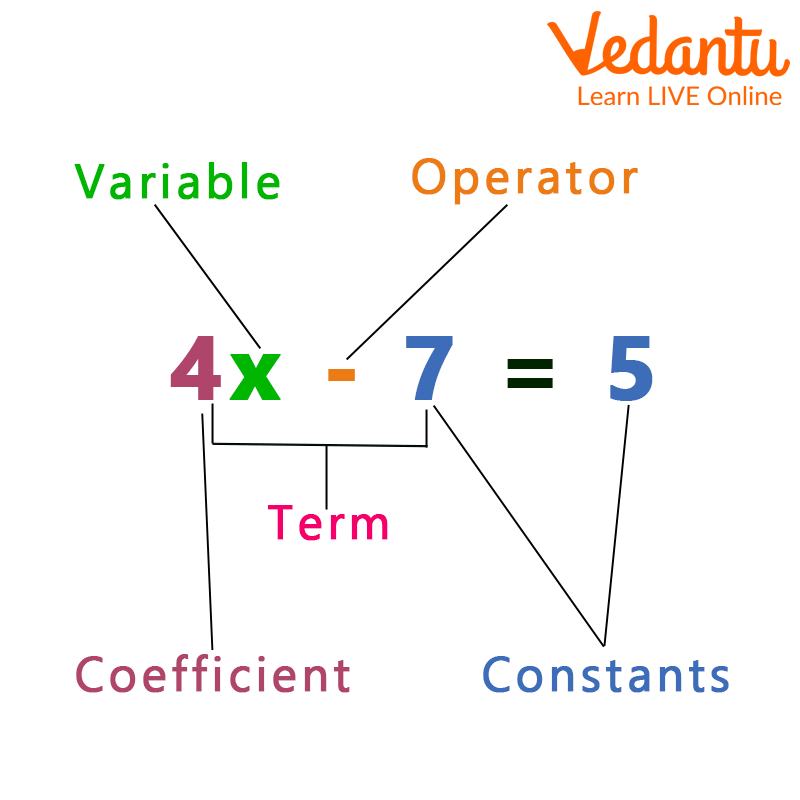
Coefficient in an Equation
Tips and Tricks on Coefficient:
When using coefficients, keep the following things in mind.
A variable always has a coefficient associated with it.
If a variable's coefficient is 1, then it has no associated value.
Conclusion
In mathematics, a coefficient is the multiplicative factor of an expression, a polynomial term, or a series term. Although it might be any sentence, it typically appears as a number. If the coefficients are variables in and of themselves, they may also be known as parameters.
Coefficient Examples:
Example 1: Find the coefficient of the term \[x^2\] in the formula \[a{x^2} + bx + c\].
Ans: In the statement above, we can see that with \[{{x^2}}\] a is written, thus ‘a’ will be its coefficient.
Example 2: Find the numbers that make up the coefficients in the algebraic statement \[3{{\rm{x}}^2} - 2{\rm{y}} + 5\].
Ans: There are three terms in the provided expression. The numerical coefficient in the expression \[{\rm{3}}{{\rm{x}}^{\rm{2}}}\]is 3, the coefficient in the expression \[ - 2{\rm{y}}\] is 2, and 5 is a constant.
Therefore, 3 and -2 are the numerical coefficients.
FAQs on Coefficient Example with Clear Explanation and Practice Problems
1. What is a coefficient in maths?
A coefficient is the numerical value that multiplies a variable in an algebraic expression. In expressions like 5x, the number 5 is the coefficient of x.
- In 7y, the coefficient is 7.
- In -3a, the coefficient is -3.
- If no number is written, such as in x, the coefficient is 1.
2. How do you find the coefficient of a term?
To find the coefficient of a term, identify the number multiplying the variable in that term. For example:
- In 8x², the coefficient is 8.
- In -4ab, the coefficient is -4.
- In x, the coefficient is 1.
3. What is an example of a coefficient in an equation?
An example of a coefficient in an equation is 3 in the equation 3x + 5 = 11. Here:
- 3 is the coefficient of x.
- 5 is a constant term.
4. What is the difference between a coefficient and a constant?
A coefficient multiplies a variable, while a constant is a standalone number without a variable. For example, in 6x + 9:
- 6 is the coefficient of x.
- 9 is the constant term.
5. What is the coefficient of x when no number is written?
The coefficient of x when no number is written is 1. For example:
- x means 1x.
- -x means -1x.
6. How do you find the coefficient in a polynomial?
To find a coefficient in a polynomial, look at the number multiplying each variable term. For example, in 4x³ - 2x² + 7x - 5:
- The coefficient of x³ is 4.
- The coefficient of x² is -2.
- The coefficient of x is 7.
7. Can a coefficient be negative or a fraction?
Yes, a coefficient can be negative, positive, or even a fraction. Examples include:
- -3x → coefficient is -3.
- ½y → coefficient is ½.
- 0.25a → coefficient is 0.25.
8. What is the numerical coefficient?
A numerical coefficient is the number that multiplies the variable in an algebraic term. In 9xy, the numerical coefficient is 9.
- It includes the sign (positive or negative).
- It does not include the variables.
9. How do coefficients affect the graph of a function?
Coefficients affect the shape and steepness of a graph by scaling the variable’s impact. For example, in linear functions:
- y = 2x is steeper than y = x.
- y = -3x slopes downward because the coefficient is negative.
10. What is the coefficient of a specific term in an example like 5x² + 3x − 4?
In the expression 5x² + 3x − 4, the coefficients are the numbers multiplying each variable term. Specifically:
- The coefficient of x² is 5.
- The coefficient of x is 3.
- -4 is the constant term.
