








What Are the Smaller Units of Length with Conversions and Examples
A unit of length is primarily used in the mathematical world. Measuring length means measurement of the length of any object with the help of measuring tools like a ruler, measuring tape, etc. For example, the length of a pencil can be measured in inches using a ruler. The height of students in a class can be measured using a feet scale. There are units of length like inches, centimetres, metres, feet, etc.
To convert larger units to smaller units, we multiply, and vice versa, we divide. This is a very simple process to convert larger units to smaller units. Another process of doing this, i.e., to convert a bigger unit to a smaller unit, we shift the decimal point to the right. Interestingly, this process is very commonly used in our daily lives.
Units for Measuring Length
To measure length, there are different units. The bigger unit of measuring length is known to be kilometres. On the other hand, to measure smaller units of length, we use decimeters, centimetres, and millimetres. The standard unit of length is “metre”, which is written as ‘m’.
Normally, a metre length is divided into 100 equal parts. Interestingly, each of these parts is named centimetres, known as ‘cm’. Moreover, we could say 1 m = 100 cm and 100 cm = 1 m. For the bigger unit, kilometres are used, which equals 1000 metres, and kilometres are written as ‘km’ in short. We could say that 1 kilometre = 1000 metres and 1000 m = 1 km.
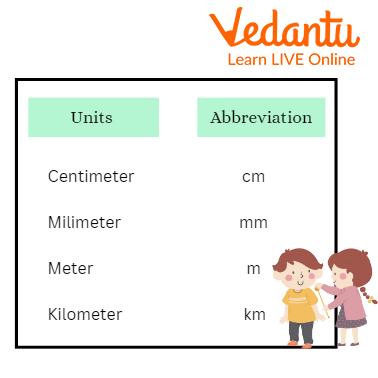
Units of Measuring Length
Below is a table that talks of equivalents of different units of length.
To convert kilometres into metres, one needs to multiply 1000. To convert metres into kilometres, one needs to divide it by 1000.
Tools to Measure Length
To measure the length of any object or article, we require the right tool. If the right tool is not provided, then there might be a change in the result. In the same way, some important tools are required to measure length. These tools are used to measure both long and short lengths.
Some tools to measure length are as follows:-
Ruler
Tapes
Feet/Foot
Yardsticks
metre sticks
Calliper
Micrometre
Roll Meter
Some tools like the roll metre, calliper, metre sticks, and feet/foot are all used to measure long lengths. On the other hand, the smaller lengths are measured using a ruler, micrometre, calliper, and many more.
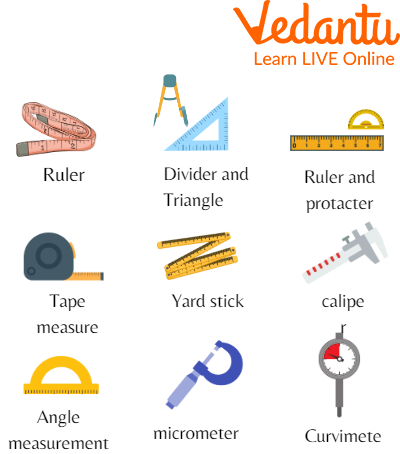
Tools for Measuring Length
Smaller Units of Mass
Many of you might have heard the word ‘mass’. It is the dimensionless quantity that represents the amount of matter in a particle. In the International System, the standard unit of mass is the kilogram (kg).
The two smaller units of mass measurement are kilogram and gram. Interestingly, a milligram is the smallest unit of mass. The prefix ‘kilo’ literally means a thousand on the other hand, ‘milli’ means one-thousandths. The basic unit of mass is the gram and is used in many parts of the world.
The equivalence of different units of mass is given below:
1 kilogram (kg) = 1,000 grams (g)
1 milligram (mg) = 0.001 gram (g)
Here, to convert a bigger unit to a smaller unit, we multiply it by a power of ten. This will further help the decimal move to the right. On the other hand, to convert grams to milligrams, one needs to multiply it by 1000.
In the case of mass, these were some ways to convert bigger units to smaller units.
Now, to convert smaller units to larger units, one needs to divide to the power of ten. This will further help to move the decimal to the left side.
1 mg ÷ 1,000 = 0.001 g
1 g ÷ 1,000 = 0.001 kg

Converting Mass to Other Units Process
Solved Examples
Here are some simple examples to convert a unit of mass or length.
1. Change 7165 kg into quintals.
Ans: We need to calculate 7165 =? Quintals
Since 100 kg = 1 quintal
So, 7165 kg ÷ 100 = 71 quintals 65 kg
Therefore, 7165 kg equals 71 quintals 65 kg.
2. Change 345 cm into m.
Ans: As we need to calculate,
345 cm =? m
Since 1 m = 100 cm
So, 345 cm = 345 ÷ 100 = 3.45 m
Therefore, the result of conversion is 3.45 m.
Practice Questions
1. Fill in the blank:
To convert a larger unit to a smaller unit, we _________.
Ans: Multiply it by powers of 10 or shift the decimal point to the right.
2. Convert 45.65 kg to a gram.
Ans: 45650 g.
3. Change 1000 centimetres to metres.
Ans: 10.
Summary
Mathematics is an interesting subject to study. The calculation and conversion of the metric system make it more interesting for kids. Now, in this article, we are clear on how to convert larger units to smaller units, and smaller into bigger, two smaller units of mass, and smaller units of length. Here, we understand that to convert a larger value to a smaller one, we multiply it by the powers of 10. Some solved examples are also given that illustrate the method of conversion more deeply.
FAQs on Smaller Units of Length in the Metric System
1. What are smaller units of length in Maths?
Smaller units of length are measurement units used to measure very short distances, such as millimetre (mm), centimetre (cm), and micrometre (µm). These units are part of the metric system and are smaller than a metre. For example:
- 1 metre = 100 centimetres
- 1 metre = 1000 millimetres
2. What is the smallest unit of length in the metric system?
The smallest commonly used unit of length in the metric system is the micrometre (µm), though smaller scientific units like nanometres also exist. In basic school Maths, the order of smaller units is:
- 1 cm = 10 mm
- 1 mm = 1000 micrometres (µm)
3. How do you convert metres into centimetres and millimetres?
To convert metres into centimetres and millimetres, multiply by 100 for centimetres and by 1000 for millimetres. The formulas are:
- Metres × 100 = Centimetres
- Metres × 1000 = Millimetres
- 2 × 100 = 200 cm
- 2 × 1000 = 2000 mm
4. How do you convert centimetres into millimetres?
To convert centimetres into millimetres, multiply the number of centimetres by 10. The formula is:
- Centimetres × 10 = Millimetres
- 7 × 10 = 70 mm
5. What is the difference between centimetre and millimetre?
The main difference between a centimetre and a millimetre is their size, where 1 centimetre = 10 millimetres. A centimetre (cm) is larger than a millimetre (mm). For example:
- A small button may measure about 2 cm
- The thickness of a coin may be about 2 mm
6. Can you give an example of measuring using smaller units of length?
Yes, smaller units of length are used to measure short objects like the length of a pencil or the width of a notebook. Example:
- A pencil may be 15 cm long
- The thickness of a book may be 25 mm
7. What is the order of smaller units of length from largest to smallest?
The order of smaller metric units of length from largest to smallest is metre → centimetre → millimetre → micrometre. In numbers:
- 1 m = 100 cm
- 1 cm = 10 mm
- 1 mm = 1000 µm
8. Why do we use smaller units of length?
We use smaller units of length to measure short distances and tiny objects accurately. Measuring a paperclip in metres would give a decimal like 0.03 m, which is less convenient than saying 3 cm or 30 mm. Smaller units like millimetres and centimetres make measurements clearer and more precise.
9. How do you convert millimetres into metres?
To convert millimetres into metres, divide the number of millimetres by 1000. The formula is:
- Millimetres ÷ 1000 = Metres
- 5000 ÷ 1000 = 5 m
10. What are common mistakes when converting smaller units of length?
A common mistake when converting smaller units of length is multiplying or dividing by the wrong power of 10. Important points to remember:
- 1 m = 100 cm (not 10)
- 1 cm = 10 mm
- 1 m = 1000 mm
