








How to Arrange Decimals in Ascending Order with Steps and Examples
Priyansh uses a ruler to cut 3 different size tapes one by one. One is 5.5 inches long, the other is 5.25 inches long and the third and last one is 5.75 inches long. He decides to stick the tape from smallest to largest. The only way to determine the order is to arrange the decimal number from smallest to largest. In this article about decimals, we will learn how to arrange decimal numbers in ascending order.
What is Place Value?
A decimal number is made up of a whole number and a fractional part that is separated by a dot called the decimal point. For example, 4.37 is a decimal number in which 4 is the whole number part and .37 is the fractional part. It should be noted that in a decimal place value chart, the place values of all the digits are shown including the digits before the decimal point and the digits after the decimal point.
Decimal Place Value Chart
If we observe the decimal place value chart, it can be seen that the place values before the decimal start with ones, followed by tens, hundreds, and so on, while the place values after the decimal point start from tenths, followed by hundredths, then thousandths and so on. The place value after the decimal represents the fractional part of the number. For example, the number 0.56 is made up of 5 tenths and 6 hundredths. This can also be written as 0.56 = 0.5 + 0.06. In other words, it means, 0.56 = $\dfrac{5}{10} + \dfrac{6}{100}$.
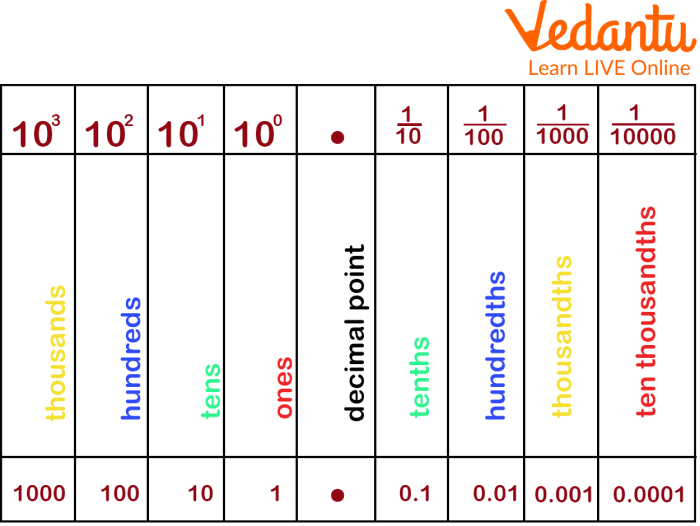
Decimal place value chart
How to Arrange Decimals in Ascending Order?
'When we arrange the decimal number from smallest to the largest order, we say that they are arranged in ascending order.
To arrange the decimals in ascending first we need to compare the decimals.
The following steps will help us to compare the decimal numbers:
Step 1: Obtain the decimal numbers.
Step 2: Now, compare the whole parts of the numbers.
The whole number part with a greater number will be greater. If the whole number of parts is equal, then go to the next step.
Step 3: Compare the digit on the left of the decimal point. Compared to the tens place didn't, the number which is greater than the decimal number will be greater.
For example, in 0.25 and 2.25,
2.25>0.25
Solved Examples
Q1. Which one is bigger, 0.2 or 0.25 ?
Ans: 0.25 is bigger than 0.2 because of an additional 0.05.
We know that,
0.2 = 0.20.
So we can simply conclude that 0.25 is bigger than 0.20 because 25 is bigger than 20.
Q 2. Arrange the following decimals in increasing order or ascending order.
7.7,0.77,0.077, 0.007
Ans: First of all compare the ones digit which is on the left of the decimal point. Here there are 0 and 7 in one's place.
Hence, 7>0
Now, compare the digits after the decimal point.
Here, 7>0 hence 7.7 is the greatest of all the given numbers.
Now let us compare 0.77, 0.077, and 0.007
Here all have '0' in one's place.
Now in 0.77, there is '7' in its tenth place.
In 0.077, there is '7' in its hundredth place.
In 0.007 there is '7' in its hundredth place.
7>0
Hence, 0.77 is greater than 0.077 and 0.007
Now, let us check the hundredth place of 0.077 and 0.007
In 0.007, there is '0' in its hundredth place.
And in 0.077, there is '7' in its hundredth place.
Hence 0.077>0.007
Now arranging all decimals in ascending order we get,
0.007<0.077<0.77<7.7
Q 3. Arrange the following decimal in ascending order.
6.5,6.25, 6.75
Ans:
Step1- First let us add zeros to make the digit numbers equal I.e 6.50,6.25, 6.75
Step2- Now compare the numbers on the left of the decimal point. Here all are 6.
Step3- Now compare the number in tenth place on the right of the decimal point.
Here, at 6.50, '5' is in tenth place.
In 6.25, '2' is in tenth place.
In 6.75, '7' is in tenth place.
Hence, 7> 2 and 5
Hence, 6.75 will be greater than 6.25 and 6.50
Step4- Now compare the tenth place of 6.25 and 6.50
There is '2' in tenth place in 6.25
There is '5' in tenth place in 6.50
5>2
Hence, 6.50>6.25
Hence, 6.75>6.50>6.25
= 6.25<6.50<6.75
Practice Questions
Q 1. Compare the two decimals 0.0987 and 0.987. Which one is greater?
Ans: 0.987>0.0987
Q 2. Express the given decimal number in increasing order.
0.340, 0.745, 0.281
Ans: The decimal number can be arranged in increasing order as follows-
0.281<0.340<0.745
0.281, 0.340, 0.745
Q 3. Arrange 0.02, 0.03, 0.07, 0.05, 0.04 in ascending order.
Ans: 0.02<0.03<0.04<0.05<0.07
Summary
We have collected that Decimal numbers are used in situations where more precision is required than the whole numbers can provide. Decimal numbers help us a lot in day-to-day transactions. When a value is very small or negligible, it takes the form of a decimal number. Or when we convert a fraction by dividing the numerator from the denominator we get a decimal number. This we learned how to compare decimal numbers and also how to arrange them in ascending order.
FAQs on Arrange the Following Decimals in Ascending Order
1. How do you arrange decimals in ascending order?
To arrange decimals in ascending order, compare their place values from left to right and list them from smallest to largest.
Follow these steps:
- Write all decimals in a column.
- Add zeros to make the number of decimal places equal (if needed).
- Compare digits starting from the leftmost place value.
- Arrange them from the smallest value to the largest value.
2. What does ascending order mean in decimals?
Ascending order in decimals means arranging numbers from the smallest value to the greatest value.
In decimal numbers:
- The number with the smaller whole number part is smaller.
- If whole numbers are equal, compare digits after the decimal point.
3. How do you compare decimal numbers with different decimal places?
To compare decimals with different decimal places, add trailing zeros to make them equal in length.
Steps:
- Write numbers vertically.
- Add zeros where necessary (e.g., 0.5 = 0.50).
- Compare digits place by place.
4. Can you give an example of arranging decimals in ascending order?
Yes, arranging decimals in ascending order means listing them from smallest to largest.
Example: Arrange 3.2, 3.02, 3.25, 3.002.
- Write as: 3.200, 3.020, 3.250, 3.002
- Compare place values carefully.
5. Why do we add zeros when arranging decimals?
We add zeros to decimals to make place values equal for easier comparison.
Adding zeros to the right of a decimal does not change its value.
- 0.5 = 0.50 = 0.500
- This helps align digits correctly.
6. How do you arrange negative decimals in ascending order?
To arrange negative decimals in ascending order, remember that numbers farther left on the number line are smaller.
Steps:
- Compare absolute values.
- The number with the larger absolute value is smaller if negative.
7. What is the rule for ordering decimals with the same whole number?
When decimals have the same whole number, compare digits after the decimal point place by place.
Check:
- Tenths place
- Hundredths place
- Thousandths place (if needed)
8. What are common mistakes when arranging decimals in ascending order?
A common mistake when arranging decimals is ignoring place value alignment.
Common errors include:
- Comparing digits without aligning decimal points.
- Thinking 0.5 is greater than 0.45 because 5 > 45.
- Forgetting that 0.50 = 0.5.
9. How do you arrange a mix of whole numbers and decimals in ascending order?
To arrange whole numbers and decimals in ascending order, write whole numbers as decimals and compare normally.
Steps:
- Convert whole numbers (e.g., 3 = 3.0).
- Align decimal points.
- Compare from left to right.
10. How does a number line help in arranging decimals in ascending order?
A number line helps arrange decimals by showing their positions from left (smaller) to right (larger).
On a number line:
- Decimals closer to zero on the right are greater.
- Negative decimals lie to the left of zero.
