








Arithmetic Pattern Formula and How to Find the Nth Term
Are you excited to know what an arithmetic pattern means and how to identify different arithmetic patterns? Yes? Okay! Let’s first learn the meaning of a pattern with examples before knowing about arithmetic patterns.
What Are Patterns?
Patterns are repeated arrangements of numbers, objects, lines, colours, shapes, etc. in a logical way.
Look at the picture below to understand patterns in a better way:

Shape pattern
In the above picture, the pattern followed is:
Triangle – Square – Pentagon, Triangle – Square – Pentagon, Triangle – Square – Pentagon.
Here, all shapes like triangle, square, and pentagon are exactly the same.
Arithmetic Pattern or Algebraic Pattern
Do you want to know the other name of the arithmetic pattern?
Yes!
The other name of the arithmetic pattern is “algebraic pattern.”
Now, let’s learn the meaning of arithmetic pattern or algebraic pattern.
Arithmetic Pattern Meaning
Arithmetic pattern or algebraic pattern is a set of numbers that are arranged in order.
For example:
0, 5, 10, 15, 20, 25
The above set of numbers follows some definite pattern.
Are you excited to know “What pattern it follows”? Let’s learn about the pattern.
Here, we used skip counting by 5 to get the next number.
In other words, we get numbers in pattern by adding ‘5’ to get the next number.

Skip counting by 5
Similarly, a different set of numbers follows a different pattern. Let's learn to identify what different patterns a set of numbers can follow with examples.
Arithmetic Patterns with Examples
Let’s learn different arithmetic patterns with examples:
1. Increasing Sequence
In increasing sequence, numbers in a pattern go on increasing. Suppose, you have one football. Now, if your mother gives you two more footballs, it will become three. Again, you received two more footballs from your brother. Now, the total number of footballs you have is 5 ( 1 + 2 + 2). Here, we have observed that the total number of footballs is increasing with each time you are receiving new footballs.
Look at the below picture to understand the increasing sequence pattern in a better way.

Increasing pattern
2. Decreasing Sequence or Decreasing Pattern
In decreasing sequence, the number in a pattern goes on decreasing. Suppose there are 18 mangoes in the basket. You give three mangoes to each of your friends in the class. The number of mangoes goes on decreasing in the basket each time you give three mangoes to your friend.
Look at the below pattern to understand the decreasing pattern in a better way.
The decreasing pattern is as follows:
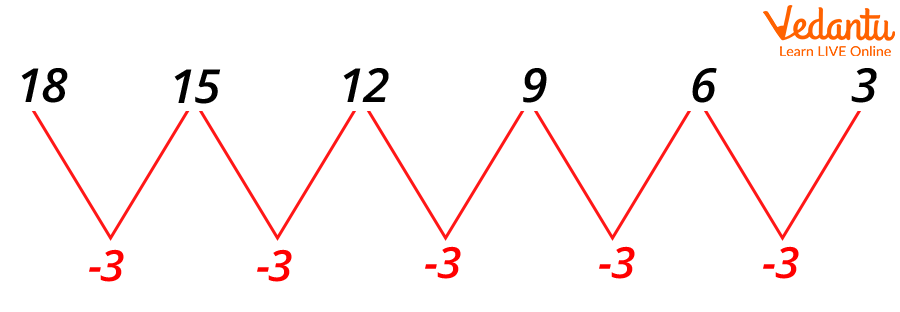
Decreasing pattern
In the pattern 18, 15, 12, 9, 6, 3, we have subtracted ‘3’ each time from the previous number to get the next number.
3. Growing Pattern
In a growing pattern, the number in a pattern increases rapidly. Here, we multiply the previous number with the same value each time to get the next number.
Look at the below picture to understand the growing pattern in a better way.
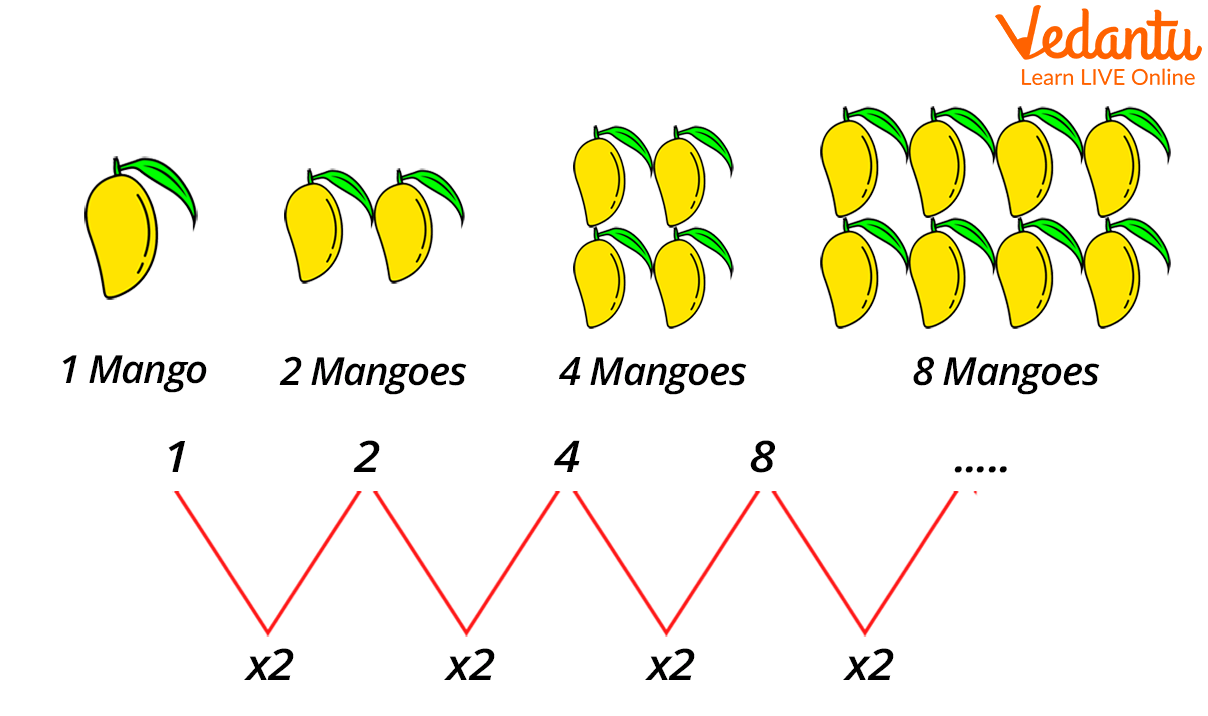
Growing pattern
Here,
The pattern 1, 2, 4, 8….. is formed by multiplying two each time.
4. Triangular Pattern
In a triangular pattern, we add another row of dots and count all the dots to find the next number in a given pattern. Let’s understand with an example:
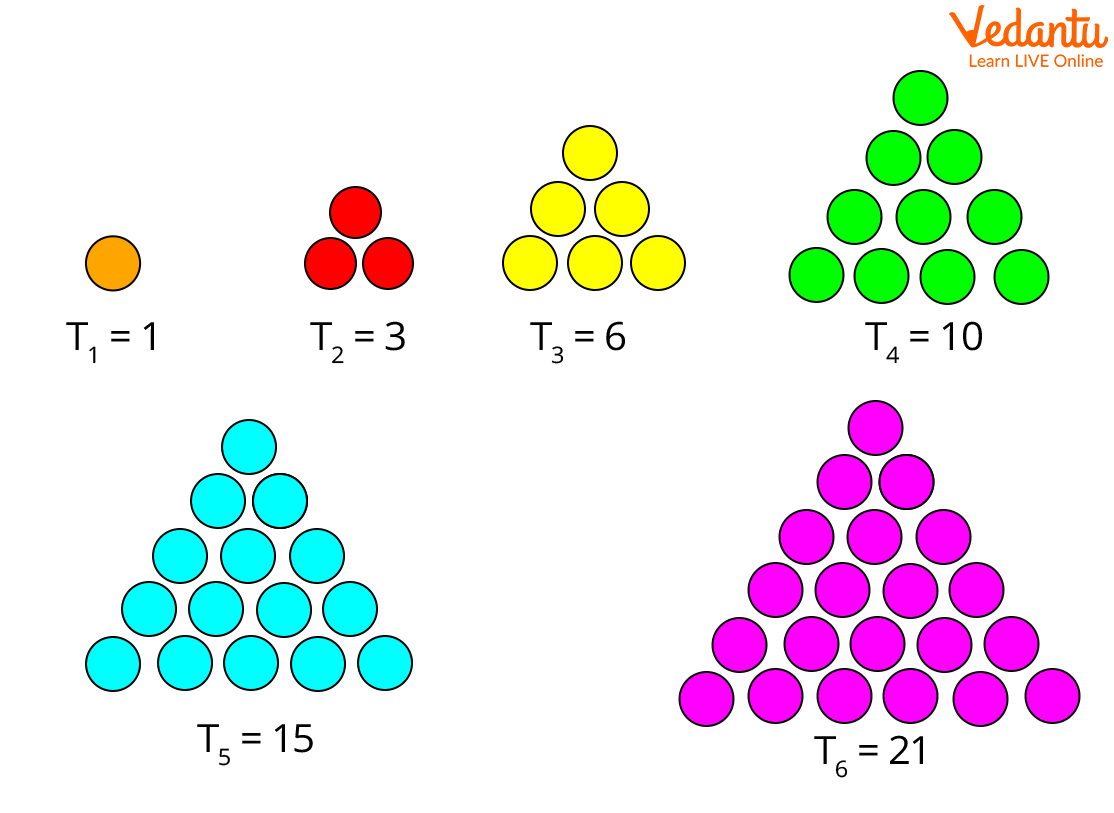
Triangular pattern
Here, the first triangle has only one dot.
In the second triangle, another row is added with 2 extra dots, making 1 + 2 = 3.
In the third triangle, another row is added with 3 extra dots, making 1 + 2 + 3 = 6.
In the fourth triangle, another row is added with 4 extra dots, making 1 + 2 + 3 + 4 = 10.
In the fifth triangle, another row is added with 5 extra dots, making 1 + 2 + 3 + 4 + 5 = 15.
In the sixth triangle, another row is added with 6 extra dots, making 1 + 2 + 3 + 4 + 5 + 6 = 21.
Hence, the pattern here follows: 1, 3, 6, 10, 15, 21….
Conclusion
In short, the arithmetic pattern is the easiest sequence to learn. It creates a string of numbers by adding or subtracting a number from a common difference that relates to one another. For example, the sequence of 3, 5, 7, 9, 12, 14 has a common difference of 2 and the numbers in the sequence are increasing by adding a common difference of 2. If you found this article interesting and wish to read more of such topics, head over to our website and explore from our collection.
FAQs on Understanding Arithmetic Patterns in Math
1. What is an arithmetic pattern in maths?
An arithmetic pattern is a number sequence in which the difference between consecutive terms is constant. This constant value is called the common difference.
- If you add or subtract the same number each time, the sequence is arithmetic.
- Example: 2, 5, 8, 11, 14 (common difference = +3).
- Example: 20, 15, 10, 5 (common difference = −5).
2. What is the formula for an arithmetic sequence?
The formula for the nth term of an arithmetic sequence is aₙ = a + (n − 1)d. Here:
- a = first term
- d = common difference
- n = term number
3. How do you find the common difference in an arithmetic pattern?
The common difference is found by subtracting one term from the next term in the sequence. Steps:
- Take any two consecutive terms.
- Subtract: next term − previous term.
4. How do you find the nth term of an arithmetic pattern?
To find the nth term, use the formula aₙ = a + (n − 1)d. Example:
- Sequence: 4, 9, 14, 19...
- First term (a) = 4
- Common difference (d) = 5
- Find 10th term (n = 10)
5. What is the sum formula for an arithmetic sequence?
The sum of the first n terms of an arithmetic sequence is given by Sₙ = n/2 [2a + (n − 1)d]. Another common form is Sₙ = n/2 (a + l), where l is the last term.
- a = first term
- d = common difference
- n = number of terms
6. Can you give an example of an arithmetic pattern?
An example of an arithmetic pattern is 3, 6, 9, 12, 15. In this sequence:
- Each term increases by 3.
- Common difference (d) = 3.
- First term (a) = 3.
7. What is the difference between arithmetic and geometric patterns?
The main difference is that an arithmetic pattern adds or subtracts a constant number, while a geometric pattern multiplies or divides by a constant number.
- Arithmetic example: 5, 8, 11, 14 (add 3 each time).
- Geometric example: 5, 15, 45, 135 (multiply by 3 each time).
8. How do you know if a sequence is arithmetic?
A sequence is arithmetic if the difference between consecutive terms is always the same. To check:
- Subtract each term from the next term.
- If all differences are equal, it is arithmetic.
9. Can an arithmetic sequence have a negative common difference?
Yes, an arithmetic sequence can have a negative common difference, which means the terms decrease. Example:
- 25, 20, 15, 10, 5
- Common difference (d) = −5
10. Where are arithmetic patterns used in real life?
Arithmetic patterns are used in real life whenever values increase or decrease by a constant amount. Common applications include:
- Saving the same amount of money every month
- Staircase steps increasing evenly
- Calculating simple interest growth
- Uniform salary increments
