








Area of Quadrilateral with Diagonal Formula Derivation and Solved Examples
In this article, we will learn about the general formula for the area of a quadrilateral with a diagonal calculator with the help of many solved examples. As we know that the area of a quadrilateral is the region enclosed by the sides of the quadrilateral. We are already acquainted with the term area.
It is defined as the region that is occupied inside the boundary of an object or figure. Its measurement is done in square units and the standard unit being square meters $\left(\mathrm{m}^2\right)$. Since we know that a polygon with four sides is called a quadrilateral. Hence, we shall learn about finding the area of a quadrilateral with sides and diagonals. A quadrilateral can be a square, rectangle, rhombus, parallelogram or trapezium.
Properties of Quadrilateral
Each of the quadrilaterals discussed above has its properties.
Though, some properties are common to all quadrilaterals.
They are as follows.
They have four sides.
They have four vertices.
They have two diagonals.
The sum of all interior angles is $360^{\circ}$.
Area of Quadrilateral with Diagonal
The formula for the area of the quadrilateral can be found using different methods like dividing the quadrilateral into two triangles, using Heron’s formula or using the sides of the quadrilateral. So now let us discuss all methods in detail.
Area of Quadrilateral by Dividing it into Two Triangles
Consider a quadrilateral PQRS of different lengths; now, let us derive a formula for the area of a quadrilateral.
We can see the quadrilateral as a combination of two triangles, with the diagonal PR being the common base.
$h_{1}$ is the height of PSR and $h_{2}$ is the height of PQR, respectively.

Area of the Quadrilateral with Diagonal
The area of quad PQRS is equal to the sum of the area of triangle PSR and the area of triangle PQR.
Area of triangle PSR $=\frac{(\text { base } \times h e I g h t)}{2}=\frac{\left(P R \times h_1\right)}{2}$ Area of triangle $P Q R=\frac{(\text { base } \times \text { height })}{2}=\frac{\left(P R \times h_2\right)}{2}$
Thus, the area of quadrilateral $P Q R S$ is equal to the Area of triangle $\mathrm{PSR}+$ Area of triangle $\mathrm{PQR}=\frac{P R \times h_1}{2}+\frac{P R \times h_2}{2}=P R\left(\frac{h_1+h_2}{2}\right)$ $=\frac{1}{2} P R \times\left(h_1+h_2\right)$
Hence the area of a general quadrilateral formula is, $=\frac{1}{2} \times$ diagonal $\times($ the sum of the height of two triangles $)$
Area of Quadrilateral with Diagonal Formula
Following are the area of quadrilateral with diagonal:
Solved Questions
Some solved examples based on the area of the quadrilateral with a diagonal calculator are given below:
Q 1. In the quadrilateral, ABCD is shown below, the side BD = 15 cm. The heights of the triangles ABD are 5cm and BCD 7 cm, respectively. Find its area.
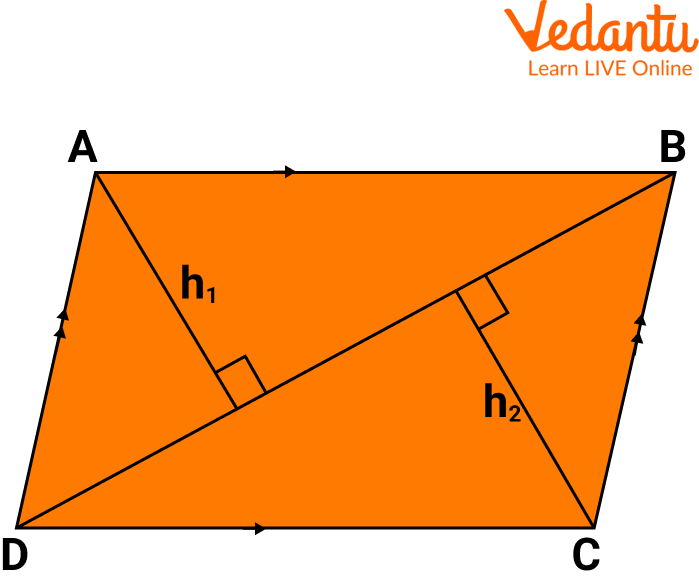
Quadrilateral
Ans:
Diagonal $=\mathrm{BD}=15 \mathrm{~cm}$
Given Heights, $h_1=5 \mathrm{~cm}$ and $h_2=7 \mathrm{~cm}$
Sum of the heights of the triangles $=h_1+h_2=5+7=12 \mathrm{~cm}$
Thus, the area of quadrilateral $A B C D$ is:
$A=12 \times$ diagonal $\times$ (Sum of the height of two triangles)
$=\frac{(15 \times 12)}{2}=90 \mathrm{~cm}^2$
Thus the area of the quadrilateral is $90 \mathrm{~cm}^2$.
Q 2. Find the sides and area of a square when the diagonal is given as $6 \mathrm{~cm}$.
Ans: Let us take a square of side $x$. If the square is divided into two right-angled triangles, then the hypotenuse of each triangle is equal to the diagonal of the square. As given, the diagonal is equal to $6 \mathrm{~cm}$.
According to Pythagoras's theorem,
$x^2+x^2=6^2$
$2 x^2=36$
$x^2=18$
$x=\sqrt{18}$
$x=3 \sqrt{2}$ units
To find the area of a square when a diagonal is given, we can use any of the below methods:
$\text { Area of a square }=\text { side } \times \text { side }=3 \sqrt{2} \times 3 \sqrt{2}$
$=9 \times 2=18 \mathrm{~cm}^2$
Practice Questions
Q1. Calculate the area of a quadrilateral with the given measurements:
Perpendicular heights = 60 m and 20 m, Diagonal = 50 m
Solution: Area $=2000 \mathrm{~m}^2$
Q2. A quadrilateral has four equal sides each of length $4 \mathrm{~cm}$. Find its area?
Solution. Area $=16 \mathrm{~m}^2$
Q3. The length of a quadrilateral (rectangle) is $6 \mathrm{~m}$ and the breadth is $5 \mathrm{~m}$. Find the area of the rectangle.
Solution: Area $=30 \mathrm{~m}^2$
Summary
In this article, we have discussed the area of quadrilaterals with a diagonal formula for different types of quadrilaterals. These formulas help you to calculate the area of a rectangle, square, parallelogram, rhombus, and trapezium. We have also discussed the area of the quadrilateral with a diagonal calculator. A quadrilateral can also be divided into two triangles, calculating the area of each triangle given its vertices, and then adding these values to get the required total area of the quadrilateral with sides and diagonals.
FAQs on Area of Quadrilateral Using a Diagonal
1. What is the formula for the area of a quadrilateral using a diagonal?
The area of a quadrilateral using a diagonal is the sum of the areas of the two triangles formed by the diagonal. If diagonal d divides the quadrilateral into two triangles with heights h₁ and h₂, then:
Area = (1/2) × d × (h₁ + h₂)
This works because:
- Each triangle has area = (1/2) × base × height.
- The diagonal acts as the common base.
- The total area is the sum of both triangle areas.
2. How do you find the area of a quadrilateral when one diagonal and perpendicular distances are given?
To find the area, use Area = (1/2) × diagonal × (sum of perpendicular distances).
Steps:
- Take the given diagonal length d.
- Add the perpendicular distances from the other two vertices to the diagonal (h₁ + h₂).
- Multiply: Area = (1/2) × d × (h₁ + h₂).
3. Why does a diagonal help in finding the area of a quadrilateral?
A diagonal helps because it divides a quadrilateral into two triangles, making the area easier to calculate.
Since:
- The area of a triangle is known: (1/2) × base × height.
- The diagonal acts as a common base.
- The total quadrilateral area equals the sum of both triangle areas.
4. What is the area of a quadrilateral if both diagonals and the angle between them are known?
If both diagonals and the angle between them are known, the area is Area = (1/2) × d₁ × d₂ × sinθ.
Where:
- d₁ and d₂ are the diagonals.
- θ is the angle between them.
5. How do you calculate the area of an irregular quadrilateral using a diagonal?
To calculate the area of an irregular quadrilateral, divide it into two triangles using a diagonal and add their areas.
Steps:
- Draw a diagonal between opposite vertices.
- Find the area of each triangle using (1/2) × base × height or Heron’s formula.
- Add both triangle areas.
6. What is the area of a rhombus using diagonals?
The area of a rhombus using diagonals is (1/2) × d₁ × d₂.
Where:
- d₁ and d₂ are the lengths of the diagonals.
- The diagonals intersect at right angles.
7. Can you find the area of a quadrilateral with only one diagonal?
Yes, you can find the area with one diagonal if the perpendicular distances from the other two vertices to the diagonal are known.
The formula is:
Area = (1/2) × diagonal × (h₁ + h₂)
Without the heights or additional information, one diagonal alone is not enough to determine the area.
8. What is the difference between the area formula using one diagonal and two diagonals?
The difference is that one formula uses heights while the other uses the sine of the angle between diagonals.
- With one diagonal: Area = (1/2) × d × (h₁ + h₂).
- With two diagonals: Area = (1/2) × d₁ × d₂ × sinθ.
9. How do you find the area of a kite using its diagonals?
The area of a kite is (1/2) × d₁ × d₂ because its diagonals are perpendicular.
Steps:
- Measure both diagonals.
- Multiply them.
- Divide by 2.
10. What are common mistakes when finding the area of a quadrilateral using a diagonal?
Common mistakes include using the wrong height or forgetting to add both perpendicular distances.
- Using side length instead of perpendicular height.
- Forgetting to add h₁ + h₂ when using one diagonal.
- Not using sinθ when applying the two-diagonal formula.
- Missing the 1/2 factor in the formula.
