








How to Find Prime Factors by Division Method Step by Step with Solved Examples
Prime factorization is a method to find the prime factors of the given number with the help of different composite numbers. We know that a composite number has more than two factors; so this method is applicable for all the composite numbers.
For example:
5 is a prime number which has two factors 5×1, whereas a composite number has more than two factors present in it. For example 15 has three factors such as 1×3×5.
Prime Factorization by Division Method
We know that there are two different methods of prime factorization:
Division Method
Factor Tree Method
We can hear discussion about the division method. In this method we will divide the large number to the small prime numbers to find the factors. In other words we can say that the division method is used to find out the prime factors of a large number by dividing the number by different prime numbers.
Division by Primes
In the prime factorization method we have to divide the large number with the small prime numbers. This method is known as the division method. For example 60 is a composite number and we have to find its prime factors. So we have different methods but we have to divide with the prime number,
60 = 2×2×3×5
Prime Factorization Steps
These are the steps of prime factorization
Divide the given number by the smallest prime numbers ( in this case we have to find the smallest prime number which can divide the number exactly).
Again divide the quotient by the smallest prime number (it can be the same or a different prime number).
Repeat the procedure until the quotient becomes 1.
At the end multiply all the prime factors. ( One thing we have to remember is that the product is the number itself).
Prime Factors of 16
First of all 16 is a composite number and we have to find its prime factors;
As we consider it to be the smallest prime number.
We get 8 and again by 2
Then we get 4 again we dividing by 2
Then we get 2 again dividing by the smallest prime number 2.
We get a quotient as 1.
16=2×2×2×2
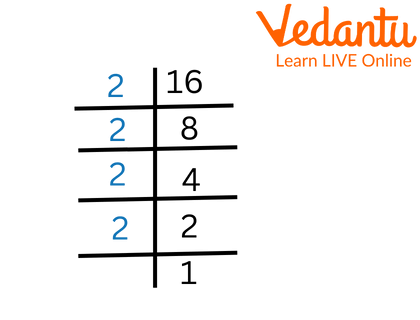
Prime Factorization of 16
How to Get Prime Factorization
We can get prime factorization by using the both methods; 1) factor tree method, 2) division method. These methods help us to get the prime factorization.
For example:
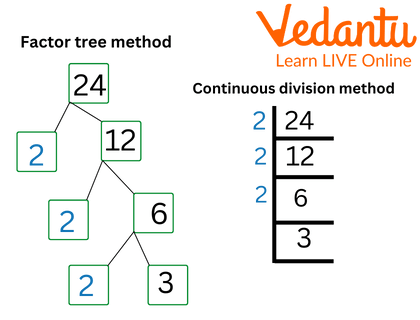
Factor Tree Method and Continuous Method
Solved Examples
1. What is the prime factorization of 90.
Solution:
Step 1: divided by the smallest prime number 2
90÷2 = 45
Step 2: divided by 3
45÷3 = 15
Step 3: divided by 3
15÷3 = 5
Step 4: divided by 5
5÷5 = 1
Ans. 2×3×3×5= 90
Solved Questions
1. Find the prime factors of 40.
Solution
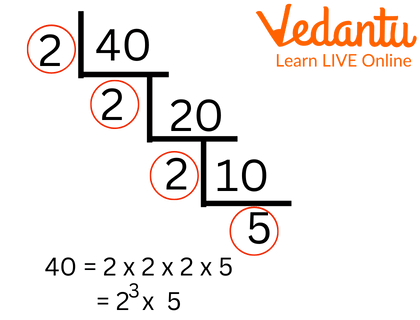
Prime Factorization of 40.
Ans. 2×2×2×5 = 40
2. Find prime factorization of 24.
Solution:
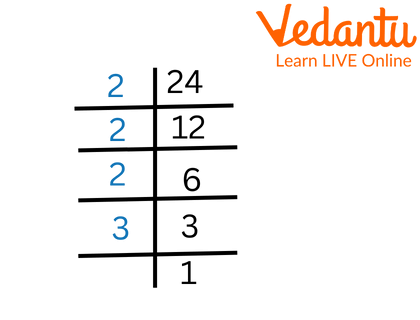
Prime Factorization of 24
Ans. 24=2×2×2×3
Summary
In this article we learn about the different types of prime factorization, mainly we learn about the division method by prime factorization and its rules or steps. The most important uses of prime factorization are cryptography, HCF and LCM. Prime factorization is really helpful for us.
FAQs on Prime Factorization Using the Division Method
1. What is prime factorization by division method?
Prime factorization by division method is a process of expressing a number as a product of its prime factors by repeatedly dividing it by the smallest possible prime numbers. In this method:
- Start with the smallest prime number, 2.
- Divide the given number by 2 as long as possible.
- Move to the next prime number (3, 5, 7, 11, …).
- Continue dividing until the quotient becomes 1.
2. How do you do prime factorization using the division method?
To do prime factorization using the division method, divide the number repeatedly by the smallest prime numbers until you reach 1. Follow these steps:
- Step 1: Write the number and divide it by 2 if possible.
- Step 2: Keep dividing by 2 until it is no longer divisible.
- Step 3: Move to the next prime number (3, 5, 7, …).
- Step 4: Continue the process until the quotient becomes 1.
3. What is an example of prime factorization by division method?
An example of prime factorization by division method is finding the prime factors of 60.
- 60 ÷ 2 = 30
- 30 ÷ 2 = 15
- 15 ÷ 3 = 5
- 5 ÷ 5 = 1
4. Why do we start dividing by 2 in the division method?
We start dividing by 2 because it is the smallest prime number and ensures we break the number into prime factors in increasing order. Starting from 2:
- Makes the method systematic and organized.
- Prevents missing any smaller prime factors.
- Ensures accurate and complete prime factorization.
5. What is the difference between prime factorization and factorization?
The difference is that factorization includes all factors, while prime factorization includes only prime numbers as factors.
- Factorization: Breaking a number into any multiplication form (e.g., 12 = 3 × 4).
- Prime factorization: Breaking a number into only prime numbers (e.g., 12 = 2 × 2 × 3).
6. Can prime factorization be done for any number?
Prime factorization can be done for any composite number, but not for 1.
- Composite numbers (like 18, 24, 100) can be expressed as products of prime numbers.
- Prime numbers (like 7, 13) have only two factors, so their prime factorization is the number itself.
- The number 1 has no prime factorization.
7. What is the prime factorization of 36 using the division method?
The prime factorization of 36 using the division method is 2² × 3².
- 36 ÷ 2 = 18
- 18 ÷ 2 = 9
- 9 ÷ 3 = 3
- 3 ÷ 3 = 1
8. How is prime factorization by division method useful in finding HCF and LCM?
Prime factorization by division method helps find HCF and LCM by comparing prime factors of numbers.
- For HCF (Highest Common Factor): Take the smallest powers of common prime factors.
- For LCM (Least Common Multiple): Take the highest powers of all prime factors.
HCF = 2 × 3 = 6
LCM = 2² × 3² = 36.
9. What are common mistakes in prime factorization by division method?
Common mistakes in prime factorization by division method include skipping prime numbers or stopping before reaching 1.
- Not starting from the smallest prime number (2).
- Dividing by a composite number instead of a prime.
- Forgetting to write repeated prime factors.
- Stopping before the quotient becomes 1.
10. Is there a formula for prime factorization by division method?
There is no single formula for prime factorization by division method, but every number can be written in the form N = p₁a × p₂b × p₃c. Here:
- p₁, p₂, p₃ are prime numbers.
- a, b, c are positive integers.
