








What Are Addition Facts in Class 2 with Solved Examples and Practice Questions
Addition is the process of adding two or more items together. In math, addition is the method of calculating the sum of two or more numbers. It is a primary arithmetic operation that is used commonly in our day-to-day life. Solving addition facts worksheets to memory helps speed up Maths tasks and also helps the brain to focus on other math processes. So let’s learn more about these addition facts for class 2 and the addition facts chart with the help of addition facts examples.
What are Addition Facts?
An addition fact is the sum of two specific addends (a number that is added to another) that will always be equal to the same result. For example, 3 + 2 will always be equal to 5. It follows some patterns to add two numbers and write their sum aside.
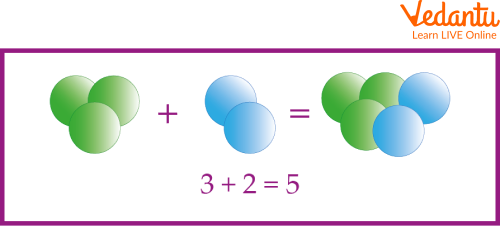
Addition of 3 and 2
Here are some examples of addition facts:
7 + 4 = 11 (the addition fact is 11)
3 + 6 = 9 (the addition fact is 9)
11 + 3 = 14 (the addition fact is 14)
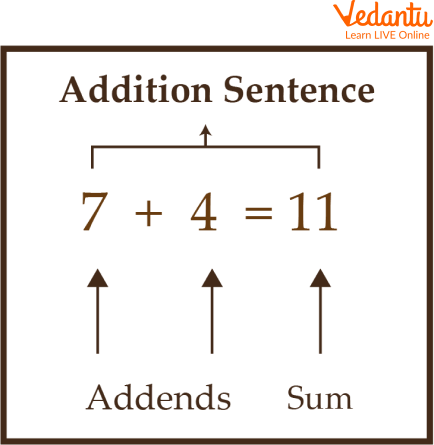
Addition Facts Examples
How to Write Addition Facts for Class 2?
You can write addition facts by writing out addition calculations. For example:
4 + 11 = 15
21 + 8 = 29
30 + 14 = 44
Addition facts can also be written by different methods of addition. For example, you can add small numbers by using your fingers.
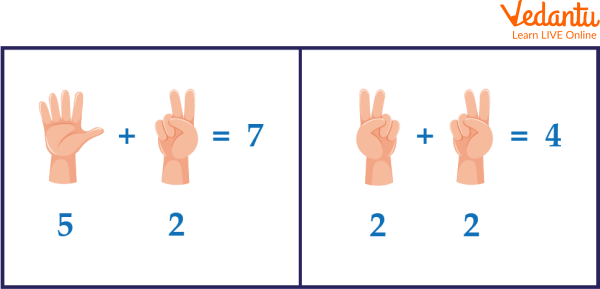
Finger Counting
We can also use the number line to add. For example, To add 5 and 7, we can count forward 7 steps from 5, as shown below.
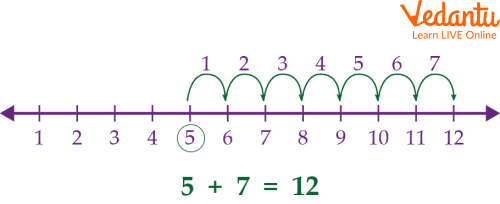
Number Line
How to Learn Addition Facts Chart?
One of the best ways to learn addition facts is through practicing since it helps children to form a good and strong memory of addition facts.
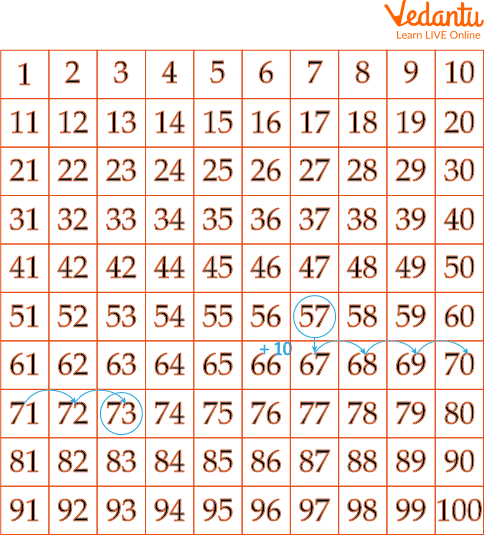
Addition Facts Chart
A facts chart is a good way to learn addition sums. For example, Add 57 and 16 using addition facts charts.
Step 1: Locate the bigger number (57).
Step 2: If the number that should be added (16) is more than 10, break it into tens and ones, 16 = 10 + 6.
Step 3: Jump as many 10s as in the second number, 57 + 10 = 67.
Step 4: Move forward as many ones as in the second number, 67 + 6 = 73.
So, the sum of 57 and 16 is 73.
Solved Addition Facts Examples
Q1. If a bag has 6 balls and 7 more balls are added to it, how many balls are there in the bag?
Ans: Originally, there were 6 balls in the bag. Now 7 more balls have been added.
The number of balls in this bag is now 6 + 7 = 13.
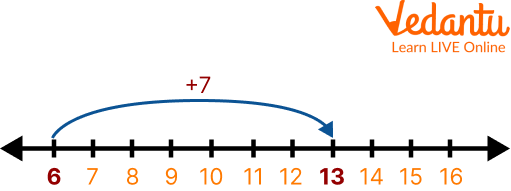
Adding 6 and 7
Therefore, the bag has 13 balls.
Q2. The present age of Tanvi is 7 years. What will be her age after 10 years?
Ans: Current age of Tanvi is 7 years.
To find Tanvi’s age after 10 years, add 10 to her current age.
After 10 years, her age would be 7 + 10 or 17 years old.
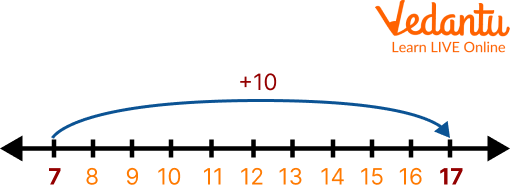
Adding 7 and 10
Thus the age after 10 years is 17 years.
Q3. Garvita bought a bag for 300Rs and some books for 100Rs. How much did she spend on both?
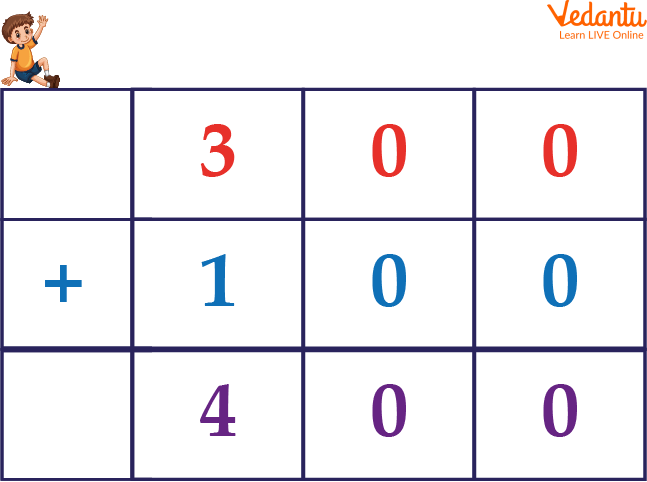
Addition of 300 and 100
Ans: To find the total cost, add 300 and 100.Thus Garvita has spent 400 Rs.
Practice Questions
Q1. Find the total number of balls in the figure.

Balls
Ans. 15.
Q2. What is the sum of 500 and 127?
Ans. 627.
Q3. Add the numbers and depict the correct sum on the number line.
3 + 6 =?
Ans. 9.
Addition Facts Worksheets
Below given are the addition facts worksheets, which help the students to evaluate their learning of the addition facts.

Addition Facts Worksheets
Summary
In this article, we learned about what are addition facts and some basic facts that are needed for adding two numbers such as the number line and number grid methods and that one of the best ways to learn an addition facts chart is through practising since it helps children to form a good and strong memory of addition facts.
We also learned about how to write and learn addition facts. Some solved and unsolved addition facts examples are also given. Addition facts worksheets serve as a useful tool in evaluating the progress of students.
FAQs on Addition Facts for Class 2 Explained Simply
1. What are addition facts for Class 2?
Addition facts for Class 2 are basic number combinations that help children quickly add two numbers, usually within 20 or 100. These facts help students solve sums mentally and improve speed in Maths.
- Examples: 3 + 4 = 7, 8 + 5 = 13
- They include single-digit and two-digit addition.
- They build a strong foundation for bigger calculations in higher classes.
2. What is the formula for addition?
The formula for addition is Addend + Addend = Sum. In addition, the numbers being added are called addends, and the result is called the sum.
- Example: In 6 + 9 = 15
- 6 and 9 are addends.
- 15 is the sum.
3. How do you solve addition sums for Class 2?
To solve addition sums for Class 2, add the numbers place by place starting from the ones place. This method is called column addition.
- Step 1: Write numbers in columns (ones under ones, tens under tens).
- Step 2: Add the ones digits.
- Step 3: Add the tens digits.
- Example:
23 + 14
Ones: 3 + 4 = 7
Tens: 2 + 1 = 3
Answer: 37
4. What are basic addition facts up to 20?
Basic addition facts up to 20 are simple sums where the total is 20 or less. These facts help children do mental Maths quickly.
- 5 + 5 = 10
- 7 + 8 = 15
- 9 + 6 = 15
- 10 + 9 = 19
5. What is the commutative property of addition?
The commutative property of addition states that changing the order of numbers does not change the sum. In simple words, you can add numbers in any order.
- Formula: a + b = b + a
- Example: 4 + 7 = 7 + 4 = 11
6. What is the associative property of addition?
The associative property of addition states that the way numbers are grouped does not change the sum. You can change the brackets without changing the answer.
- Formula: (a + b) + c = a + (b + c)
- Example: (2 + 3) + 4 = 2 + (3 + 4) = 9
7. How do you add two-digit numbers without carrying?
To add two-digit numbers without carrying, add the ones and tens separately when their sum is less than 10 in each place. No regrouping is needed.
- Example: 24 + 35
- Ones: 4 + 5 = 9
- Tens: 2 + 3 = 5
- Answer: 59
8. How do you add two-digit numbers with carrying?
To add two-digit numbers with carrying, add the ones first and carry over when the sum is 10 or more. This process is also called regrouping.
- Example: 27 + 18
- Ones: 7 + 8 = 15 (write 5, carry 1)
- Tens: 2 + 1 + 1 (carried) = 4
- Answer: 45
9. What is the identity property of addition?
The identity property of addition states that adding zero to any number gives the same number. Zero does not change the value.
- Formula: a + 0 = a
- Example: 9 + 0 = 9
10. Why are addition facts important for Class 2 students?
Addition facts are important for Class 2 students because they build speed, accuracy, and confidence in solving Maths problems. Knowing addition facts helps in mental Maths and solving word problems.
- Improves quick calculation skills.
- Helps in learning subtraction and multiplication later.
- Makes solving larger sums easier.
