








How To Add And Subtract Decimals With Step By Step Examples
How Can We Add and Subtract Decimals?
We are familiar with the addition and subtraction of the whole numbers but what about the addition and subtraction of decimals? We are going to learn the same in this discussion on how we can add and subtract the decimal numbers.
The addition and subtraction of decimals involve a specific sequence of operations which we are going to learn in this study.
What is a Decimal Number?
What is a decimal number? Let us give a quick revision.
A decimal is a number that has a denominator with a power of 10, like the fraction 4/10, which can be written in another format like 0.4.
The dot in the decimal number is called the ‘decimal point’.
The number which is on the right side of the decimal point is the numerator in the fractional form while the number which is on the left of the decimal point is the denominator in the fractional form.
Also, the number which is on the left side of the decimal is the whole number in the fraction.
This decimal point separates the whole number from the fractional number.
Learn the Subtraction and Addition of Decimals
Addition and subtraction of decimals are as easy as adding and subtracting the whole numbers, only that you are required to know a few detailed steps before doing so. Let us proceed on to the steps of subtraction and addition of decimals, after which we will practice some examples with solutions.
Steps to Add or Subtract the Decimals
First, we have to convert the decimals to like decimals by adding zeros in places where there is no number. But what are ‘Like decimals’? Like decimals are those decimals that have the same number of digits after the decimal point.
Then we have to place the decimals one below the other one which will be according to the places of the digit.
Add or subtract from right to left.
In answer, place the decimal point under the decimal point.
Let us Solve
Now let us solve some problems related to the decimals.
1. Add - 23.45, 13.101, and 345.5
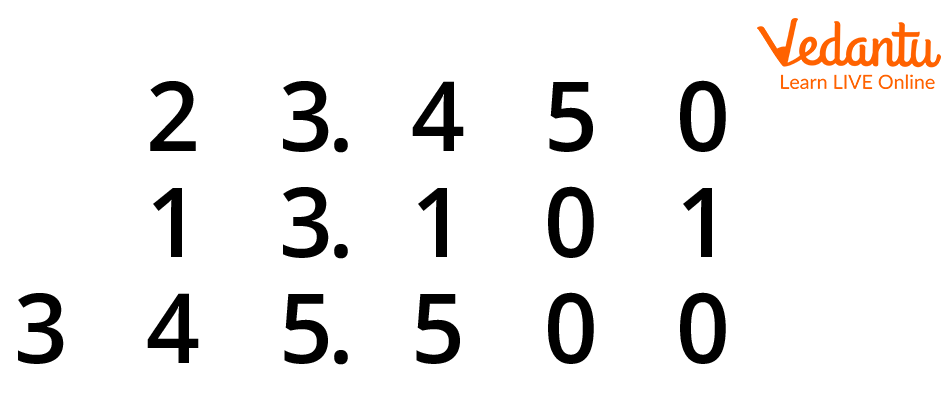
Solution: Firstly convert the decimal to like decimal form. We see that the highest decimal place is 3 so we add the zeroes in the rest and get the 3 decimal places in them equally.
In the picture given below, we will see how the decimal is being lined up.
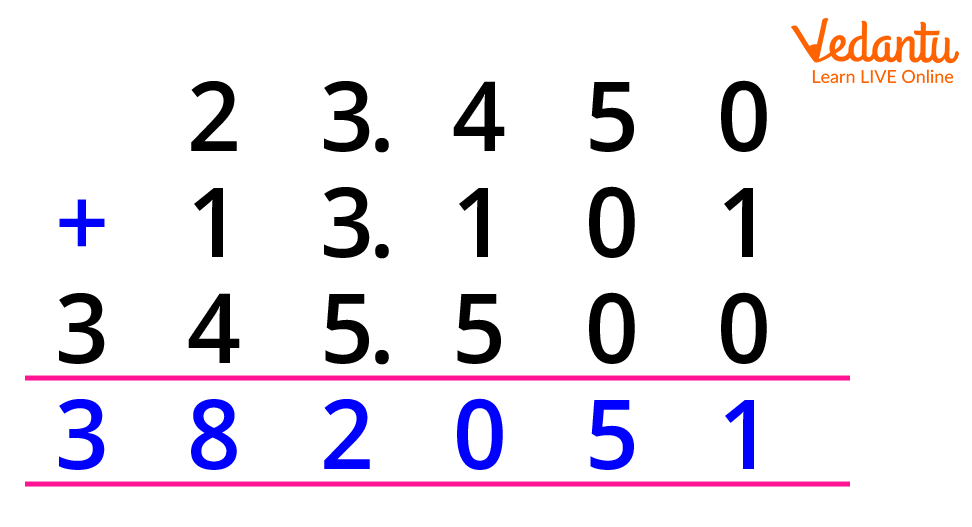
Now, we have to add the decimals, the image is shown below:
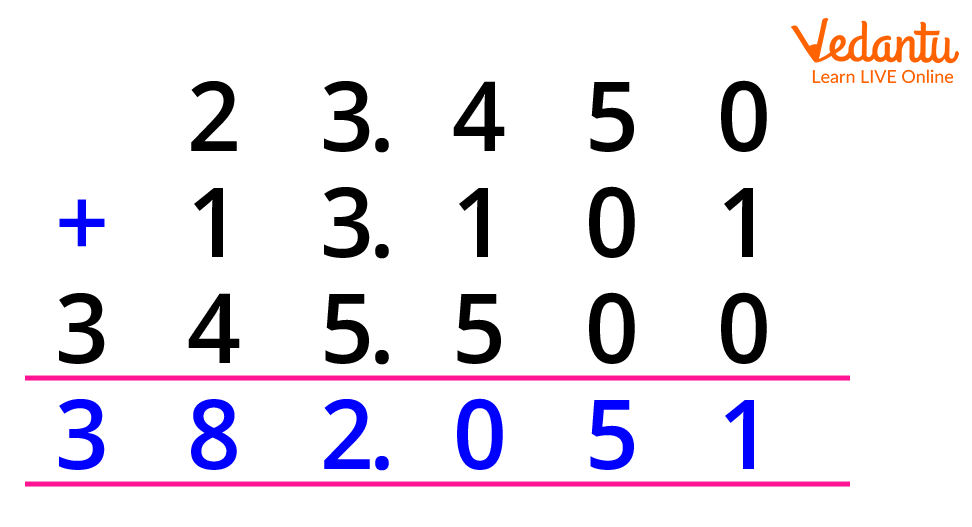
Now at the end, place the decimal point in the answer according to the question.
2. Rekha had a 25 m of red ribbon. She uses 8 m and 13 cm to decorate a gown with it. How much ribbon is still remaining with Rekha?
Solution:
Length of the ribbon Rekha had = 25 m = 25.00 m
Length of the ribbon used by Rekha = 8 m 13 cm = 8.13 m
The remaining length of the ribbon Rekha still has = 25.00 – 8.13 = 16.87m
Thus, 16.87m ribbon is still remaining with Rekha.
How are Decimals Used in Real Life?
In our daily life, we apply the addition and subtraction of decimals in these activities:
Money
Measurements
Temperature
Did You Know?
The term ‘decimal’ originated in the 17th century from a Latin word which was known as ‘decimus’ meaning ‘tenth’.
We use the decimal system when we desire a precise and exact answer.
The addition and subtraction of decimals can be mastered by practicing more sums on the same concept. The students are required to first understand the placement of the decimal point and thus they can easily add or subtract decimals thereafter.
FAQs on Addition And Subtraction Of Decimals Explained Clearly
1. What is addition and subtraction of decimals?
Addition and subtraction of decimals is the process of combining or taking away decimal numbers by aligning their decimal points correctly. In decimal arithmetic, place value is very important.
- Write the numbers vertically.
- Align the decimal points.
- Add or subtract as with whole numbers.
- Place the decimal point in the answer directly below the others.
2. How do you add decimals step by step?
To add decimals, you line up the decimal points and then add as you would with whole numbers. Follow these steps:
- Arrange numbers vertically with decimal points aligned.
- Add zeros if needed to make equal decimal places.
- Add from right to left.
- Bring down the decimal point into the sum.
3. How do you subtract decimals correctly?
To subtract decimals correctly, align the decimal points and subtract digit by digit from right to left. Steps include:
- Write numbers in column form.
- Align decimal points.
- Add zeros if necessary.
- Subtract as with whole numbers.
4. Why is it important to line up decimal points when adding or subtracting?
It is important to line up decimal points to ensure digits with the same place value are added or subtracted correctly. Misalignment can mix tenths, hundredths, and whole numbers, leading to incorrect results. For example, 3.2 + 0.45 must be written as 3.20 + 0.45 to get 3.65.
5. Can you add decimals with different numbers of decimal places?
Yes, you can add decimals with different decimal places by adding trailing zeros to make the places equal. Steps:
- Align decimal points.
- Add zeros where needed.
- Perform the addition.
6. What are common mistakes in adding and subtracting decimals?
The most common mistake in decimal addition and subtraction is not aligning the decimal points correctly. Other common errors include:
- Forgetting to add zeros as placeholders.
- Misplacing the decimal point in the final answer.
- Making borrowing errors during subtraction.
7. How do you subtract decimals with borrowing?
To subtract decimals with borrowing, regroup from the next left digit just as in whole-number subtraction while keeping decimal points aligned. Example:
- Subtract 4.20 − 1.85.
- Borrow in the hundredths place.
- Complete subtraction carefully.
8. What is an example of adding and subtracting decimals in real life?
Adding and subtracting decimals is commonly used in money calculations, measurements, and shopping totals. For example:
- If an item costs $12.75 and you buy another for $3.50, total = 12.75 + 3.50 = 16.25.
- If you pay $20.00, change = 20.00 − 16.25 = 3.75.
9. How do you check your answer when adding or subtracting decimals?
You can check decimal addition by subtracting the sum from one addend, and check subtraction by adding the difference to the subtrahend. For example:
- If 2.4 + 1.6 = 4.0, check: 4.0 − 1.6 = 2.4.
- If 5.5 − 2.2 = 3.3, check: 3.3 + 2.2 = 5.5.
10. Do the rules for adding and subtracting decimals differ from whole numbers?
The rules are similar to whole numbers, but decimals require careful alignment of the decimal point. The key difference is:
- Whole numbers align by place value automatically.
- Decimals must have decimal points lined up.
- Zeros may be added as placeholders.
