








How to Multiply 3 Digit Numbers Using Standard Algorithm with Examples
3-digit multiplication involves multiplying 3-digit numbers with 1-digit, 2-digit, and 3-digit numbers by placing them at their correct place values. This multiplication goes difficult with 2 and 3-digit numbers. However, multiplying 3-digit with 1-digit is quite simple.
Therefore, in this article, we will learn about 3-digit with 1-digit multiplication, 3-digit with 2-digit multiplication, and 3-digit with 3-digit multiplication along with regrouping and without regrouping numbers. We will understand these through detailed steps and solve examples so you can have a good grasp of concepts and solve questions easily.
Further, this article will help you score good marks in this chapter and improve your grades.
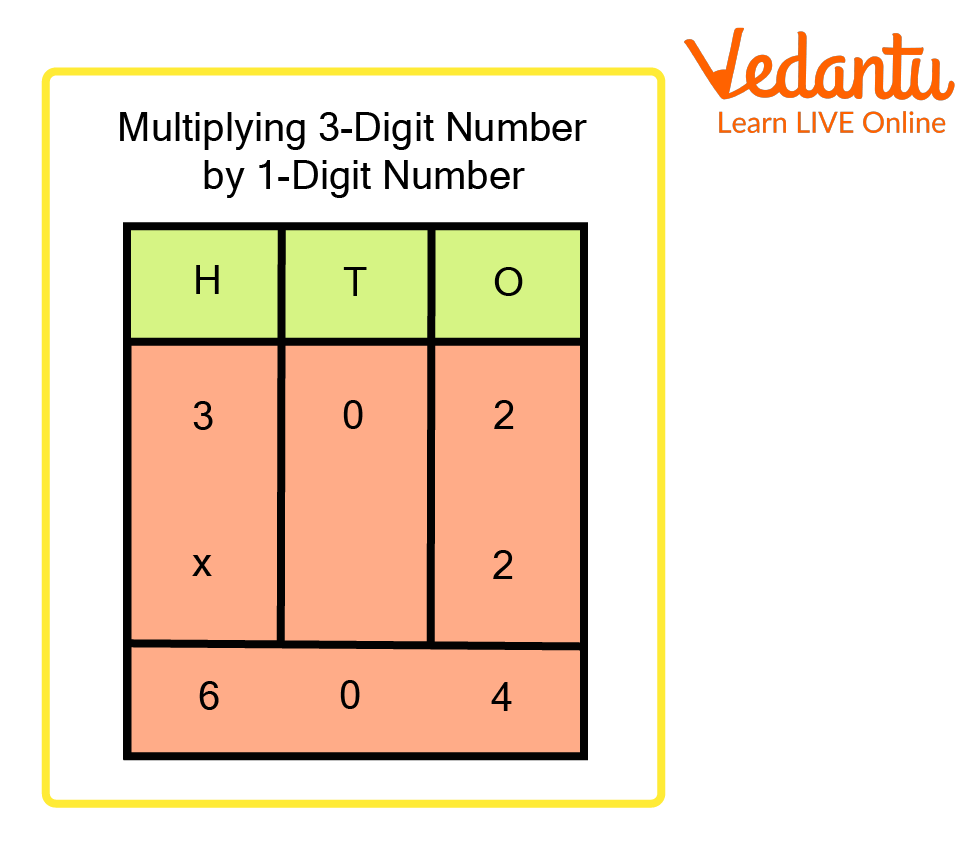
3-Digit Multiplication with 1-Digit
What is 3-Digit Multiplication?
It is a method of multiplying 3-digit numbers with other numbers. During the multiplication, the numbers are arranged in the columns as per their place values. The 3-digit numbers are arranged according to their place values as ones, tens, and hundreds.
While multiplying the two sets of digits, the larger number is kept on the top and the smaller number is placed below it. The number placed on top is called the multiplicand and the number placed below is called the multiplier.
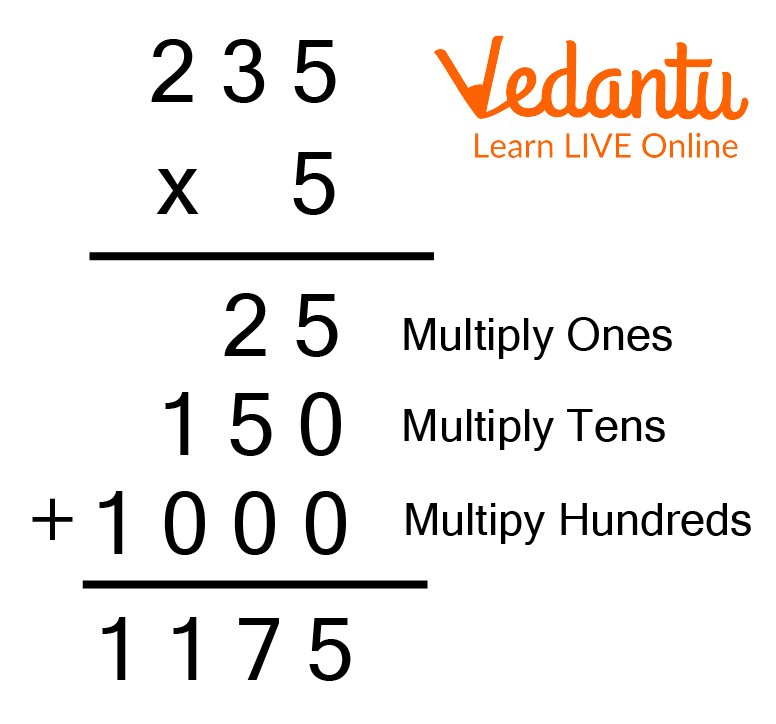
An Example of 3-Digit Multiplication
After arranging the numbers according to their place values, the multiplier is multiplied by all the digits of the multiplicand one by one starting from the left. Firstly, the one digit is multiplied, followed by the tens digit, and then the hundreds digit. Thus, the product obtained is the final result.
Let us understand this with some multiplication examples.
Example 1 – When we multiply 211 by 3, we get 633.

Multiplication of 211 by 3
Let us now understand how to do this multiplication with other numbers.
Multiplication of a 3-Digit By a 1-Digit Number
In this type of multiplication, there are two cases:
3-Digit Multiplication without Regrouping – In this multiplication, the 1-digit number is simply multiplied by the 3-digit number without any carry-overs.
For example –Multiply 314×2

Multiplication of 314 by 2
3-Digit Multiplication with Regrouping – It is multiplication in which the 3-digit number is multiplied by the 1-digit number using the carry-overs.
For example – Multiply 315×2

Multiplication of 315 by 2
Multiplication of a 3-Digit By a 2-Digit Number
In this type of multiplication (3-digit), we multiply the digits by placing the 3-digit on the top and the 2-digit number below it. This multiplication is also performed with regrouping and without regrouping.
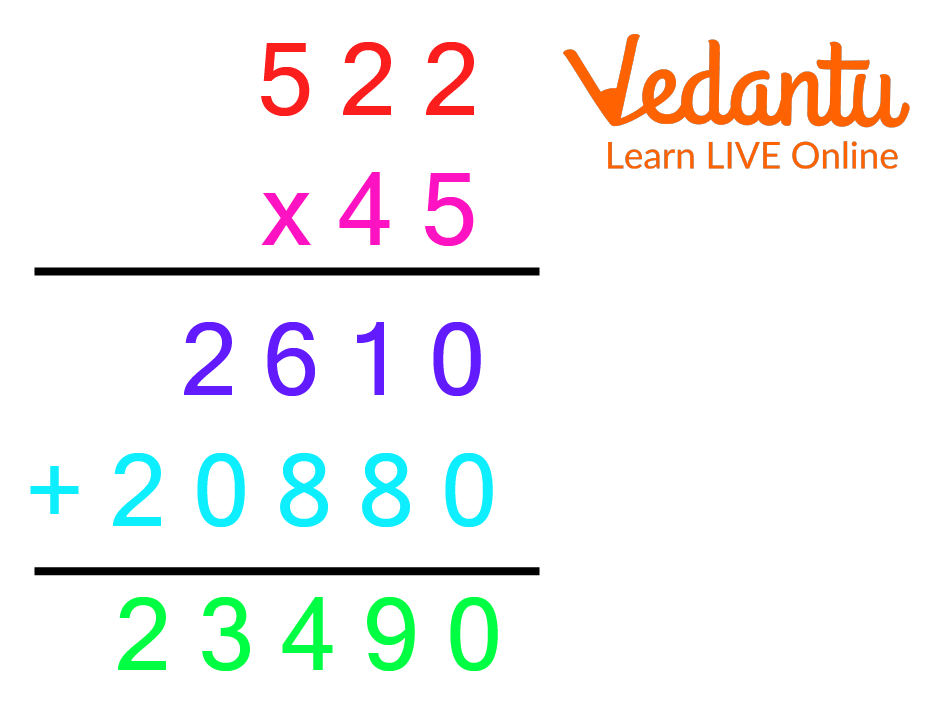
An Example of 3-Digit Multiplication with 2-Digit
During the multiplication of a 3-digit number by a 2-digit number, the one digit of the multiplier is multiplied with the multiplicand. Then, zero is placed under the one digit of the number obtained. After this, the tens digit of the multiplier is multiplied with the multiplicand. Then, both these products are added to get the final result.
Let us discuss this through examples.
Example 1 – Multiply 511×21

Multiplication of 511 by 21
Example 2 – Multiply 213×14
It is a 3-digit multiplication with regrouping

Multiplication of 213 by 14
Multiplication of a 3-Digit By a 3-Digit Number
Before doing multiplication, arrange the numbers according to their place values. Firstly, the one digit of the multiplier is multiplied by the multiplicand, followed by the tens digit, and then the hundreds digit.
The products so obtained will get added to obtain the final product. The method of this multiplication is the same as the previous one.
Let us discuss some multiplication sums with answers to understand this.
Example 1 – Multiply 311×123

Multiply 311 by 123
Here two zeroes are placed under ones and tens digit.
Example 2 – Multiply 314×213

Multiply 314 by 213
Summary
3-digit multiplication is multiplication in which each digit of the multiplier is multiplied with the multiplicand. This multiplication is of three types. These are:
3-digitby1-digit multiplication
3-digit by 2-digit multiplication
3-digit by 3-digit multiplication
The above multiplication types have two scenarios, with regrouping and without regrouping. The 3-digit multiplication becomes easy if 3-digit multiplication tricks are followed correctly.
FAQs on Mastering 3 Digit Multiplication Step by Step
1. What is 3 digit multiplication?
3 digit multiplication is the process of multiplying a three-digit number by another number (one, two, or three digits) using place value and the standard algorithm. It involves breaking the numbers into hundreds, tens, and ones and multiplying step by step.
- Example: 345 × 6
- Multiply 6 × 5 = 30 (write 0, carry 3)
- 6 × 4 = 24 + 3 = 27 (write 7, carry 2)
- 6 × 3 = 18 + 2 = 20
- Final answer: 2070
2. How do you multiply two 3 digit numbers step by step?
To multiply two 3 digit numbers, use the long multiplication method and multiply each digit according to place value.
- Example: 234 × 156
- 234 × 6 = 1404
- 234 × 50 = 11,700
- 234 × 100 = 23,400
- Add: 1404 + 11,700 + 23,400 = 36,504
3. What is the standard algorithm for 3 digit multiplication?
The standard algorithm for 3 digit multiplication is a column method where you multiply digit by digit and add partial products.
- Write numbers vertically aligned by place value.
- Multiply the bottom digit by each digit of the top number.
- Shift left when multiplying by tens or hundreds.
- Add all partial products.
4. Can you give an example of 3 digit by 3 digit multiplication?
An example of 3 digit by 3 digit multiplication is 321 × 123 = 39,483.
- 321 × 3 = 963
- 321 × 20 = 6,420
- 321 × 100 = 32,100
- Add: 963 + 6,420 + 32,100 = 39,483
5. Why do you add zeros in 3 digit multiplication?
You add zeros in 3 digit multiplication to account for place value when multiplying by tens or hundreds.
- Multiplying by 10 shifts digits one place left (add one zero).
- Multiplying by 100 shifts digits two places left (add two zeros).
- Example: 245 × 30 = 245 × 3 × 10 = 7,350
6. What is the easiest way to multiply 3 digit numbers?
The easiest way to multiply 3 digit numbers is by using the long multiplication method or breaking numbers into expanded form.
- Example: 312 × 4
- (300 + 10 + 2) × 4
- = 1200 + 40 + 8
- = 1,248
7. What are common mistakes in 3 digit multiplication?
Common mistakes in 3 digit multiplication include place value errors and forgetting to carry digits.
- Not aligning numbers correctly by place value.
- Forgetting to add carried numbers.
- Missing zeros when multiplying by tens or hundreds.
- Adding partial products incorrectly.
8. How do you check your answer in 3 digit multiplication?
You can check your 3 digit multiplication answer using the inverse operation (division) or estimation.
- Example: 234 × 12 = 2,808
- Check: 2,808 ÷ 12 = 234
- Or estimate: 234 ≈ 200 and 12 ≈ 10, so 200 × 10 = 2,000 (close to 2,808).
9. What is the difference between 2 digit and 3 digit multiplication?
The difference between 2 digit and 3 digit multiplication is the number of place values involved and partial products required.
- 2 digit multiplication involves tens and ones.
- 3 digit multiplication involves hundreds, tens, and ones.
- More digits mean more partial products to add.
10. Where is 3 digit multiplication used in real life?
3 digit multiplication is used in real life for calculating totals involving large numbers such as money, quantities, and measurements.
- Shopping: 125 items × $24 each = $3,000
- Area calculation: 125 m × 240 m = 30,000 m²
- Business and budgeting calculations.
