




The side \[{\text{BC}}\] of a triangle \[{\text{ABC}}\] is bisected at \[{\text{D}}\]; \[{\text{O}}\] is any point in \[{\text{AD}}\]. \[{\text{BO}}\] and \[{\text{CO}}\] produced to meet \[{\text{AC}}\] and \[{\text{AB}}\] in \[{\text{E}}\] and \[{\text{F}}\] respectively and \[{\text{AD}}\] is produced to \[{\text{X}}\] so that \[{\text{D}}\] is the midpoint of \[{\text{OX}}\]. Prove that \[{\text{AO:AX = AF:AB}}\] and show that \[{\text{EF}}\] is parallel to \[{\text{BC}}\].
Answer
 Verified
233.1k+ views
Hint— The quadrilateral \[{\text{BOCX}}\] represents a parallelogram as the diagonals \[{\text{OX}}\] and \[{\text{BC}}\] intersects each other. So use the definition of a parallelogram which states that the opposite sides of a parallelogram are parallel to each other as \[{\text{D}}\] is the midpoint of the line \[{\text{BC}}\] which divides the line into two parts equally.
Complete step-by-step solution
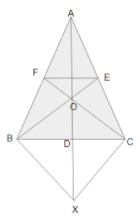
We are given in the question that the side \[{\text{BC}}\] of a triangle \[{\text{ABC}}\] is bisected at \[{\text{D}}\]; \[{\text{O}}\] is any point in \[{\text{AD}}\]. \[{\text{BO}}\] and \[{\text{CO}}\] are produced to meet \[{\text{AC}}\] and \[{\text{AB}}\] in \[{\text{E}}\] and \[{\text{F}}\] respectively and \[{\text{AD}}\] is produced to \[{\text{X}}\] so that \[{\text{D}}\] is the midpoint of \[{\text{OX}}\].
There are two objectives that need to be fulfilled. First is to prove that \[{\text{AO:AX = AF:AB}}\] and secondly we need to show that \[{\text{EF}}\] is parallel to \[{\text{BC}}\].
Consider the first objective,
As from the figure it is clear that, in a quadrilateral \[{\text{BOCX}}\] \[{\text{BD = DC}}\] and \[{\text{DO = DX}}\] as \[{\text{D}}\] is the midpoint of the line \[{\text{BC}}\] and \[{\text{OX}}\].
Since, the diagonals \[{\text{OX}}\] and \[{\text{BC}}\] of a quadrilateral \[{\text{BOCX}}\] intersects each other at \[{\text{D}}\].
Therefore, the quadrilateral \[{\text{BOCX}}\] becomes the parallelogram \[{\text{BOCX}}\].
Further, use the definition of parallelogram, which states that the opposite sides of a parallelogram are parallel to each other.
Thus, we get that,
\[{\text{BX||CO}}\] and \[{\text{CX||BO}}\]
Or \[{\text{BX||CF}}\] and \[{\text{CX||BE}}\]
Or \[{\text{BX||OF}}\] and \[{\text{CX||OE}}\]
Now, since \[{\text{BX||OF}}\] in the \[\Delta {\text{ABX}}\],
We get, \[\dfrac{{{\text{AO}}}}{{{\text{AX}}}} = \dfrac{{{\text{AF}}}}{{{\text{AB}}}}\]
Thus, from equation (1) we can conclude that \[{\text{AO:AX = AF:AB}}\]
Consider the second objective,
From above solution we have, \[\dfrac{{{\text{AO}}}}{{{\text{AX}}}} = \dfrac{{{\text{AF}}}}{{{\text{AB}}}}\] ---(1)
Next, we have \[{\text{CX||OE}}\] in the \[\Delta {\text{ACX}}\],
Thus, we get, \[\dfrac{{{\text{AO}}}}{{{\text{AX}}}} = \dfrac{{{\text{AE}}}}{{{\text{AC}}}}\] ---(2)
Consider the equations (1) and (2),
We get that,
\[\dfrac{{{\text{AF}}}}{{{\text{AB}}}} = \dfrac{{{\text{AE}}}}{{{\text{AC}}}}\]
Thus, we can conclude that as the points \[{\text{E}}\] and \[{\text{F}}\] divides the lines \[{\text{AB}}\] and \[{\text{AC}}\] respectively in the same ratio, so, \[{\text{FE||BC}}\].
Note: Do not forget to use the fact that as the diagonals of a quadrilateral bisect each other then the quadrilateral becomes the parallelogram and as the lines are parallel to each other, we can determine the ratio between the lines as the particular point cuts them. The midpoint divides the line into exactly two parts and both the parts are of equal length. When the points divide the lines in the same ratio then the lines are parallel to each other as shown.
Complete step-by-step solution
We are given in the question that the side \[{\text{BC}}\] of a triangle \[{\text{ABC}}\] is bisected at \[{\text{D}}\]; \[{\text{O}}\] is any point in \[{\text{AD}}\]. \[{\text{BO}}\] and \[{\text{CO}}\] are produced to meet \[{\text{AC}}\] and \[{\text{AB}}\] in \[{\text{E}}\] and \[{\text{F}}\] respectively and \[{\text{AD}}\] is produced to \[{\text{X}}\] so that \[{\text{D}}\] is the midpoint of \[{\text{OX}}\].
There are two objectives that need to be fulfilled. First is to prove that \[{\text{AO:AX = AF:AB}}\] and secondly we need to show that \[{\text{EF}}\] is parallel to \[{\text{BC}}\].
Consider the first objective,
As from the figure it is clear that, in a quadrilateral \[{\text{BOCX}}\] \[{\text{BD = DC}}\] and \[{\text{DO = DX}}\] as \[{\text{D}}\] is the midpoint of the line \[{\text{BC}}\] and \[{\text{OX}}\].
Since, the diagonals \[{\text{OX}}\] and \[{\text{BC}}\] of a quadrilateral \[{\text{BOCX}}\] intersects each other at \[{\text{D}}\].
Therefore, the quadrilateral \[{\text{BOCX}}\] becomes the parallelogram \[{\text{BOCX}}\].
Further, use the definition of parallelogram, which states that the opposite sides of a parallelogram are parallel to each other.
Thus, we get that,
\[{\text{BX||CO}}\] and \[{\text{CX||BO}}\]
Or \[{\text{BX||CF}}\] and \[{\text{CX||BE}}\]
Or \[{\text{BX||OF}}\] and \[{\text{CX||OE}}\]
Now, since \[{\text{BX||OF}}\] in the \[\Delta {\text{ABX}}\],
We get, \[\dfrac{{{\text{AO}}}}{{{\text{AX}}}} = \dfrac{{{\text{AF}}}}{{{\text{AB}}}}\]
Thus, from equation (1) we can conclude that \[{\text{AO:AX = AF:AB}}\]
Consider the second objective,
From above solution we have, \[\dfrac{{{\text{AO}}}}{{{\text{AX}}}} = \dfrac{{{\text{AF}}}}{{{\text{AB}}}}\] ---(1)
Next, we have \[{\text{CX||OE}}\] in the \[\Delta {\text{ACX}}\],
Thus, we get, \[\dfrac{{{\text{AO}}}}{{{\text{AX}}}} = \dfrac{{{\text{AE}}}}{{{\text{AC}}}}\] ---(2)
Consider the equations (1) and (2),
We get that,
\[\dfrac{{{\text{AF}}}}{{{\text{AB}}}} = \dfrac{{{\text{AE}}}}{{{\text{AC}}}}\]
Thus, we can conclude that as the points \[{\text{E}}\] and \[{\text{F}}\] divides the lines \[{\text{AB}}\] and \[{\text{AC}}\] respectively in the same ratio, so, \[{\text{FE||BC}}\].
Note: Do not forget to use the fact that as the diagonals of a quadrilateral bisect each other then the quadrilateral becomes the parallelogram and as the lines are parallel to each other, we can determine the ratio between the lines as the particular point cuts them. The midpoint divides the line into exactly two parts and both the parts are of equal length. When the points divide the lines in the same ratio then the lines are parallel to each other as shown.
Recently Updated Pages
Mutually Exclusive vs Independent Events: Key Differences Explained

Area vs Volume: Key Differences Explained for Students
Area of an Octagon Formula Explained Simply
Absolute Pressure Formula Explained: Key Equation & Examples
Central Angle of a Circle Formula Explained Quickly
Difference Between Vapor and Gas: JEE Main 2026
Trending doubts
JEE Main 2026: Session 2 Registration Open, City Intimation Slip, Exam Dates, Syllabus & Eligibility
JEE Main 2026 Jan 21 Shift 1 Question Papers with Solutions & Answer Keys – Detailed Day 1 Analysis
JEE Main Response Sheet 2026 Released – Key Dates and Official Updates by NTA
JEE Main 2026 Answer Key OUT – Download Session 1 PDF, Response Sheet & Challenge Link
JEE Main Marks vs Percentile 2026: Calculate Percentile and Rank Using Marks
JEE Main 2026 Jan 22 Shift 1 Today Paper Live Analysis With Detailed Solutions
Other Pages
Pregnancy Week and Due Date Calculator: Find How Far Along You Are
NCERT Solutions For Class 10 Maths Chapter 11 Areas Related to Circles (2025-26)
NCERT Solutions For Class 10 Maths Chapter 12 Surface Areas and Volumes (2025-26)
All Mensuration Formulas with Examples and Quick Revision
Complete List of Class 10 Maths Formulas (Chapterwise)
NCERT Solutions for Class 10 Maths Chapter 13 Statistics