

Courses
Courses for Kids
Free study material
Offline Centres
More
Store Icon
Store

JEE Advanced 2026 Syllabus for Mathematics: Download FREE PDF

ffImage
banner
widget title icon
Latest Updates

widget icon
Start Your JEE Practice Here :
JEE Test Series 2026

JEE Advanced Updated Maths Syllabus 2026: Download The Topic-Wise PDF with Weightage

Students who qualify JEE Main move to the next stage of the engineering entrance process, which is JEE Advanced. While both exams cover similar subjects, JEE Advanced requires stronger problem-solving skills.


In JEE Advanced Mathematics, questions focus on using concepts, formulas, and mathematical ideas to solve challenging problems. The JEE Advanced 2026 Mathematics syllabus provided here will help students understand the topics they need to prepare and plan their study approach effectively.
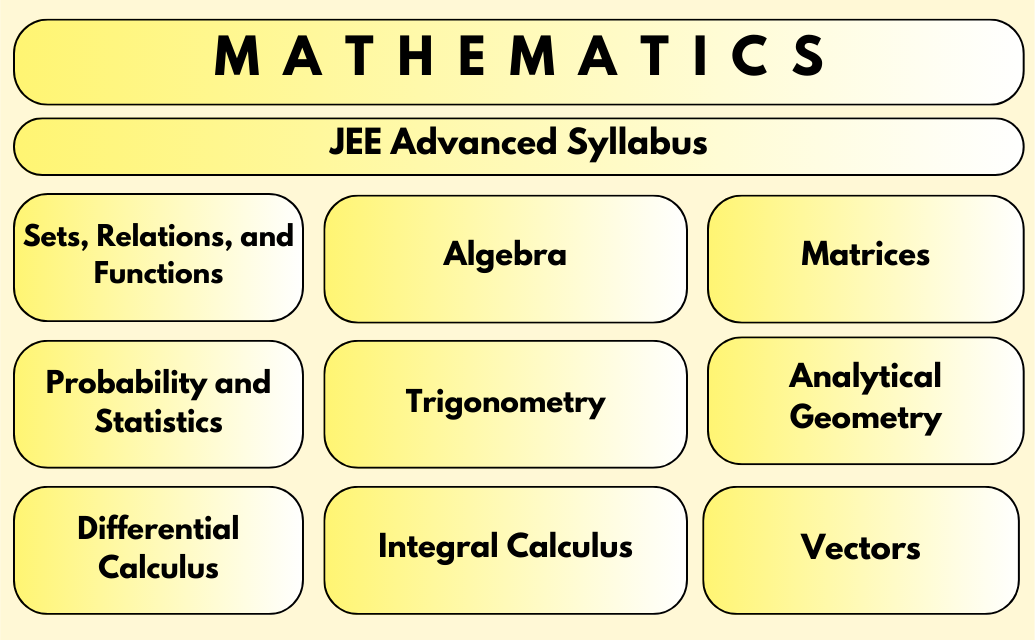
JEE Advanced Maths Syllabus 2024


JEE Advanced Maths Syllabus Topics


USE Coupon Code: CJEE Click Here for Best JEE Crash Course

Competitive Exams after 12th Science
tp-imag
bottom-arrow
tp-imag
bottom-arrow
tp-imag
bottom-arrow
tp-imag
bottom-arrow
tp-imag
bottom-arrow
tp-imag
bottom-arrow

JEE Advanced Maths Syllabus 2026 PDF Download


Section A

Chapter Name

Topics

Sets, Relations and Functions

  • Sets and their representations, different kinds of sets (empty, finite and infinite), algebra of sets, intersection, complement, difference and symmetric difference of sets and their algebraic properties, De-Morgan’s laws on union, intersection, difference (for finite number of sets) and practical problems based on them.

  • Cartesian product of finite sets, ordered pair, relations, domain and codomain of relations, equivalence relation.

  • Function as a special case of relation, functions as mappings, domain, codomain, range of functions, invertible functions, even and odd functions, into, onto and one-to-one functions, special functions (polynomial, trigonometric, exponential, logarithmic, power, absolute value, greatest integer etc.), sum, difference, product and composition of functions.

Algebra

  • Algebra of complex numbers, addition, multiplication, conjugation, polar representation, properties of modulus and principal argument, triangle inequality, cube roots of unity, geometric interpretations.

  • Statement of fundamental theorem of algebra, Quadratic equations with real coefficients, relations between roots and coefficients, formation of quadratic equations with given roots, symmetric functions of roots.

  • Arithmetic and geometric progressions, arithmetic and geometric means, sums of finite arithmetic and geometric progressions, infinite geometric series, sum of the first n natural numbers, sums of squares and cubes of the first n natural numbers.

  • Logarithms and their properties, permutations and combinations, binomial theorem for a positive integral index, properties of binomial coefficients. 

Matrices

  • Matrices as a rectangular array of real numbers, equality of matrices, addition, multiplication by a scalar and product of matrices, transpose of a matrix, elementary row and column transformations, 

  • Determinant of a square matrix of order up to three, adjoint of a matrix, inverse of a square matrix of order up to three, properties of these matrix operations, diagonal, symmetric and skew-symmetric matrices and their properties, solutions of simultaneous linear equations in two or three variables.

Probability and Statistics 

  • Random experiment, sample space, different types of events (impossible, simple, compound), addition and multiplication rules of probability, conditional probability, independence of events, total probability, Bayes Theorem, computation of probability of events using permutations and combinations.

  • Measure of central tendency and dispersion, mean, median, mode, mean deviation, standard deviation and variance of grouped and ungrouped data, analysis of the frequency distribution with same mean but different variance, random variable, mean and variance of the random variable.

Trigonometry

  • Trigonometric functions, their periodicity and graphs, addition and subtraction formulae, formulae involving multiple and sub-multiple angles, general solution of trigonometric equations.

  • Inverse trigonometric functions (principal value only) and their elementary properties.

Analytical Geometry 

  • Two dimensions: Cartesian coordinates, distance between two points, section formulae, shift of origin.

  • Equation of a straight line in various forms, angle between two lines, distance of a point from a line; Lines through the point of intersection of two given lines, equation of the bisector of the angle between two lines, concurrency of lines; Centroid, orthocentre, incentre and circumcentre of a triangle.

  • Equation of a circle in various forms, equations of tangent, normal and chord. Parametric equations of a circle, intersection of a circle with a straight line or a circle, equation of a circle through the points of intersection of two circles and those of a circle and a straight line.

  • Equations of a parabola, ellipse and hyperbola in standard form, their foci, directrices and eccentricity, parametric equations, equations of tangent and normal.

  • Locus problems.

  • Three dimensions: Distance between two points, direction cosines and direction ratios, equation of a straight line in space, skew lines, shortest distance between two lines, equation of a plane, distance of a point from a plane, angle between two lines, angle between two planes, angle between a line and the plane, coplanar lines.

Differential Calculus 

  • Limit of a function at a real number, continuity of a function, limit and continuity of the sum, difference, product and quotient of two functions, L’Hospital rule of evaluation of limits of functions.

  • Continuity of composite functions, intermediate value property of continuous functions.

  • Derivative of a function, derivative of the sum, difference, product and quotient of two functions, chain rule, derivatives of polynomial, rational, trigonometric, inverse trigonometric, exponential and logarithmic functions.

  • Tangents and normals, increasing and decreasing functions, derivatives of order two, maximum and minimum values of a function, Rolle’s theorem and Lagrange’s mean value theorem, geometric interpretation of the two theorems, derivatives up to order two of implicit functions, geometric interpretation of derivatives.

Integral Calculus 

  • Integration as the inverse process of differentiation, indefinite integrals of standard functions, definite integrals as the limit of sums, definite integral and their properties, fundamental theorem of integral calculus.

  • Integration by parts, integration by the methods of substitution and partial fractions, application of definite integrals to the determination of areas bounded by simple curves. 

  • Formation of ordinary differential equations, solution of homogeneous differential equations of first order and first degree, separation of variables method, linear first order differential equations.

Vectors

  • Addition of vectors, scalar multiplication, dot and cross products, scalar and vector triple products, and their geometrical interpretations.


JEE Advanced 2026 Maths Syllabus – Best Books for Preparation

Choosing the right books is crucial for excelling in JEE Advanced 2026 Mathematics. Here’s a list of top-recommended books that cover the syllabus comprehensively and enhance problem-solving skills.


Best Books for JEE Advanced 2026 Maths

Book Name

Author/Publications

Why This Book?

NCERT (Class 11 & 12)

NCERT

Covers JEE syllabus, strong fundamentals

Mathematics for Class 11 & 12

RD Sharma

Step-by-step solutions, practice problems

Plane Coordinate Geometry

SL Loney

Conceptual clarity, detailed explanations

Plane Trigonometry Part 1

SL Loney

In-depth trigonometry concepts solved examples

Objective Mathematics for JEE Advanced

RD Sharma

Focus on problem-solving, vast practice sets

Higher Algebra

Hall & Knight

Strong theoretical approach, advanced problems

Problems in Calculus of One Variable

IA Maron

Advanced problem-solving techniques

Differential Calculus

A Das Gupta

Concise theory, diverse question types

Integral Calculus for JEE

Amit Agarwal (Arihant)

Aligned with the JEE pattern, conceptual depth

Mathematics for IIT JEE

Tata McGraw Hill

Emphasis on conceptual understanding

Algebra for JEE Advanced

Dr. SK Goyal (Arihant)

Challenging problems, problem-solving focus


Additional Resources for JEE Advanced Maths 2026

Additional resources that go beyond the JEE Advanced 2026 Maths Syllabus can be found here. Here is a list of useful learning materials, practice papers, mock tests, and insights. You can improve your preparation, overcome challenges, and set yourself up for success by using these JEE Advanced 2026 resources.


Reference Links

Details

JEE Advanced Maths Practice Paper

Helps students familiarize themselves with the exam pattern and question types.

JEE Advanced Mock Test 2026

Allows students to simulate the actual exam environment and assess their time management skills.

JEE Advanced Sample Paper

Provides a comprehensive overview of the syllabus and helps students identify their strengths and weaknesses.

JEE Advanced Previous Paper Question Paper

Enables students to practice solving past year questions and gain insights into recurring concepts and exam trends.


Download Subject-wise JEE Advanced 2026 Syllabus

S.No

Subject-Wise JEE Advanced 2026 Syllabus PDF

1

JEE Advanced Chemistry Syllabus 2026

2

JEE Advanced Physics Syllabus 2026


Analysis for JEE Advanced 2026 Mathematics

To excel in JEE Advanced 2026 Mathematics, it's essential to understand historical trends, topic-wise weightage, and difficulty levels. By analysing previous years’ question papers, we can identify which topics are more important and how difficult the questions have been over time.


Topic-Wise Weightage Analysis (2019-2025)

Based on past JEE Advanced papers (2019-2025), the most frequently asked topics in Mathematics are:


Topic

Average % of Questions

Difficulty Level

Calculus

30%

Moderate to Hard

Algebra

25%

Moderate

Coordinate Geometry

20%

Moderate to Hard

Trigonometry

10%

Easy to Moderate

Probability & Statistics

10%

Moderate

Vectors & 3D Geometry

5%

Moderate to Hard


Key Observations:

  • Calculus & Algebra contribute nearly 55% of the total marks.

  • Coordinate Geometry is a high-weightage but challenging topic.

  • Trigonometry has fewer questions but is often used in Calculus & Coordinate Geometry.


The JEE Advanced Maths Syllabus 2026 is your roadmap to success in one of the most competitive engineering entrance exams. Covering essential topics like Algebra, Calculus, Coordinate Geometry, and Vectors, it provides a structured approach to mastering key mathematical concepts. Download the JEE Advanced Maths Syllabus 2026 now and take the first step toward acing your IIT dreams with confidence!

WhatsApp Banner

FAQs on JEE Advanced 2026 Syllabus for Mathematics: Download FREE PDF

1. How do I prepare for both the JEE Advanced and the board exams at the same time?

JEE Main and 12th Board exams usually always occur at the same time. It forces the student to focus solely on JEE preparation. As a result, it is critical to study for both the board examinations and the JEE at the same time. Aspirants who choose the correct content, books, and tutoring are far more likely to succeed in the exam. Certain publications, such as NCERT and HC Verma, feature numerous questions from practical applications of principles that might help you study for both exams. Vedantu has all the materials that will be of great use when you face yourself against such a situation. Head over to the website and let our experts guide your way through.

2. What is the weightage for each topic in the JEE Advanced Maths Syllabus 2026?

The weightage for each topic in the JEE Advanced Maths Syllabus 2026 is not officially released by the Joint Entrance Examination (JEE) Advanced. However, based on past years' question papers, it is estimated that the weightage for each topic is as follows:


Algebra: 30%

Calculus: 35%

Coordinate Geometry: 20%

Vectors: 15%

3. What is the JEE Advanced Mathematics Syllabus for 2026?

The JEE Advanced Mathematics Syllabus for 2026 is based on the syllabus for Classes 11 and 12 of the Central Board of Secondary Education (CBSE) and other equivalent boards. It covers a wide range of topics, including algebra, calculus, coordinate geometry, and vectors.

4. What are the important chapters for each topic in the JEE Advanced Mathematics Syllabus?

Here are some of the important chapters for each topic in the JEE Advanced Mathematics Syllabus:


  • Algebra: Sets, relations, and functions, Complex numbers, Permutations and combinations, Quadratic equations, Binomial theorem, Sequences and series, Matrices and determinants

  • Calculus: Differential calculus, Integral calculus, Applications of calculus

  • Coordinate Geometry: Lines and circles, Parabolas, ellipses, and hyperbolas, Three-dimensional geometry

  • Vectors: Vector algebra, Applications of vectors

5. What is the difference between the JEE Main and JEE Advanced Mathematics Syllabus?

The JEE Main Mathematics Syllabus is less comprehensive than the JEE Advanced Mathematics Syllabus. The JEE Main Syllabus covers the essential topics from all four domains of mathematics: algebra, calculus, coordinate geometry, and vectors. The JEE Advanced Syllabus covers a more in-depth and rigorous treatment of these topics.

6. What is the syllabus for advanced maths?

The JEE Advanced Maths syllabus covers the following key topics:


  • Sets, Relations, and Functions: Understanding sets, various types of relations, and properties of functions.

  • Algebra: Matrices, determinants, permutations and combinations, quadratic equations, binomial theorem.

  • Trigonometry: Trigonometric identities, inverse trigonometry.

  • Calculus: Differential calculus (limits, continuity, differentiation, applications), integral calculus (integration, applications).

  • Analytical Geometry: Two-dimensional (lines, circles, parabolas, ellipses, hyperbolas) and three-dimensional geometry (lines, planes, spheres).

  • Probability and Statistics: Basic concepts, random variables, probability distributions, measures of central tendency and dispersion.

  • Vectors: Addition, scalar multiplication, dot and cross products, their geometrical interpretations.

7. What is the difference between basic and advanced maths?

While basic maths covers fundamental arithmetic operations, algebra, and geometry, advanced maths delves deeper into:


  • More complex concepts: Advanced maths introduces concepts like calculus, vector analysis, probability theory, etc.

  • Abstraction and theoretical depth: It requires a higher level of abstraction and theoretical understanding.

  • Problem-solving complexity: Advanced maths problems often involve multistep solutions and require applying various concepts together.

8. How can I improve my advanced maths?

Here are some tips to improve your advanced maths skills:

  • Solid foundation: Ensure a strong grasp of basic maths concepts before diving into advanced topics.

  • Practice regularly: Solve problems consistently from various resources like textbooks, previous year papers, and mock tests.

  • Focus on understanding: Don't just memorize formulas; strive to understand the underlying concepts and their applications.

  • Seek help: Don't hesitate to seek guidance from teachers, tutors, or online resources when facing difficulties.
