






Benefits, Eligibility and Objectives of PM Garib Kalyan Scheme
Pradhan Mantri Garib Kalyan Yojana (PMGKY) is a welfare scheme launched by the Government of India to provide relief and support to the economically weaker sections of society. The scheme aims to ensure food security, financial assistance, and social protection for poor and vulnerable families, especially during times of crisis. It plays a significant role in strengthening India’s social security framework and is an important topic for General Knowledge and competitive examinations.
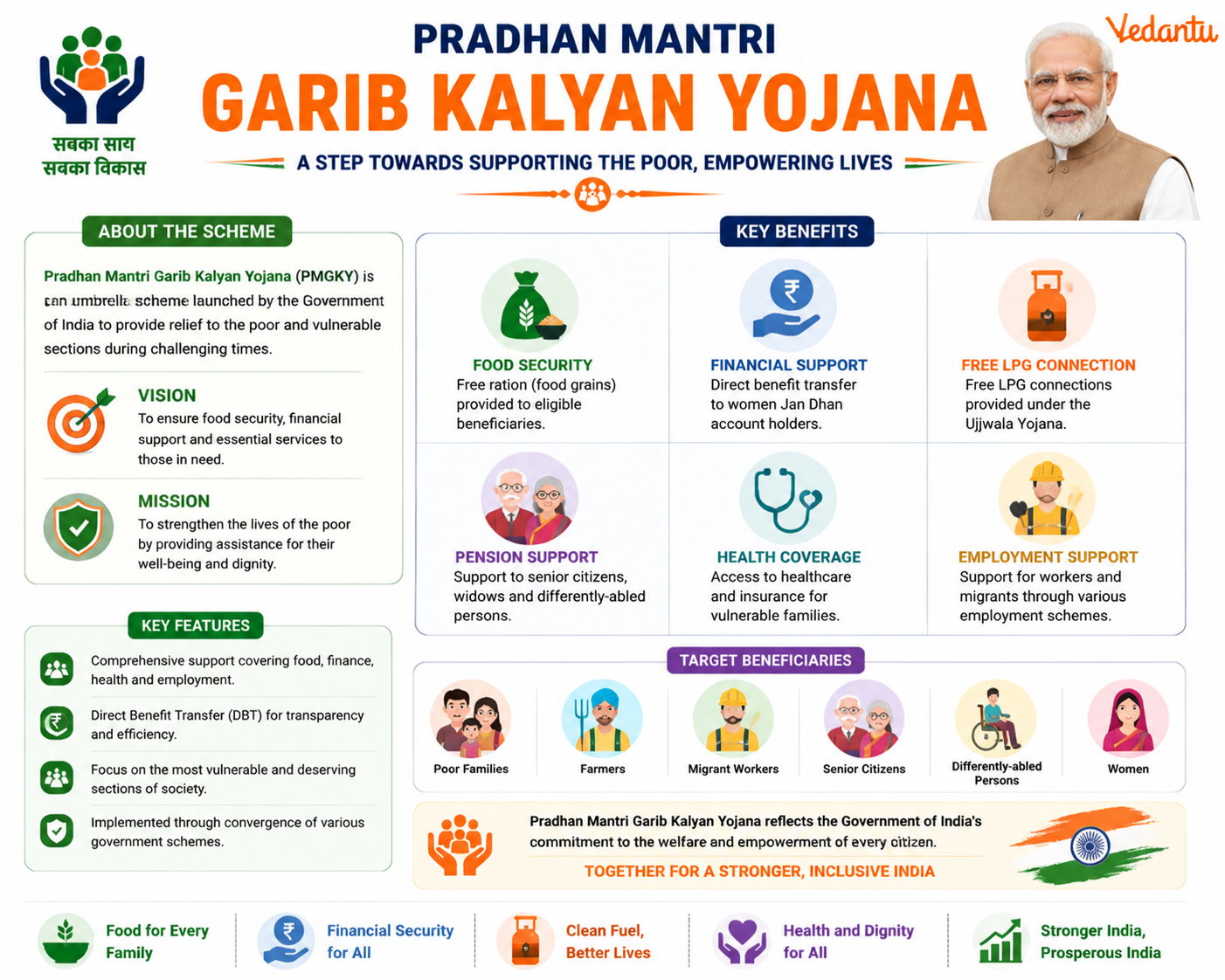
Overview of Pradhan Mantri Garib Kalyan Yojana
Pradhan Mantri Garib Kalyan Yojana was first introduced in 2016, but it gained major prominence in 2020 during the COVID-19 pandemic. The scheme was designed to provide immediate relief to poor households affected by economic disruptions. It includes free food grains, direct cash transfers, insurance coverage, and other welfare measures.
Key Details of PMGKY
| Particular | Details | Year/Authority |
|---|---|---|
| Scheme Name | Pradhan Mantri Garib Kalyan Yojana | Government of India |
| Major Launch | COVID-19 Relief Package | 2020 |
The scheme focuses on providing direct benefits to the poor through existing welfare platforms such as Public Distribution System (PDS), Jan Dhan Yojana, Ujjwala Yojana, and MGNREGA.
Objectives of PMGKY
The main objective of Pradhan Mantri Garib Kalyan Yojana is to protect vulnerable populations from financial distress and ensure their basic needs are met. The scheme aims to provide food security, financial support, and healthcare protection to economically weaker sections.
- Ensure free food grains to poor families under the Public Distribution System.
- Provide direct cash transfers to women, farmers, and senior citizens.
- Support migrant workers and daily wage earners during crises.
- Strengthen social security measures for unorganized sector workers.
Major Components of PMGKY
1. Free Food Grain Distribution
Under this component, eligible beneficiaries receive additional free food grains such as rice or wheat per person per month. This is provided over and above the regular subsidized ration under the National Food Security Act.
2. Direct Benefit Transfer (DBT)
Financial assistance is directly credited to bank accounts of beneficiaries including women Jan Dhan account holders, farmers under PM-KISAN, and pensioners. This ensures transparency and reduces leakages.
3. Ujjwala Scheme Support
Free LPG cylinders are provided to beneficiaries under the Pradhan Mantri Ujjwala Yojana to ensure clean cooking fuel access during difficult times.
4. Insurance for Health Workers
Insurance coverage was provided to frontline health workers fighting the COVID-19 pandemic, offering financial protection in case of loss of life.
Eligibility Criteria
The benefits under PMGKY are extended to specific categories of beneficiaries identified through existing government databases and welfare schemes.
- Families covered under the National Food Security Act.
- Women holding Jan Dhan bank accounts.
- Farmers registered under PM-KISAN.
- Beneficiaries of Ujjwala Yojana.
- Senior citizens, widows, and disabled persons receiving pensions.
Significance of PMGKY
Pradhan Mantri Garib Kalyan Yojana plays a crucial role in reducing poverty and ensuring social security. During the COVID-19 pandemic, it helped millions of families survive economic hardships by guaranteeing food and financial support. The scheme also strengthened India’s Direct Benefit Transfer system and promoted financial inclusion through Jan Dhan accounts.
Challenges and Criticism
Despite its large scale implementation, the scheme faced certain challenges. Distribution logistics, identification errors, and exclusion of some migrant workers were reported in some regions. However, continuous monitoring and digital systems helped improve transparency and delivery efficiency.
PMGKY for Competitive Exams
Pradhan Mantri Garib Kalyan Yojana is an important topic for UPSC, SSC, Banking, State PSC, and other government examinations. Questions are generally asked about its objectives, launch year, major components, and target beneficiaries.
- Remember the launch year and its connection with COVID-19 relief.
- Understand the key components such as free food grains and DBT.
- Revise the beneficiary categories and objectives of the scheme.
- Focus on its role in strengthening India’s social security framework.
Conclusion
Pradhan Mantri Garib Kalyan Yojana is a comprehensive welfare initiative aimed at protecting the poor and vulnerable sections of society. By ensuring food security, financial assistance, and social protection, the scheme has played a vital role in crisis management and poverty alleviation. For students and competitive exam aspirants, understanding PMGKY is essential to grasp India’s social welfare policies and governance framework.
FAQs on Pradhan Mantri Garib Kalyan Yojana: Key Features and Impact
1. What is Pradhan Mantri Garib Kalyan Yojana (PMGKY)?
Pradhan Mantri Garib Kalyan Yojana (PMGKY) is a government welfare scheme launched to provide financial and food security support to the poor and vulnerable sections of India.
• Launched in 2016 and expanded during COVID-19 (2020)
• Aimed at poverty alleviation and social security
• Provided free food grains, cash transfers, LPG benefits, and insurance cover
• Targeted migrant workers, daily wage earners, women, farmers, and BPL families
This scheme is often searched under terms like PMGKY scheme details, Garib Kalyan Yojana benefits, and COVID relief package India.
2. When was Pradhan Mantri Garib Kalyan Yojana launched?
PMGKY was first introduced in December 2016 as part of the Taxation and Investment Regime after demonetization and was later expanded in March 2020 during the COVID-19 pandemic.
• 2016: Linked to income declaration scheme
• 2020: Announced under the ₹1.70 lakh crore COVID-19 relief package
• Extended multiple times to support the poor during economic slowdown
This timeline is important for competitive exams and general knowledge preparation.
3. What are the main objectives of PMGKY?
The main objective of PMGKY is to provide relief and financial assistance to economically weaker sections during crises and ensure food security.
• Ensure free food grains under the Public Distribution System (PDS)
• Provide direct cash transfers to Jan Dhan account holders
• Support women, farmers, senior citizens, and poor households
• Strengthen social security and economic stability
It focuses on poverty reduction, welfare schemes, and inclusive growth in India.
4. Who are the beneficiaries of Pradhan Mantri Garib Kalyan Yojana?
The beneficiaries of PMGKY include poor and vulnerable citizens of India identified under government welfare databases.
• Below Poverty Line (BPL) families
• Jan Dhan Yojana women account holders
• PM-KISAN registered farmers
• Ujjwala Yojana LPG beneficiaries
• Senior citizens, widows, and persons with disabilities
This scheme targets economically weaker sections and marginalized communities.
5. What benefits are provided under PMGKY?
PMGKY provides free ration, financial aid, and insurance coverage to eligible citizens to reduce economic hardship.
• 5 kg free wheat or rice per person per month
• ₹500 per month to women Jan Dhan account holders (during COVID phase)
• Free LPG cylinders under Ujjwala Yojana
• ₹2 lakh insurance cover for healthcare workers
These benefits are commonly searched as PMGKY ration scheme and government relief package details.
6. How is PMGKY different from other government welfare schemes?
PMGKY is specifically designed as an emergency relief package during economic crises like demonetization and COVID-19.
• Focuses on immediate relief rather than long-term development
• Combines multiple schemes under one umbrella
• Direct Benefit Transfer (DBT) for transparency
• Large-scale food distribution under National Food Security Act (NFSA)
It differs from schemes like MGNREGA or PMAY, which focus on employment and housing.
7. What was the role of PMGKY during the COVID-19 pandemic?
During COVID-19, PMGKY acted as a major relief package to support poor families affected by lockdowns.
• Announced a ₹1.70 lakh crore economic package
• Provided free food grains to over 80 crore beneficiaries
• Offered direct cash transfers and pension support
• Extended scheme duration multiple times till 2022
This made PMGKY one of the world’s largest food security programs.
8. How does PMGKY ensure food security in India?
PMGKY ensures food security by distributing free food grains through the Public Distribution System (PDS).
• Additional 5 kg ration per person over NFSA quota
• Coverage of Antyodaya Anna Yojana (AAY) households
• Nationwide distribution across all states and UTs
• Funded and monitored by the Central Government
This initiative strengthened India’s food security system during crisis periods.
9. Is Pradhan Mantri Garib Kalyan Yojana still active?
The free ration component of PMGKY was extended multiple times and later merged under the National Food Security framework.
• Extended till December 2022 under COVID relief
• Continued focus on free food grain distribution
• Integrated into long-term food security policies
Students should verify current updates for exams as government notifications may revise timelines.
10. Why is PMGKY important for competitive exams and GK?
PMGKY is important for competitive exams because it relates to Indian government schemes, economic policy, and social welfare.
• Frequently asked in UPSC, SSC, Banking, Railways, and State PSC exams
• Linked with topics like COVID-19 relief measures and poverty alleviation
• Demonstrates India’s approach to welfare economics and public distribution
Understanding PMGKY helps in General Knowledge, Current Affairs, and Indian Polity preparation.
