






Complete List of Indian Police Rank Insignia and Their Roles
The Police Ranks in India and their badges represent the hierarchical structure of law enforcement agencies across the country. Understanding these ranks is important for students, competitive exam aspirants, and general readers interested in General Knowledge. The Indian Police system follows a structured chain of command, with each rank having specific responsibilities, authority, and insignia. The badges worn on uniforms help in identifying the rank and position of police personnel quickly and clearly.
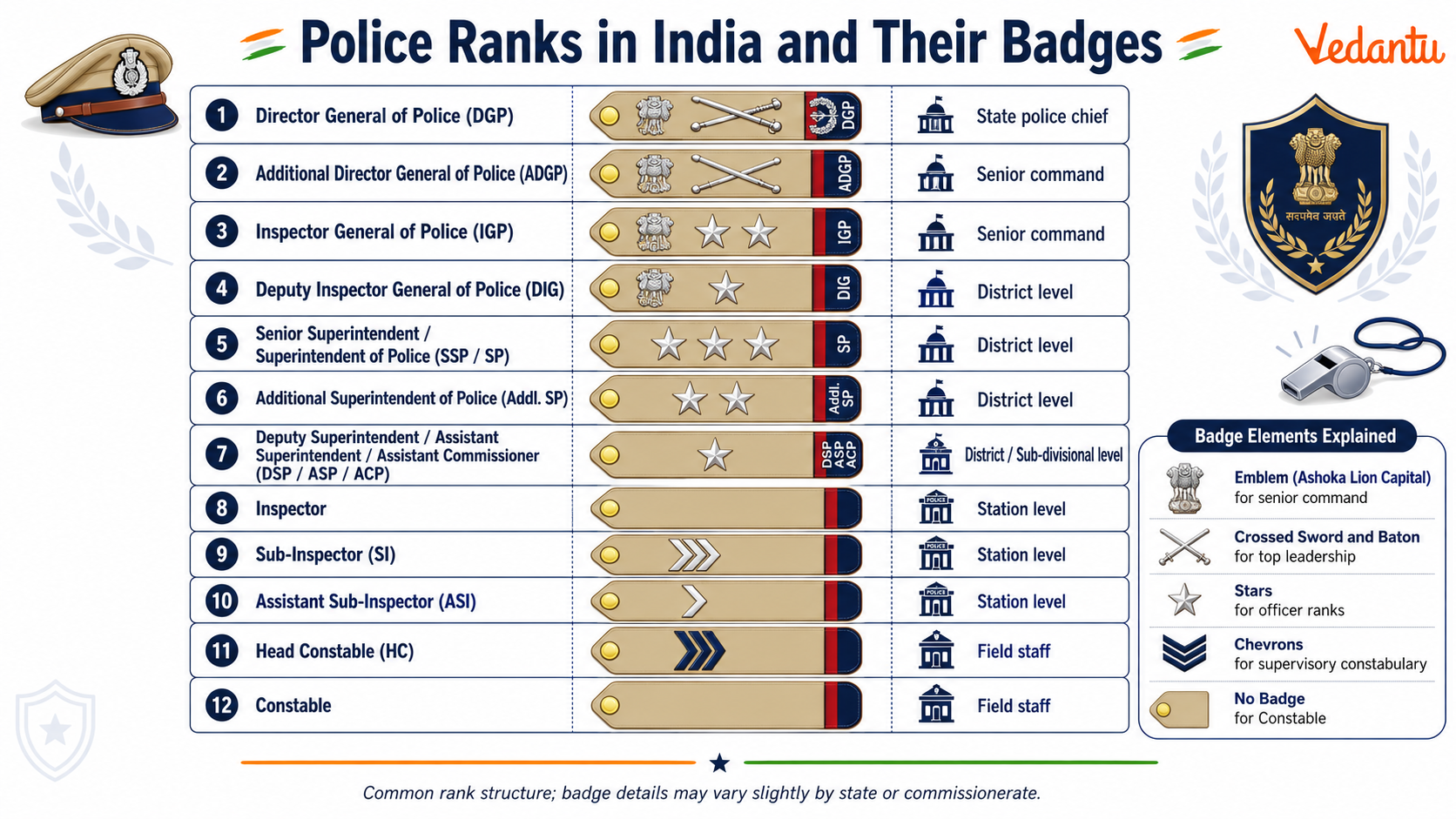
Overview of Police System in India
The police system in India functions under the control of individual state governments, while certain central police forces work under the Ministry of Home Affairs. The structure is broadly divided into Gazetted Officers and Non-Gazetted Officers. The rank insignia and badges are displayed on the shoulder or sleeves of the uniform and indicate authority and seniority.
- State Police forces maintain law and order within states.
- Indian Police Service - IPS officers hold senior leadership positions.
- Ranks are divided into Officers and Subordinate ranks.
- Badges include stars, national emblem, and crossed sword and baton symbols.
Police Ranks in India and Their Badges
| Rank | Category | Badge or Insignia |
|---|---|---|
| Director General of Police - DGP | Gazetted Officer | National Emblem with crossed sword and baton and stars |
| Inspector General of Police - IG | Gazetted Officer | National Emblem with crossed sword and baton |
| Deputy Inspector General - DIG | Gazetted Officer | National Emblem with one star |
| Superintendent of Police - SP | Gazetted Officer | National Emblem |
| Additional SP | Gazetted Officer | National Emblem with one star |
| Deputy SP - DSP or Assistant SP - ASP | Gazetted Officer | Three stars |
| Inspector | Non-Gazetted Officer | Three stars with red and blue stripe |
| Sub Inspector - SI | Non-Gazetted Officer | Two stars with red and blue stripe |
| Assistant Sub Inspector - ASI | Non-Gazetted Officer | One star with red and blue stripe |
| Head Constable | Non-Gazetted Officer | Three chevrons on sleeve |
| Constable | Non-Gazetted Officer | No star, basic uniform insignia |
The insignia may slightly vary in design across different states, but the overall structure and symbol pattern remain largely uniform throughout India.
Detailed Hierarchy of Police Ranks
Top Level Officers
The highest rank in a state police force is the Director General of Police - DGP. The DGP heads the entire police department of a state. Officers of this rank are selected from the Indian Police Service - IPS. They are responsible for overall law enforcement administration, policy implementation, and coordination with the state government.
Senior Officers
Ranks such as Inspector General - IG, Deputy Inspector General - DIG, and Superintendent of Police - SP supervise large regions, districts, or specialized units. The SP usually heads a district police force and plays a crucial role in maintaining law and order.
Mid Level Officers
Deputy Superintendent of Police - DSP and Inspectors manage police stations and field operations. They oversee investigations, crime control activities, and administrative tasks within their jurisdiction.
Subordinate Officers
Sub Inspectors - SI, Assistant Sub Inspectors - ASI, Head Constables, and Constables form the backbone of the police force. They handle daily patrolling, registration of cases, investigation assistance, and public interaction.
Importance of Police Badges and Insignia
Police badges are not just decorative elements but symbols of authority and responsibility. They help in:
- Quick identification of rank during operations.
- Maintaining discipline and chain of command.
- Displaying official authority to the public.
- Ensuring respect for hierarchy within the force.
Police Ranks in India for Competitive Exams
Questions related to police ranks in India are commonly asked in exams such as SSC, UPSC, State PSC, Banking, Railways, and other government recruitment tests. Students should remember:
- The highest police rank in a state is DGP.
- SP heads a district police force.
- DSP and ASP are equivalent entry level IPS positions.
- Stars and the National Emblem are key parts of police insignia.
Conclusion
The structure of Police Ranks in India and their badges reflects a well defined hierarchy that ensures smooth functioning of law enforcement agencies. Each rank carries specific duties, powers, and responsibilities. For students preparing for competitive examinations, understanding the order of ranks and their insignia is essential. This knowledge not only enhances General Awareness but also helps in building a clear understanding of the administrative framework of India.
FAQs on Police Ranks in India Explained with Badge Details and Hierarchy
1. What are the different police ranks in India?
Police ranks in India are structured in a hierarchical order from constable to top-level IPS officers. The main ranks include:
• Constable
• Head Constable
• Assistant Sub-Inspector (ASI)
• Sub-Inspector (SI)
• Inspector
• Deputy Superintendent of Police (DSP)/ACP
• Superintendent of Police (SP)
• Deputy Inspector General (DIG)
• Inspector General (IG)
• Director General of Police (DGP)
This Indian Police hierarchy helps maintain law and order at district, state, and national levels.
2. What is the highest police rank in India?
The highest police rank in India is the Director General of Police (DGP), who heads the state police force. Key points include:
• DGP is the top-ranking IPS officer in a state.
• Appointed by the State Government.
• Responsible for overall law enforcement and administration.
In central agencies, the highest rank can be Director of CBI or Commissioner of Police in metropolitan cities.
3. What are the badges of Indian police ranks?
Indian police badges represent rank through stars, the Ashoka emblem, and stripes. Common badge symbols include:
• Constable: No stars, basic insignia
• Sub-Inspector: Two stars
• Inspector: Three stars
• SP: National Emblem + one star
• DGP: National Emblem + crossed sword and baton
These police insignia help identify authority and rank instantly.
4. What is the difference between IPS and State Police officers?
IPS officers belong to the All India Services, while State Police officers are recruited by state commissions. Key differences include:
• IPS: Recruited through UPSC Civil Services Exam
• State Police: Recruited via State Public Service Commission
• IPS officers usually hold senior ranks like SP, DIG, IG, DGP
This distinction is important for competitive exams and general knowledge.
5. What does a Sub-Inspector (SI) do in India?
A Sub-Inspector (SI) is responsible for supervising police stations and investigations. Major duties include:
• Registering FIRs (First Information Reports)
• Conducting investigations
• Managing constables and head constables
• Maintaining law and order
The SI rank is crucial in the Indian Police ranking system.
6. How are police ranks identified by stars in India?
Police ranks in India are identified by stars and the national emblem on shoulder badges. Star system overview:
• ASI: One star
• SI: Two stars
• Inspector: Three stars
• SP: Emblem + one star
• DIG and above: Emblem + crossed sword and baton
This star badge system helps easily recognize rank and authority.
7. Who appoints the Director General of Police (DGP)?
The Director General of Police (DGP) is appointed by the State Government from senior IPS officers. Important facts:
• Selected from a panel approved by UPSC
• Heads the State Police Department
• Reports to the Home Department
The appointment process ensures transparency in top-level police administration.
8. What is the role of a Superintendent of Police (SP)?
The Superintendent of Police (SP) is the head of police administration in a district. Key responsibilities include:
• Maintaining law and order
• Supervising police stations
• Managing crime control operations
• Reporting to DIG or IG
In metropolitan cities, this rank is often known as Deputy Commissioner of Police (DCP).
9. What is the lowest rank in the Indian Police?
The lowest rank in the Indian Police is Constable. Key points include:
• Entry-level position in the police hierarchy
• Responsible for patrolling and basic duties
• Works under Head Constable or SI
Constables form the backbone of the law enforcement system in India.
10. Are police ranks and badges the same across all Indian states?
Police ranks are generally similar across Indian states, but minor variations may exist in badge design. Important details:
• Basic rank structure remains uniform
• Badge colors and uniform styles may differ
• IPS insignia follow central government standards
This uniformity ensures consistency in the Indian Police ranking and insignia system.
