






How Hieroglyphics Symbols Were Read and Decoded
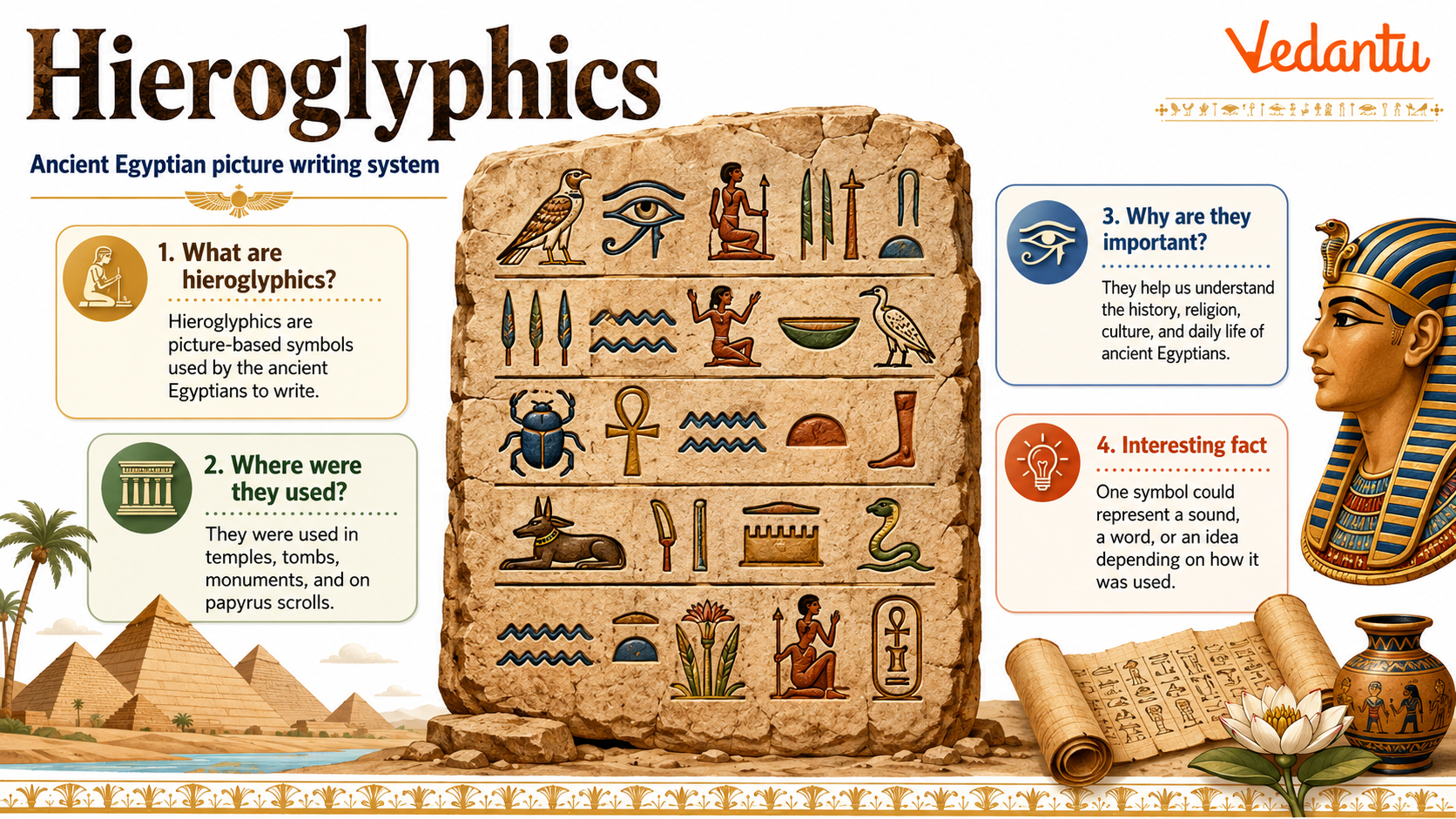
Hieroglyphics refers to the ancient writing system used by the Egyptians for thousands of years. It is one of the earliest forms of writing in human history and played a crucial role in preserving Egypt’s religion, administration, culture, and daily life. The word "hieroglyphics" comes from Greek words meaning "sacred carvings," as these symbols were often carved on temple walls and monuments. Understanding hieroglyphics helps us explore the civilization of Ancient Egypt and its contributions to world history.
Origin and History of Hieroglyphics
Egyptian hieroglyphics developed around 3100 BCE, during the early dynastic period of Egypt. It remained in use for more than 3000 years, making it one of the longest-used writing systems in the world. The script evolved over time but retained its symbolic nature.
- Developed around 3100 BCE
- Used mainly in temples, tombs, monuments, and official inscriptions
- Gradually replaced by other scripts like Demotic
- Disappeared around the 4th century CE
After the spread of Christianity and later Islamic rule in Egypt, knowledge of hieroglyphics was lost until modern scholars deciphered it in the 19th century.
Structure of Hieroglyphic Writing
Hieroglyphics is a complex writing system that combines pictures, symbols, and sounds. It includes more than 700 symbols, each with specific meanings and functions.
Types of Hieroglyphic Symbols
- Logograms - Represent whole words or objects
- Phonograms - Represent sounds, similar to letters
- Determinatives - Silent symbols added to clarify meaning
The script could be written from right to left or left to right. The direction can be identified by observing the way animals or human figures face.
Key Features of Egyptian Hieroglyphics
| Feature | Description | Importance |
|---|---|---|
| Number of Symbols | 700 plus characters | Allowed detailed expression |
| Writing Direction | Left to right or right to left | Flexible format |
| Medium Used | Stone, papyrus, wood | Preserved historical records |
These features made hieroglyphics suitable for religious texts, royal decrees, and monumental inscriptions that needed durability and clarity.
The Rosetta Stone and Decipherment
For centuries, hieroglyphics remained undeciphered. The breakthrough came in 1799 when the Rosetta Stone was discovered by French soldiers in Egypt. The stone contained the same text written in three scripts: Greek, Demotic, and Hieroglyphic.
- Discovered in 1799
- Contained three versions of the same decree
- Jean Francois Champollion deciphered it in 1822
By comparing the Greek text with the hieroglyphics, Champollion successfully unlocked the meaning of the ancient script, opening a new era in Egyptology.
Uses of Hieroglyphics in Ancient Egypt
Hieroglyphics was not used for everyday writing by common people. Instead, it had specific purposes in Egyptian society.
- Religious texts such as the Book of the Dead
- Royal proclamations and achievements of pharaohs
- Tomb inscriptions to guide the dead in the afterlife
- Recording historical events and trade activities
Scribes were specially trained individuals who learned to read and write hieroglyphics. Their role was highly respected in Egyptian society.
Significance of Hieroglyphics
Hieroglyphics is significant because it provides direct insight into Ancient Egyptian civilization. Without it, knowledge about Egyptian religion, politics, science, and daily life would have been limited.
- Helped historians understand ancient culture
- Revealed details about pharaohs and dynasties
- Contributed to the study of early writing systems
- Played a key role in the development of alphabets
Today, hieroglyphics remains an important subject in archaeology and ancient history studies worldwide.
Conclusion
Hieroglyphics was a sophisticated and symbolic writing system that preserved the legacy of Ancient Egypt for thousands of years. From temple walls to papyrus scrolls, it documented religious beliefs, royal achievements, and daily life. The discovery of the Rosetta Stone enabled scholars to decode this ancient script, allowing modern society to understand one of the world’s greatest civilizations. Studying hieroglyphics enhances our knowledge of early human communication and the development of written language.
FAQs on Hieroglyphics Writing System in Ancient Egypt
1. What are Hieroglyphics?
Hieroglyphics are the ancient writing system used by the Egyptians that combined pictures and symbols to represent sounds and ideas.
- Derived from the Greek word meaning "sacred carvings"
- Used in Ancient Egypt for religious texts, monuments, and tombs
- Included symbols for sounds (phonograms), objects (logograms), and ideas (ideograms)
- Often carved on temples, pyramids, and papyrus scrolls
2. Who invented Hieroglyphics?
Hieroglyphics were developed by the ancient Egyptians around 3100 BCE during the early dynastic period.
- Emerged along the Nile River Valley
- Used by trained writers called scribes
- Among the world’s earliest writing systems, alongside cuneiform
- Played a key role in Egyptian administration and religion
3. How were Hieroglyphics written and read?
Hieroglyphics could be written in rows or columns and read in multiple directions depending on symbol orientation.
- Written left to right or right to left
- Direction determined by which way the human or animal figures face
- Consisted of over 700 symbols
- Used mainly on stone inscriptions and papyrus manuscripts
4. What is the Rosetta Stone and why is it important?
The Rosetta Stone is a key artifact that helped scholars decode Egyptian Hieroglyphics.
- Discovered in 1799 by French soldiers
- Contains the same text in Hieroglyphics, Demotic script, and Greek
- Deciphered by Jean-François Champollion in 1822
- Crucial for understanding ancient Egyptian language and culture
5. What materials were used to write Hieroglyphics?
Hieroglyphics were written on various materials including stone and papyrus depending on their purpose.
- Carved on temple walls, pyramids, and monuments
- Painted on papyrus scrolls for religious and administrative records
- Also found on wooden coffins and pottery
- Tools included chisels, reed pens, and ink
6. What was the purpose of Hieroglyphics in Ancient Egypt?
Hieroglyphics were mainly used for religious, ceremonial, and official purposes in Ancient Egypt.
- Recorded prayers and spells in the Book of the Dead
- Honored gods and pharaohs on monuments
- Maintained government and trade records
- Preserved Egyptian history and mythology
7. What is the difference between Hieroglyphics and Cuneiform?
Hieroglyphics and Cuneiform are two different ancient writing systems developed in Egypt and Mesopotamia respectively.
- Hieroglyphics: Picture-based symbols used in Egypt
- Cuneiform: Wedge-shaped marks used in Mesopotamia
- Hieroglyphics were often carved in stone; cuneiform was pressed into clay tablets
- Both are among the earliest forms of written communication
8. Who were scribes in Ancient Egypt?
Scribes were educated officials responsible for reading and writing Hieroglyphics in Ancient Egypt.
- Highly respected members of society
- Recorded laws, taxes, and religious texts
- Worked in temples, royal courts, and government offices
- Played a vital role in preserving Egyptian civilization
9. Why did Hieroglyphics disappear?
Hieroglyphics gradually disappeared after the decline of Ancient Egyptian civilization and the rise of other languages.
- Replaced by simpler scripts like Demotic and later Coptic
- Roman rule reduced traditional temple use
- Knowledge of reading Hieroglyphics was eventually lost
- Rediscovered and decoded in the 19th century
10. Are Hieroglyphics still used today?
Hieroglyphics are no longer used as a daily writing system but remain important for historical study.
- Studied in Egyptology and archaeology
- Seen in museums and historical sites
- Used in educational materials and cultural research
- Provide insights into Ancient Egyptian history, religion, and society
