






Key Differences Between Fundamental Rights and Directive Principles of State Policy Explained
The Difference Between Fundamental Rights and Directive Principles is one of the most important topics in Indian Polity. Both are enshrined in the Constitution of India and aim to establish justice, equality, and welfare in society. However, they differ in nature, enforceability, purpose, and legal status. Understanding this difference is crucial for students, competitive exam aspirants, and anyone preparing for civil services or other government examinations.
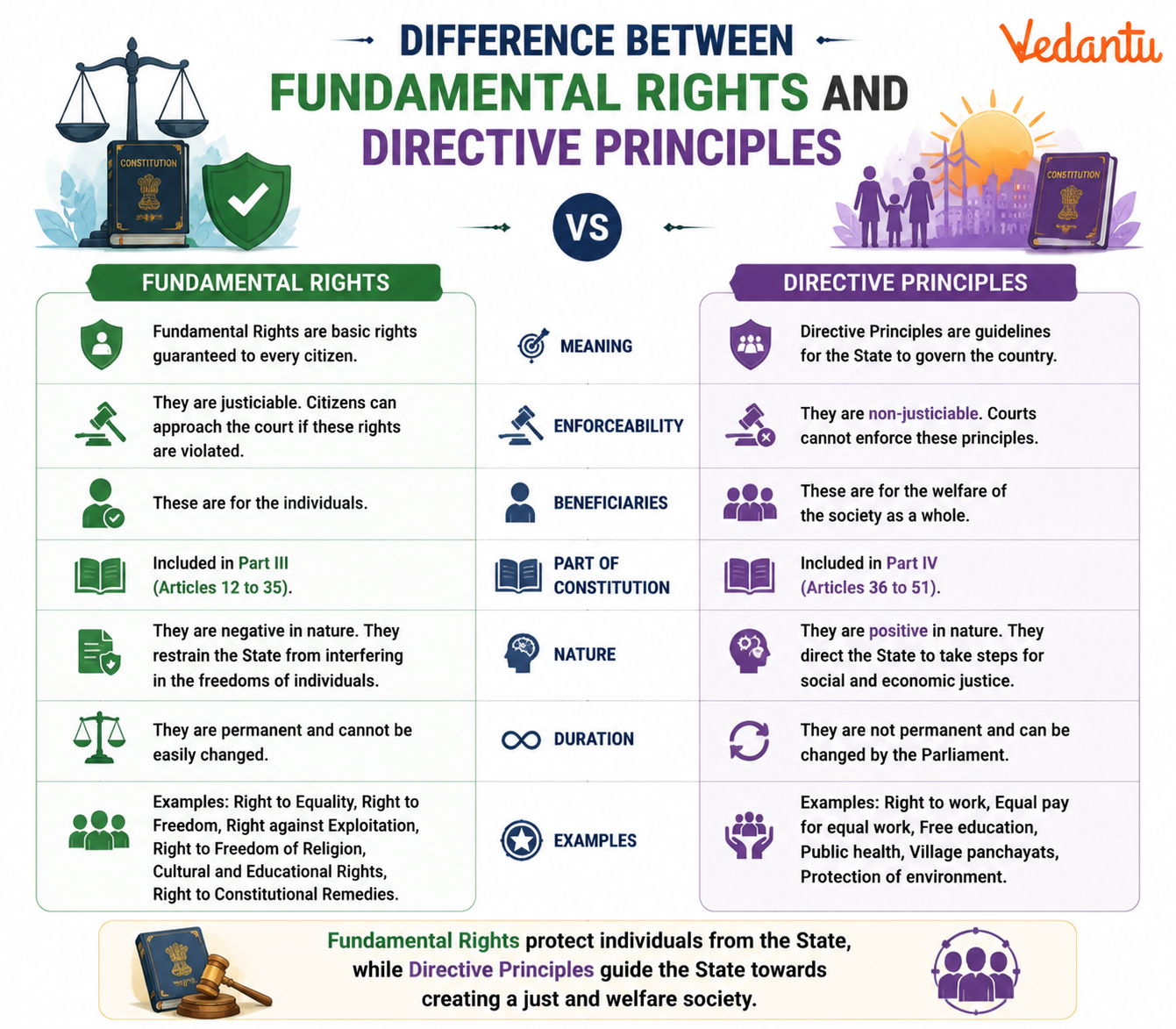
Introduction to Fundamental Rights
Fundamental Rights are basic rights guaranteed to citizens under Part III of the Indian Constitution from Articles 12 to 35. These rights are essential for the development of an individual’s personality and for ensuring political democracy in the country. They are enforceable by courts, meaning a person can approach the judiciary if these rights are violated.
Key Features of Fundamental Rights
- Guaranteed by the Constitution under Part III.
- Enforceable by courts under Article 32 and Article 226.
- Promote political democracy and individual liberty.
- Apply mainly to citizens, though some rights are available to all persons.
- Can be suspended during a National Emergency with certain exceptions.
Introduction to Directive Principles of State Policy
Directive Principles of State Policy are mentioned in Part IV of the Indian Constitution from Articles 36 to 51. They are guidelines given to the government to establish social and economic democracy in the country. These principles are not enforceable by courts, but they are fundamental in the governance of the country.
Key Features of Directive Principles
- Mentioned in Part IV of the Constitution.
- Not enforceable by any court of law.
- Aim to establish social and economic justice.
- Guide the State in policy making and law formulation.
- Promote the concept of a welfare state.
Difference Between Fundamental Rights and Directive Principles
| Basis of Comparison | Fundamental Rights | Directive Principles |
|---|---|---|
| Part of Constitution | Part III (Articles 12-35) | Part IV (Articles 36-51) |
| Nature | Justiciable and legally enforceable | Non-justiciable and not legally enforceable |
| Objective | Political democracy and individual rights | Social and economic democracy |
| Authority | Courts can enforce | Courts cannot enforce |
| Suspension | Can be suspended during Emergency | Cannot be suspended as they are guidelines |
The table clearly shows that Fundamental Rights focus on protecting individual freedoms, while Directive Principles focus on guiding the State to create a just and equitable society. Both complement each other and together help in achieving the goals of the Constitution.
Relationship Between Fundamental Rights and Directive Principles
Although Fundamental Rights and Directive Principles differ in nature, they are not opposed to each other. The Supreme Court has clarified in several judgments that both are complementary and supplementary to each other. The aim is to balance individual freedom with social welfare.
- Fundamental Rights ensure freedom and equality.
- Directive Principles ensure social and economic justice.
- Parliament can amend Fundamental Rights to implement Directive Principles within constitutional limits.
- Courts try to interpret laws in harmony with both parts.
Importance in Competitive Exams
The Difference Between Fundamental Rights and Directive Principles is frequently asked in competitive exams such as UPSC, SSC, State PSC, and other government examinations. Questions may appear in the form of direct comparisons, constitutional articles, or conceptual understanding.
Preparation Tips
- Memorize the Parts and Article numbers of both.
- Understand the meaning of justiciable and non-justiciable.
- Practice previous year questions related to Indian Polity.
- Focus on landmark judgments explaining their relationship.
Conclusion
In conclusion, the Difference Between Fundamental Rights and Directive Principles lies mainly in their enforceability and purpose. Fundamental Rights protect individual liberties and are legally enforceable, while Directive Principles guide the State in building a welfare society and are not enforceable by courts. Together, they form the backbone of the Indian Constitution and ensure the balanced development of political, social, and economic justice in the country.
FAQs on Difference Between Fundamental Rights and Directive Principles in the Indian Constitution
1. What is the main difference between Fundamental Rights and Directive Principles of State Policy?
The main difference between Fundamental Rights and Directive Principles is that Fundamental Rights are legally enforceable, whereas Directive Principles are non-justiciable guidelines for governance.
• Fundamental Rights (Part III) protect individual freedoms and can be enforced in court.
• Directive Principles of State Policy (Part IV) guide the government in policymaking but cannot be enforced by courts.
• Fundamental Rights focus on political and civil rights, while Directive Principles focus on social and economic justice.
• Both are essential features of the Indian Constitution and promote democracy and welfare state principles.
2. What are Fundamental Rights in the Indian Constitution?
Fundamental Rights are basic human rights guaranteed by the Indian Constitution to protect citizens from state oppression.
• Mentioned in Part III (Articles 12–35).
• Include rights like Right to Equality, Right to Freedom, Right against Exploitation, Right to Freedom of Religion, Cultural and Educational Rights.
• Enforceable through the Supreme Court (Article 32) and High Courts (Article 226).
• Promote liberty, equality, and democratic governance.
3. What are Directive Principles of State Policy (DPSP)?
Directive Principles of State Policy are constitutional guidelines for establishing a welfare state in India.
• Mentioned in Part IV (Articles 36–51).
• Inspired by the Irish Constitution.
• Aim to promote social justice, economic equality, and good governance.
• Not legally enforceable but fundamental in governance.
• Examples include equal pay for equal work and free legal aid.
4. Are Directive Principles enforceable by courts?
No, Directive Principles are not enforceable by any court of law.
• DPSPs are non-justiciable in nature.
• Courts cannot compel the government to implement them.
• However, they influence law-making and judicial interpretation.
• They help in achieving the goal of a welfare state under the Indian Constitution.
5. Why are Fundamental Rights important for citizens?
Fundamental Rights are important because they safeguard individual liberty and protect citizens from arbitrary state action.
• Ensure equality before law.
• Protect freedom of speech and expression.
• Prevent discrimination and exploitation.
• Provide the right to constitutional remedies under Article 32.
• Form the backbone of Indian democracy and rule of law.
6. What happens when Fundamental Rights conflict with Directive Principles?
When Fundamental Rights conflict with Directive Principles, courts aim to maintain a balance between them.
• Initially, Fundamental Rights were given supremacy (Champakam Dorairajan Case, 1951).
• After the Kesavananda Bharati Case (1973), harmony and balance were emphasized.
• Parliament can amend laws to implement DPSPs, but not violate the Basic Structure Doctrine.
• Both are complementary parts of the Constitution.
7. Which part of the Constitution contains Fundamental Rights and Directive Principles?
Fundamental Rights are in Part III, while Directive Principles are in Part IV of the Indian Constitution.
• Part III (Articles 12–35) – Fundamental Rights.
• Part IV (Articles 36–51) – Directive Principles of State Policy.
• Both sections reflect the vision of the Constituent Assembly.
• Together, they aim to establish political democracy and social democracy.
8. Can Fundamental Rights be amended?
Yes, Fundamental Rights can be amended, but not beyond the Basic Structure of the Constitution.
• Amendments are made under Article 368.
• The Kesavananda Bharati Case (1973) restricted Parliament's power.
• Parliament cannot destroy the basic structure doctrine.
• Example: The 44th Constitutional Amendment (1978) removed the Right to Property as a Fundamental Right.
9. What are examples of Directive Principles of State Policy?
Examples of Directive Principles focus on promoting social and economic welfare in India.
• Equal pay for equal work (Article 39).
• Free and compulsory education (Article 45).
• Promotion of cottage industries.
• Protection of environment and wildlife (Article 48A).
• Uniform Civil Code (Article 44).
These principles guide the state in building a just society.
10. How are Fundamental Rights and Directive Principles complementary to each other?
Fundamental Rights and Directive Principles are complementary because together they ensure political freedom and social justice.
• Fundamental Rights guarantee individual liberty and equality.
• Directive Principles promote economic and social welfare.
• Rights without welfare are incomplete, and welfare without rights can be oppressive.
• The Indian Constitution blends both to achieve the goal of a democratic welfare state.
