Practise Class 4 EVS Chapter 7 Important Questions on How Things Work
The following questions cover spinning objects, cardboard spinners, colour patterns, floating and sinking, paper boats, aluminium foil and balancing activities.
Class 4 EVS Chapter 7 Important Questions MCQ with Answers
Q1. What did Meera spin at the beginning of the chapter?
(a) A wooden wheel
(b) A coin
(c) A paper boat
(d) An empty bottle
Answer: (b) A coin.
Explanation: Meera spun a coin while Dhruv watched. This made them curious about how different objects spin.
Q2. Which object is least likely to spin steadily in the activity?
(a) Wooden top
(b) Coin
(c) Bangle
(d) Ordinary rectangular eraser
Answer: (d) Ordinary rectangular eraser.
Explanation: A rectangular eraser is not shaped like a spinning top. It usually wobbles or stops quickly when we try to spin it.
Q3. Where should the toothpick be placed to help a circular cardboard spinner spin steadily?
(a) Near the edge
(b) At the centre
(c) Outside the cardboard
(d) At any position
Answer: (b) At the centre.
Explanation: A toothpick placed at the centre helps balance the cardboard around the point of rotation.
Q4. What is a charkha used for?
(a) Making paper boats
(b) Spinning cotton fibres into thread
(c) Measuring water
(d) Balancing stones
Answer: (b) Spinning cotton fibres into thread.
Explanation: A charkha is a traditional spinning wheel used to make thread from cotton fibres.
Q5. Which statement about floating and sinking is correct?
(a) All heavy objects sink
(b) All light objects float
(c) All metal objects sink
(d) Shape and material can affect floating and sinking
Answer: (d) Shape and material can affect floating and sinking.
Explanation: An empty steel bowl may float, while a small iron nail sinks. Weight alone does not decide whether an object floats.
Class 4 EVS Chapter 7 Very Short Answer Questions
Q6. What is a spinner?
Answer: A spinner is an object that turns around a point or axis. A spinning top is an example.
Q7. What is a lattu?
Answer: A lattu is a traditional Indian spinning top, commonly made of wood.
Q8. What is a charkha used for?
Answer: A charkha is a spinning wheel used to make thread from cotton fibres.
Q9. What does floating mean?
Answer: Floating means staying on or near the surface of water without sinking to the bottom.
Class 4 EVS Chapter 7 Short Answer Questions
Q10. What did Meera and Dhruv learn by spinning different objects?
Answer:
Meera and Dhruv tried spinning objects of different shapes.
They learned that the shape of an object and the way it is placed affect its spinning.
Q11. Picture-Based Question: Compare Two Cardboard Spinners.
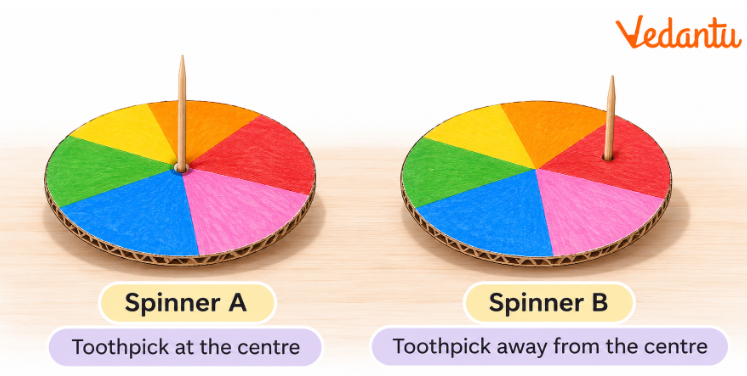
Observe two circular cardboard spinners.
Spinner A: The toothpick passes through the centre.
Spinner B: The toothpick passes through a point away from the centre.
Answer the following questions:
(a) Which spinner is more likely to spin steadily?
(b) Which spinner may wobble more?
(c) What is the main difference between the two spinners?
(d) How can Spinner B be improved?
Answer:
(a) Spinner A is more likely to spin steadily.
(b) Spinner B may wobble more.
(c) Spinner A has its toothpick at the centre, while Spinner B has it away from the centre.
(d) Move the toothpick to the centre of Spinner B.
Q12. Why does a spinning coin wobble before stopping?
Answer:
When we spin a coin, it moves quickly at first.
As the coin spins, friction with the surface and resistance from the air gradually slow it down. The coin begins to wobble, becomes less steady, and finally falls flat.
Observation: Watch a spinning coin carefully to see how its movement changes before it stops.
Q13. What happens when a square cardboard spinner rotates quickly?
Answer:
A square cardboard spinner may appear almost circular when it rotates quickly.
Its corners move around so fast that we cannot easily see its square outline. When the spinner slows down, its corners become easier to see.
Compare square, triangular and circular cardboard spinners while they rotate.
Q14. Picture-Based Question: Observe the Colours of Spinning Tops.
Look at the four coloured cardboard spinners shown in the picture.
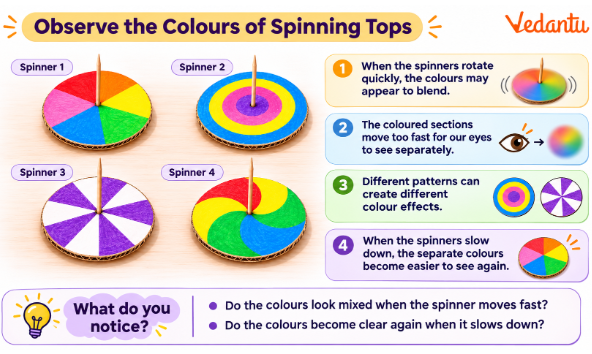
Answer the following questions:
(a) What happens to the colours when the spinners rotate quickly?
(b) Why do the coloured sections become difficult to see separately?
(c) Will all four spinners produce the same colour effect?
(d) What happens when the spinners slow down?
Answer:
(a) The colours may appear to blend.
(b) The coloured sections move too quickly for our eyes to follow separately.
(c) No. Different colour patterns may produce different effects.
(d) The separate colours become easier to see as the spinners slow down.
Q15. Why did some paper boats made by Meera and Dhruv float while others flipped over?
Answer:
Meera and Dhruv made paper boats and placed them in a puddle after the rain.
Some boats floated properly, while others flipped over.
Possible reasons include:
Some boats were folded more evenly.
Some had a wider and more stable base.
Some were not balanced properly.
Water entering a boat could make it unstable.
The shape, folding and balance of a paper boat affect how well it floats.
Q16. Picture-Based Question: Which Objects Float and Which Sink?
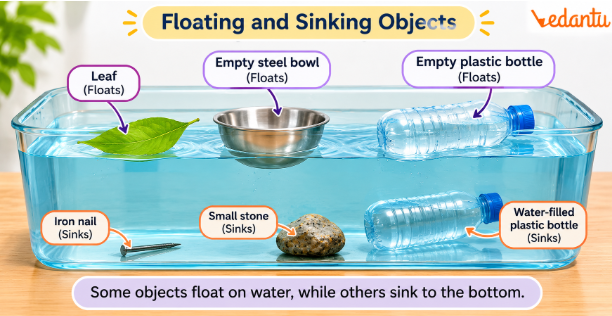
A student places different objects in a bowl of water.
Predict what may happen to each object.
Question: Why should students test the objects instead of deciding only by their weight?
Answer: Objects of different materials and shapes behave differently in water. Testing helps us observe what actually happens.
Q17. How does changing the shape of aluminium foil affect whether it floats or sinks?
Answer:
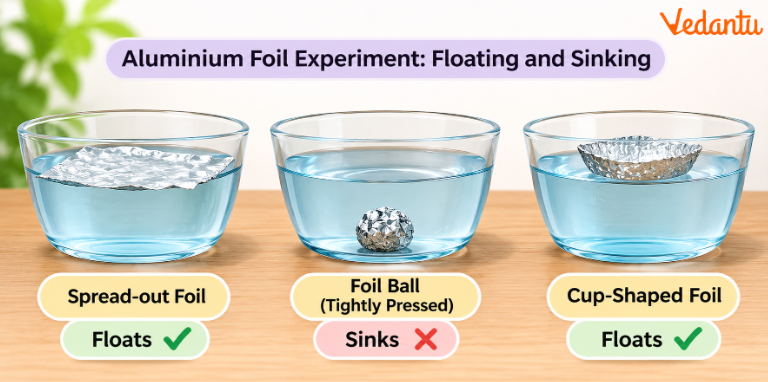
The textbook shows an experiment using aluminium foil in different shapes.
The cup-shaped foil can push aside enough water to support its weight. A tightly pressed ball takes up less space in the water and may sink.
Changing the shape of an object can affect how it behaves in water.
Class 4 EVS Chapter 7 Long Answer and Application-Based Questions
Q18. Activity-Based Question: Make a Cardboard Spinner and Test Different Designs
Your teacher asks you to make a cardboard spinner and observe how changing its design affects spinning.
Explain how you will complete the activity.
Answer:
Materials Needed:
Cardboard
Pencil
Toothpick
Scissors
Colours or crayons
Steps:
Draw a circle on a piece of cardboard.
Cut out the circle with adult help.
Mark the centre of the circle.
Carefully make a hole at the centre with adult supervision.
Pass a toothpick through the hole.
Decorate the cardboard.
Spin it on a smooth surface.
Test Different Designs:
Conclusion: By changing one feature at a time, we can observe how a spinner's design affects its movement.
Q19. Activity-Based Question: Make a Boat Using Natural or Reused Materials
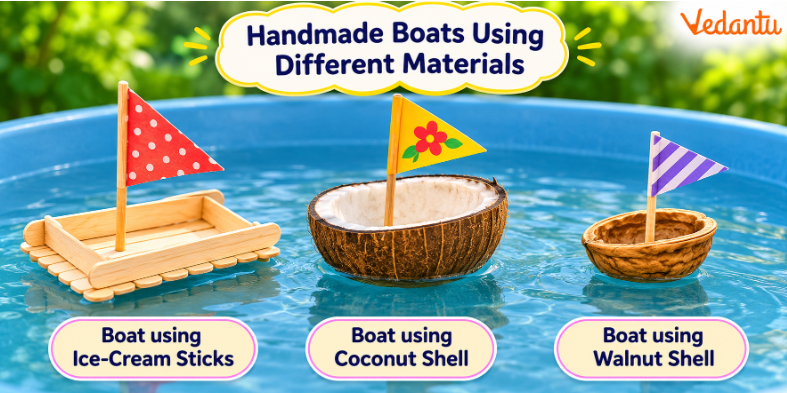
Your teacher asks you to make a small boat using materials such as coconut shells, walnut shells or ice-cream sticks.
How will you make and test your boat?
Answer:
Activity Name: My Floating Boat
Materials:
A coconut shell or ice-cream sticks
Adhesive tape
A small paper flag
A bowl or tub of water
Steps:
Choose suitable materials.
Plan the shape of the boat.
Make a base that can rest steadily on water.
Attach the parts carefully.
Place the boat gently in water.
Observe whether it floats or tips over.
Change the design if necessary.
Observation Table:
Conclusion: Testing a boat helps us understand how its shape and balance affect floating.
Q20. Picture-Based Question: How Can You Balance the Hanging Objects?
Look at the balancing activity shown in the textbook.
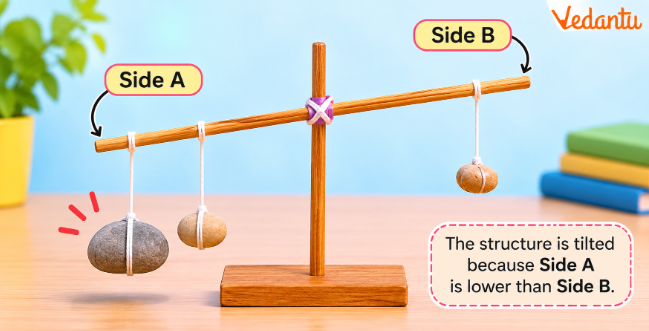
The structure is tilted because Side A is lower than Side B.
Answer the following questions:
(a) Which side is lower?
(b) Which side needs to move upwards?
(c) Suggest two ways to balance the structure.
(d) Why does the position of the hanging objects matter?
Answer:
(a) Side A is lower.
(b) Side A needs to move upwards.
(c) Two possible ways to balance the structure are:
Move some weight on Side A closer to the centre.
Add suitable weight to Side B or move its existing weight farther from the centre.
(d) The position of the hanging objects affects how strongly they turn the structure around its supporting point.
Both weight and distance from the centre affect balance.
Key Topics and Preparation Guide for Class 4 EVS Chapter 7 – How Things Work
Revise the following concepts before practising Class 4 EVS Chapter 7 important questions and answers.
Quick Preparation Tips for Class 4 EVS Chapter 7
Observe how a coin spins and wobbles before stopping.
Compare cardboard spinners with toothpicks at different positions.
Revise the colour patterns seen in fast-spinning tops.
Practise predicting and testing which objects float or sink.
Learn the steps of the aluminium foil and boat-making experiments.
Study how moving hanging objects can change their balance.
Class 4 EVS Chapter 7 Important Questions PDF Download
Download Vedantu's Class 4 EVS Chapter 7 important questions PDF to practise solved MCQs, short answers, picture-based questions and activity-based exercises from How Things Work.
The Class 4 EVS Chapter 7 important questions and answers PDF covers spinning objects, cardboard spinners, floating and sinking, aluminium foil, handmade boats and balancing activities for offline revision.
The PDF is regularly reviewed and updated to align with the latest syllabus.
CBSE Class 4 EVS Chapter 7 Study Materials
Use these chapter-specific resources to understand How Things Work and revise its experiments.
CBSE Class 4 EVS Chapter-wise Important Questions
Explore important questions from the other chapters of Our Wondrous World to revise topics related to communities, nature, health and the environment.
Important Study Materials for CBSE Class 4 EVS