



Key Benefits of Cambridge Curriculum Tutoring for Students
Personalized tutoring helps students master the Cambridge curriculum by identifying learning gaps, adapting explanations to their pace, and providing feedback on exam-style answers. For Cambridge students also preparing for NEET 2027, this support has an additional purpose: connecting strong subject understanding with syllabus-specific revision and multiple-choice practice. The most useful approach keeps Cambridge assessment requirements and NEET preparation distinct, while using overlapping Physics, Chemistry and Biology concepts to make study time more productive.
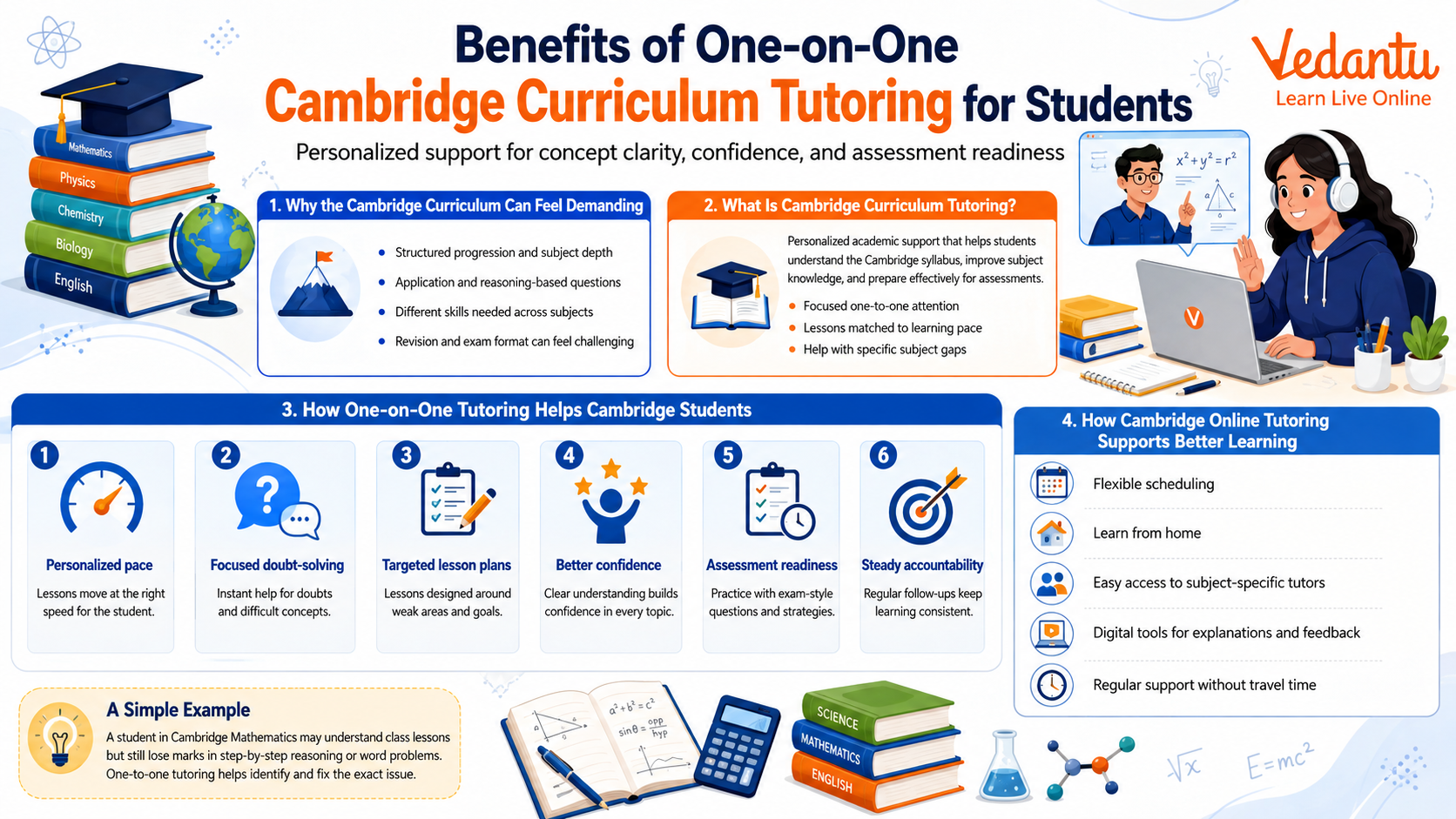
Why Cambridge Students May Need Personalized Support
Cambridge programmes develop subject knowledge alongside application, interpretation and reasoning. Depending on the subject and level, students may need to explain scientific processes, interpret unfamiliar data, show mathematical working or demonstrate practical understanding. Knowing a definition is not always enough to produce a complete answer.
A student may understand a classroom explanation yet struggle to solve a question independently. Another may know the science but miss what a command word such as “describe” or “explain” requires. One-on-one Cambridge curriculum tutoring can separate these difficulties and address the actual cause rather than simply assigning more questions.
How Personalized Tutoring Builds Cambridge Curriculum Mastery
Identifies the Gap Before Starting the Lesson
Effective tutoring begins with a short diagnostic task, a review of recent work and a discussion of the student’s difficulties. For example, errors in Physics calculations may come from weak algebra, incorrect units or misunderstanding the underlying principle. Each problem needs a different solution.
Adjusts the Pace Without Removing Challenge
A tutor can revisit a prerequisite, demonstrate one example and then ask the student to solve a fresh problem without help. Familiar material can receive a quick check rather than another full lesson. This makes personalization useful for both students rebuilding basics and confident learners tackling more demanding questions.
Makes Feedback Specific and Actionable
“Revise this chapter” is less useful than “Your answer identifies the trend but does not explain its cause.” A tutor can use the relevant syllabus, assessment objectives and mark schemes to show what needs improvement. Students should then rewrite or retry the answer themselves so that feedback becomes a learning task.
Builds Confidence Through Independent Success
Private sessions give students space to ask questions they might hesitate to raise in class. However, the goal is not constant assistance. Gradually reducing hints helps students become more independent. Vedantu’s guide to personalized online tuition for confidence and performance explores this aspect of individual support.
Connecting Cambridge Learning With NEET 2027 Preparation
Cambridge syllabus coverage should not be treated as automatic NEET syllabus coverage. Topic boundaries, terminology and assessment demands can differ. Students targeting medicine should build a separate NEET checklist alongside their Cambridge subject plans.
- Confirm the Cambridge syllabus: Record the programme, subject code, examination year and relevant assessment components.
- Map the NEET requirements: Use the latest officially published syllabus for planning and check the NEET 2027 syllabus and information bulletin when available.
- Identify overlap and gaps: Mark topics as shared, requiring additional NEET study, or needing separate Cambridge assessment practice.
- Use appropriate resources: Study relevant NCERT Class 11 and 12 content alongside Cambridge materials, guided by the official NEET syllabus.
- Practise both formats: Use Cambridge-style written or practical tasks where required and separate NEET-style multiple-choice sets.
For example, understanding enzymes can support both pathways. Cambridge practice may involve explaining experimental results, while NEET preparation may involve distinguishing closely related statements under time pressure. A tutor can teach the shared concept once, then practise each assessment skill separately.
Students with Cambridge qualifications should also verify the qualifying-examination, subject, equivalence and documentation requirements in the official NEET 2027 guidance. Tutoring support does not establish eligibility, and IGCSE alone should not be assumed to meet senior-secondary qualifying requirements.
Subject-Wise Tutoring Priorities for Cambridge Science Students
| Subject | Cambridge Learning Priority | Additional NEET Preparation |
|---|---|---|
| Physics | Reasoning, graphs, units and clear working | Timed numerical MCQs and efficient calculation |
| Chemistry | Concepts, equations, calculations and experimental interpretation | Syllabus-aligned recall and mixed conceptual and numerical MCQs |
| Biology | Scientific explanations, diagrams and data interpretation | Precise NCERT-based revision and statement-based practice |
The balance should follow the student’s actual errors. A Biology learner who remembers terms but cannot explain relationships needs concept work; one who understands processes but confuses similar statements needs closer reading and retrieval practice. More lessons are not always the answer—better-targeted practice may be.
A Practical Weekly Tutoring and Revision Routine
Build tutoring around independent study rather than filling every available hour with classes. The following routine can be adjusted around schoolwork, Cambridge assessments and NEET preparation.
- Before the session: Attempt a short topic test and bring specific doubts or incorrect answers.
- During the session: Review the main misconception, work through an example and attempt a new question independently.
- After the session: Recall key ideas without notes, then complete a short practice set.
- Later in the week: Revisit the concept through a Cambridge-style task and a separate NEET-style MCQ set where relevant.
- At the weekly review: Sort errors into concept gaps, recall gaps, calculation mistakes and misread questions.
Revisit difficult material after a few days and again in later mixed practice. As syllabus coverage grows, include broader timed tests and protect time for reviewing them. Vedantu’s article on how one-on-one online tuition supports exam-day preparation offers related guidance.
Choosing a Cambridge Tutor Online
Choose a tutor familiar with the student’s exact Cambridge programme and subject syllabus. If NEET support is also needed, check that expertise separately; experience with one assessment system does not automatically imply experience with the other.
- Check teaching fit: In an initial session, notice whether the tutor asks the student to explain their thinking.
- Look for syllabus alignment: Lessons should reflect the correct examination year and assessment components.
- Ask about feedback: Expect clear correction, follow-up practice and checks of independent understanding.
- Assess the online format: Students should be able to show working, annotate diagrams and receive usable feedback.
- Keep the schedule manageable: Leave room for school assignments, self-study, revision and rest.
For students at IGCSE level, Vedantu’s guide to one-on-one tuition for Cambridge IGCSE exams provides programme-specific context. Students progressing towards NEET should plan senior-secondary subject study separately.
Tracking Progress Without Depending on the Tutor
Track what the student can do alone, not just how many lessons they attend. Useful indicators include fewer repeated errors, clearer explanations, improved accuracy on comparable practice sets and better recall after a gap. Parents can review these indicators with the tutor without turning every session into a marks discussion.
Avoid passive lessons, excessive homework without feedback and dropping Cambridge written or practical preparation in favour of MCQs alone. Equally, do not assume strong Cambridge grades remove the need for NEET-specific revision. Each goal needs evidence of readiness in its own assessment format.
Personalized tutoring is most useful when it turns specific learning gaps into focused practice and stronger independent performance. For Cambridge students targeting NEET 2027, the right plan combines syllabus mapping, clear concepts, Cambridge assessment skills and separate NEET revision. Choose support that helps you understand more deeply, practise purposefully and gradually need fewer hints.
FAQs on How Personalised One-on-One Tutoring Improves Cambridge Curriculum Mastery
1. What is Cambridge curriculum tutoring?
Cambridge curriculum tutoring is personalised support tailored to the Cambridge programmes’ syllabus, subject depth, and assessment style. It helps students by:
• Clarifying challenging concepts and topics
• Offering targeted practice that matches Cambridge exam patterns
• Adapting lessons to each student’s learning pace and academic needs
• Preparing for Cambridge assessments with focused revision and feedback
2. How does one-on-one tutoring help Cambridge students?
One-on-one Cambridge tutoring provides personalised academic guidance, making it easier for students to master concepts and improve exam performance. Benefits include:
• Lessons adapted to the student's strengths and weaknesses
• Immediate resolution of doubts
• Practice tailored to syllabus and assessment style
• Boosted confidence through individual attention
3. Which Cambridge programme levels can tutoring support?
Cambridge curriculum tutoring can support learners at various stages, including Cambridge Primary, Lower Secondary, IGCSE, O Level, International AS Level, and International A Level. Tutors customise lessons to match the student’s current programme, subject, and specific assessment requirements.
4. Which subjects can a Cambridge tutor teach?
Cambridge tutors can provide subject-specific support in Mathematics, Science (Physics, Chemistry, Biology), English, and other Cambridge subjects. Support typically includes:
• Targeted concept explanation
• Application-based question practice
• Writing skills and comprehension
• Revision planning and assessment strategies
5. Is online tutoring effective for the Cambridge curriculum?
Yes, Cambridge online tutoring is effective when it is syllabus-aligned, interactive, and adapts to a student's learning style. Key benefits include:
• Flexible scheduling around school and activities
• Access to expert tutors without location limits
• Continuous feedback and progress tracking
• Digital tools for clear explanations and problem-solving
6. How can Cambridge tutoring help with exam preparation?
Cambridge tutoring for exam preparation focuses on developing exam-readiness and confidence. Effective tutoring will:
• Review syllabus and assessment objectives
• Practise a range of Cambridge question types
• Strengthen answer structure and time management
• Identify and correct recurring errors
• Build a structured revision plan leading up to assessments
7. How is one-on-one Cambridge tutoring different from group learning?
One-on-one Cambridge tutoring provides personalised lessons just for one student, while group learning follows a fixed pace for a group. Individual sessions offer:
• Immediate, detailed doubt-solving
• Full tutor attention
• Lesson pacing adapted to one student’s progress
• Customised feedback and accountability
Group classes may offer peer interaction but tend to move at a collective pace.
8. How do I choose the right Cambridge tutor online?
To choose the right Cambridge tutor online:
• Check for experience with Cambridge syllabuses and assessment formats
• Confirm adaptability to your child’s learning pace and needs
• Look for structured explanations and patient doubt-solving
• Prefer a tutor who provides regular feedback and progress tracking
• Ensure the schedule supports consistent study and revision
9. How often should a student attend Cambridge tutoring sessions?
The ideal frequency of Cambridge tutoring depends on a student’s goals, current understanding, and upcoming assessments. Usually:
• 1–2 sessions per week support ongoing learning
• Extra sessions may be scheduled before exams
• Enough time should be left for independent practice and review
10. Is Cambridge curriculum tutoring only for students who are struggling?
No, Cambridge curriculum tutoring benefits all learners—struggling students, those who need help applying concepts, and high-achievers aiming for deeper subject mastery. Personalised tutoring can:
• Rebuild weak fundamentals
• Provide challenge and enrichment
• Develop strong exam techniques for top performers
11. How can parents track progress in Cambridge online tutoring?
Parents can track tutoring progress by:
• Reviewing set learning goals and completed topics
• Monitoring regular tutor feedback
• Comparing performance in practice tasks and assessments
• Discussing confidence, consistency, and upcoming revision priorities with the tutor
12. What are the main benefits of one-on-one Cambridge Curriculum tutoring?
Main advantages of one-on-one Cambridge tutoring:
• Lessons progress at a comfortable, productive pace
• Doubts are addressed immediately and thoroughly
• Practice targets specific conceptual or skill gaps
• Regular, personalised feedback improves confidence and results
• Revision aligns with Cambridge assessment requirements



