



Exams are an integral part of education systems worldwide, but have you ever wondered who invented exams? While exams have been a staple of modern academic life, their origins trace back centuries. From ancient civil service tests to the creation of standardized testing systems, the journey of exams is both fascinating and complex. In this article, we will explore who invented exams, their evolution over time, and the types of exams that shape academic and professional life today, including exams like JEE and NEET.
What is the History of Exams?
Exams did not have a single inventor, but rather evolved over time across cultures and civilizations. The earliest forms of exams can be traced back to Imperial China, where the Imperial Examinations (Keju) were used to recruit officials based on merit. These exams began during the Sui Dynasty (circa 607 CE) and continued for over 1,300 years, serving as the first large-scale written competitive exams.
The development of exams was not limited to one country; many ancient civilizations contributed to the idea of assessments. For instance, Imperial China’s civil service exams influenced the British and later Western systems of education.
Who Invented Exams? The Role of Henry Fischel
Although no single person invented exams, Henry Fischel, an American businessman-philanthropist, is often credited with shaping modern exams. In the late 19th century, Fischel helped to formalize the idea of written exams as a systematic and standardized method of evaluating students. His contributions helped transform exams into the widespread educational tools they are today.
However, Fischel's contributions were not about inventing exams from scratch, but about institutionalizing written assessments as a formal means of measuring student progress and knowledge.
Who Invented Exams in India?
In India, the concept of exams evolved similarly. The British colonial government introduced written exams for recruitment into civil services, drawing inspiration from the Imperial Chinese model. These exams, like the Indian Civil Services (ICS) exams, became the precursors to modern competitive exams in India. Today, exams like JEE and NEET are key to gaining admission to top universities in India, continuing the legacy of merit-based selection.
Types of Exams
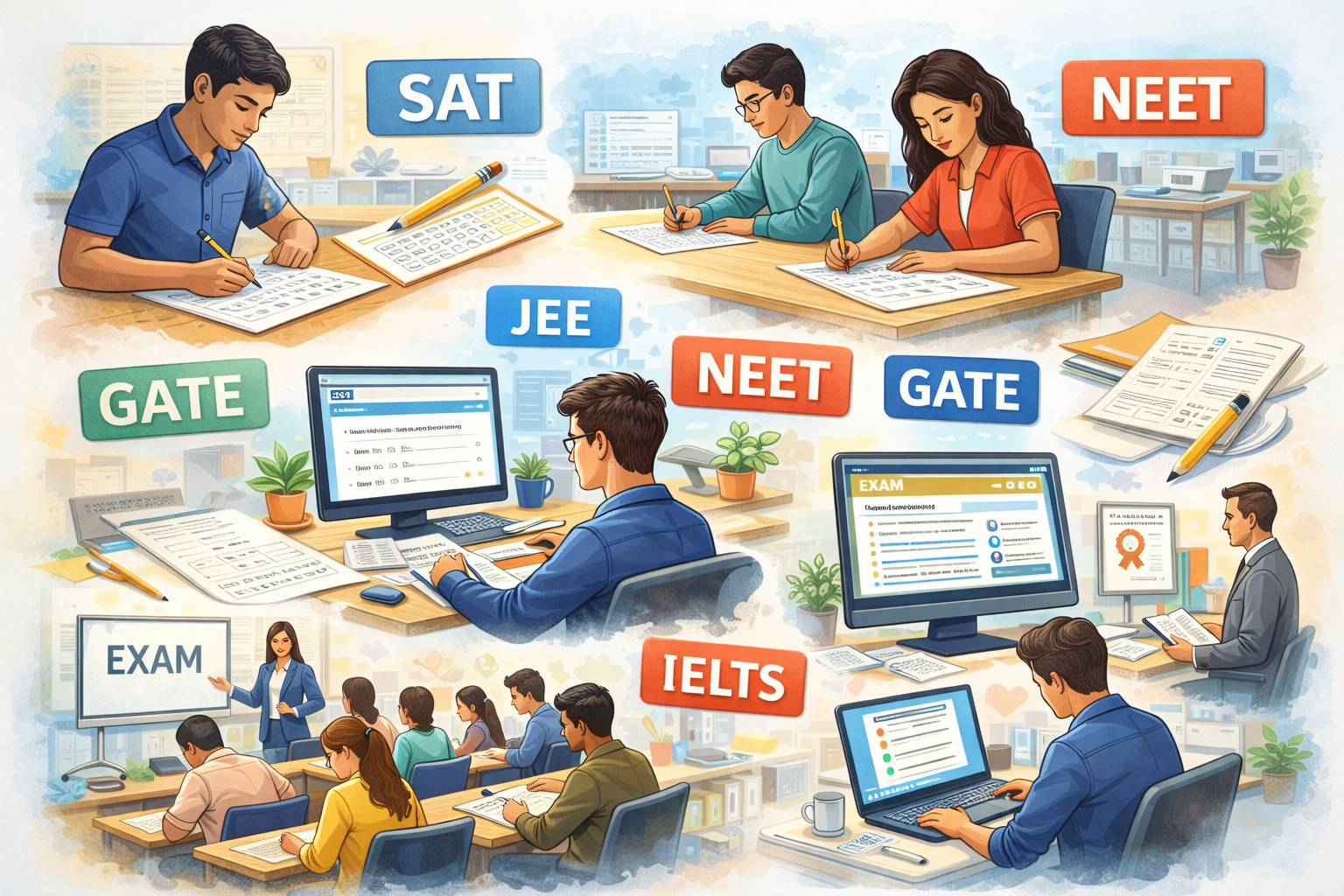
Exams today come in various forms, serving different purposes. Here’s a breakdown of some of the key types of exams:
Standardized Exams: These exams are the same for all students, ensuring consistency in the assessment process. Examples include the SAT in the US, the JEE (Joint Entrance Examination) in India, and the NEET (National Eligibility cum Entrance Test).
Entrance Exams: These exams are used for admission to colleges or universities. Popular exams include:
JEE Exam: The Joint Entrance Examination is a highly competitive exam for admission into undergraduate engineering programs in India.
NEET Exam: The National Eligibility cum Entrance Test is used for admission into medical and dental colleges in India.
Classroom Exams: These exams are commonly used in schools and colleges to assess student knowledge over a specific term or subject.
Certification Exams: These exams are taken to obtain professional certifications, such as the GATE (Graduate Aptitude Test in Engineering) or IELTS (International English Language Testing System).
What is JEE Exam?
The JEE exam (Joint Entrance Examination) is one of the most prestigious entrance exams in India. It is conducted in two phases: JEE Main and JEE Advanced. The exam is held for admission into undergraduate engineering programs at various Indian Institutes of Technology (IITs), National Institutes of Technology (NITs), and other top engineering colleges in India.
JEE is a highly competitive exam, testing knowledge in subjects like Physics, Chemistry, and Mathematics.
What is NEET Exam?
The NEET exam (National Eligibility cum Entrance Test) is a national-level exam conducted by the National Testing Agency (NTA) for admission into medical and dental colleges in India. It is the only entrance exam for undergraduate medical education (MBBS) and dental education (BDS) in India. NEET has become essential for students aspiring to pursue a medical career and is the most recognized exam for admissions to top medical colleges.
Why Do We Use Exams Today?
Exams have become an integral part of the educational and professional landscape due to their ability to:
Ensure Merit-Based Selection: Exams ensure that students are evaluated based on their knowledge and abilities rather than external factors like family background.
Standardize Assessment: Exams provide a uniform way of assessing students, ensuring fairness and consistency.
Foster Healthy Competition: Competitive exams encourage students to perform their best and push their limits.
Offer Opportunities: Exams like JEE and NEET provide students with opportunities to get into prestigious institutions and pursue careers in medicine and engineering.
Conclusion
Exams have evolved significantly over time, with roots tracing back to ancient civilizations. While Henry Fischel is often credited with formalizing modern written exams, their origins go back to Imperial China’s civil service exams. In India, the introduction of exams began with the British colonial system, leading to modern-day entrance exams like JEE and NEET. Today, exams serve as essential tools for assessing students' knowledge, providing a merit-based system for educational and professional opportunities.
Whether it’s for admission to top universities or career advancement, exams like JEE and NEET continue to play a vital role in shaping the future of millions of students worldwide. At Vedantu, we believe in providing the best preparation for these crucial exams, offering personalized learning resources and expert guidance to ensure every student reaches their potential and succeeds in their academic journey.
FAQs on Who Invented Exams? Unraveling the History and Evolution of Examinations
1. Who Invented Exams?
Exams evolved over time, with no single inventor. The system was formalized by Henry Fischel in the 19th century, building on earlier practices like China’s Imperial Examinations.
2. Who Invented the First Exam?
The first exams can be traced back to Imperial China, which used them to recruit government officials based on merit.
3. What is JEE Exam?
The JEE exam is an entrance exam for admission to engineering programs at top institutions in India, including IITs and NITs.
4. What is NEET Exam?
The NEET exam is used for admissions to undergraduate medical and dental courses in India.
5. Why Do We Use Exams Today?
Exams are essential for merit-based selection, standardized assessment, and fostering healthy competition



