








NEET Courses Based on Rank: Options, Eligibility & Career Paths
Searching for which courses come under NEET other than MBBS is a common challenge for medical aspirants. NEET acts as an entry point for many healthcare courses apart from MBBS, opening the door to diverse fields in medicine, AYUSH, nursing, and allied health. Understanding these options early supports better career decisions after NEET results are announced.
Why NEET Is Not Just for MBBS
Many believe NEET only leads to MBBS, but it is the qualifying exam for a range of healthcare courses in India. After clearing NEET, students can consider dental, AYUSH, veterinary, and other health science degrees. This understanding broadens career prospects beyond the traditional route.
Which Courses Come Under NEET Other Than MBBS?
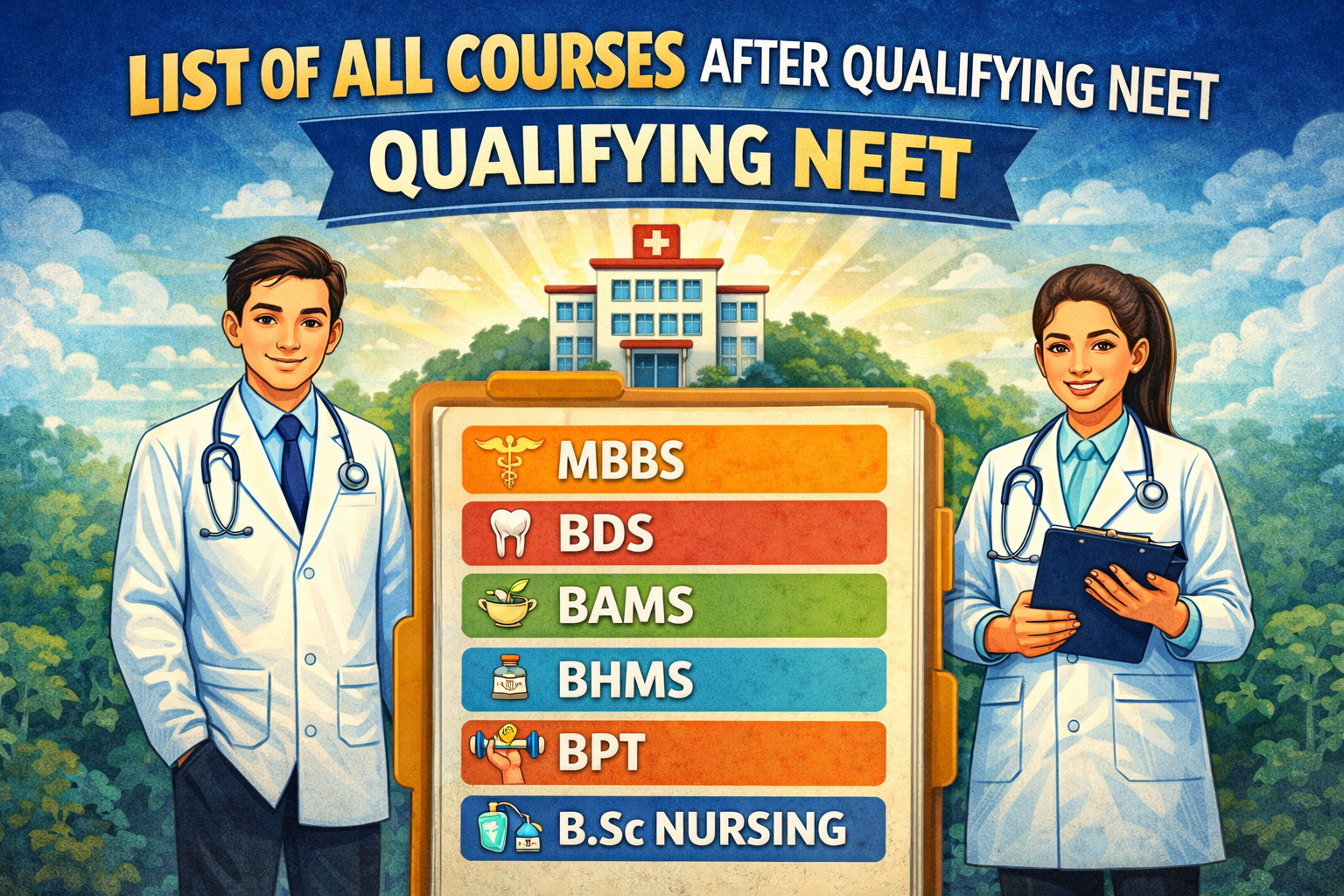
NEET-UG qualification is required for admissions to several courses besides MBBS. Gaining awareness about these courses helps students identify professional paths best aligned to their skills and ambitions. Below is a structured overview of these options.
Bachelor of Dental Surgery (BDS) – Focuses on dental and oral health.
Bachelor of Ayurveda, Medicine, and Surgery (BAMS) – Involves traditional Ayurvedic medicine.
Bachelor of Homeopathic Medicine & Surgery (BHMS) – Centres around homeopathy.
Bachelor of Unani Medicine & Surgery (BUMS) – Specialises in Unani medicine.
Bachelor of Siddha Medicine & Surgery (BSMS) – Focuses on Siddha traditions.
Bachelor of Naturopathy & Yogic Sciences (BNYS) – Encompasses naturopathy and yoga therapy.
Bachelor of Veterinary Science and Animal Husbandry (BVSc & AH) – Dedicated to animal healthcare.
BSc Nursing – Professional nursing education for hospital settings.
Bachelor of Physiotherapy (BPT) – Helps patients recover physical mobility.
Various Allied Health Programmes – Including occupational therapy, optometry, and radiology.
These courses build a foundation for careers in different branches of healthcare, often providing strong employment opportunities.
AYUSH Courses Through NEET
Students interested in traditional systems of medicine can pursue BAMS, BHMS, BUMS, BSMS, and BNYS after qualifying NEET. These degrees involve four to five-year study periods and include mandatory internships for hands-on training.
AYUSH degrees are regulated by national authorities and recognised for clinical practice.
Students study modern subjects along with traditional healing systems.
Such courses suit those aspiring for holistic and preventive approaches in healthcare and community service.
Allied Health & Paramedical Courses under NEET
Due to evolving regulations, several allied health science programs now require NEET qualification. These professions provide crucial diagnostic and therapeutic support in hospitals and health centres, offering strong demand.
Bachelor of Science (BSc) in Nursing, Optometry, Medical Lab Technology, and Radiology.
Bachelor of Physiotherapy (BPT) and Occupational Therapy (BOT).
Bachelor of Audiology and Speech Language Pathology (BASLP).
Programs in prosthetics, orthotics, and emergency care.
These fields are gaining popularity for their employment scope and the chance to develop specialist expertise.
Eligibility Criteria for NEET Courses
NEET is only for students who have studied Physics, Chemistry, and Biology (PCB) in class 12. Biology is a mandatory subject for all NEET-based courses. Score requirements and reservation policies vary by state and institute.
Candidates must be 17 years or older at admission.
Indian and overseas nationals are eligible.
Certain allied health disciplines have separate age or score criteria.
Researching detailed course-specific eligibility is essential before applying for counselling and admissions.
Courses Under NEET: Rank vs. Course Options
Your NEET rank determines which courses and colleges are available. Top ranks offer government MBBS or BDS seats, while middle and lower ranks unlock AYUSH, nursing, and allied health paths. Strategic choice ensures you make the most of your performance.
High ranks secure MBBS/BDS in top government colleges.
Mid-range ranks make private MBBS/BDS or public AYUSH courses possible.
Lower ranks offer allied health, nursing, and physiotherapy admissions.
Understanding realistic options based on cut-off trends increases confidence during counselling rounds.
Quick Comparison: Popular Courses Under NEET
This table highlights core information on major NEET courses, helping students compare essential details about program duration and future fields.
How to Choose the Right NEET Course
Selecting the best course depends on personal strengths, rank, preferences, and long-term goals. While MBBS is the dream for many, several other NEET-based courses offer impactful and respected healthcare careers.
Assess your interests in direct patient care or technical roles.
Consider course length, study environment, and practical training options.
Review past year cut-offs for target colleges and courses.
Guidance from mentors and careful career planning boosts satisfaction and confidence throughout the admission process.
Explore Related Student Resources
For those preparing for competitive exams, learning effective strategies is crucial. Students can benefit from study methods to master both JEE Main and NEET. Additionally, insights on the key differences between JEE and NEET help clarify exam choices.
If you are looking for parallel exam guidance, see how to prepare for JEE and NEET together or explore alternative courses after entrance exams on Vedantu.
Choosing the right program after NEET depends on informed planning, self-awareness, and an honest assessment of career options. From MBBS and BDS to AYUSH, veterinary, nursing, and allied sciences, aspirants have multiple paths to serve in India’s healthcare system.
FAQs on List of All Courses After Qualifying NEET 2026
1. What are the main courses available after qualifying NEET 2026?
After qualifying NEET 2026, candidates can pursue a wide range of undergraduate healthcare and medical courses, including:
MBBS (Bachelor of Medicine, Bachelor of Surgery)
BDS (Bachelor of Dental Surgery)
AYUSH courses such as BAMS, BHMS, BUMS, BSMS, BNYS
BVSc & AH (Bachelor of Veterinary Science and Animal Husbandry)
B.Sc. Nursing
BPT (Bachelor of Physiotherapy)
Allied health sciences like Occupational Therapy, Optometry, Medical Lab Technology, and Radiology
2. Is NEET only for MBBS or are there other programs included?
NEET is not limited to MBBS admissions. It is the eligibility exam for MBBS, BDS, AYUSH, veterinary, nursing, and selected allied health courses, making it essential for a broad range of medical and healthcare professions.
3. Which stream is eligible to appear for NEET 2026?
Only students from the Science stream with Physics, Chemistry, and Biology (PCB) in Class 12 are eligible to appear for NEET 2026. Biology is mandatory for applying and for all NEET-based courses.
4. What are AYUSH courses and can they be pursued through NEET?
AYUSH courses include BAMS (Ayurveda), BHMS (Homeopathy), BUMS (Unani), BSMS (Siddha), and BNYS (Naturopathy & Yoga). Admission to these programs in 2026 will be through NEET, as per the current guidelines.
5. Which allied health courses require NEET from 2026 onwards?
From the 2026 admissions cycle, several allied health science courses require NEET qualification, including:
B.Sc. Nursing
BPT (Physiotherapy)
Bachelor of Occupational Therapy
B.Sc. in Medical Imaging Technology
B.Sc. in Medical Laboratory Technology
B.Sc. Optometry
B.Sc. Radiology and Anaesthesia
6. What is the NEET courses list rank-wise and how does it help in counselling?
The NEET courses list rank-wise means programs are allocated based on your NEET rank. Higher ranks generally secure government MBBS/BDS seats, while mid and lower ranks find opportunities in:
Private medical colleges
AYUSH colleges
Veterinary sciences
Nursing and allied healthcare programs
Understanding this helps students set realistic preferences and improves their counselling decisions.
7. After NEET, if MBBS is not possible, what are other good career options?
If MBBS is not achievable, students can choose other rewarding healthcare careers such as:
BDS (Dentistry)
BAMS, BHMS, BUMS (AYUSH)
B.Sc. Nursing
BPT (Physiotherapy)
Allied health sciences (e.g., Occupational Therapy, Optometry, Radiology, MLT)
These fields offer strong job prospects and diverse professional growth.
8. Can I get a veterinary seat with NEET 2026 scores?
Yes, admission to Bachelor of Veterinary Science & Animal Husbandry (BVSc & AH) is done through NEET scores. Candidates must meet the eligibility and cut-off criteria set by veterinary colleges and authorities.
9. Is NEET required for B.Sc. Nursing and other allied health sciences from 2026?
Yes, NEET qualification is mandatory for B.Sc. Nursing and several other allied health science courses from 2026 onwards in most government and private institutes, as per recent regulatory updates.
10. How should students select the best course after NEET according to their rank?
Students should consider the following to select the most suitable course:
Interest and aptitude for the field (clinical, dental, nursing, allied health, veterinary, AYUSH)
NEET rank and expected cut-offs of various programs
Long-term career scope and growth potential in each field
Admission trends from previous years and seat availability
11. What documents are required during counselling for NEET courses?
Candidates need to provide the following essential documents at the time of counselling:
NEET Admit Card & Score Card
Class 10 and 12 Mark Sheets and Certificates
Domicile and Category Certificates (if applicable)
Passport-size Photographs
Identity Proof (Aadhar Card, etc.)
12. Are there management quota seats available in NEET-based courses?
Yes, most private colleges offer a limited number of management quota seats in MBBS, BDS, AYUSH, nursing, and allied health sciences. However, qualifying NEET is typically mandatory even for management quota admissions.
