



How IB Tutors Improve Exam, Internal Assessment, and Essay Results
IB assessment tutoring is personalized academic support that helps students prepare for the full range of International Baccalaureate assessments, including exams, internal assessments, oral tasks, Theory of Knowledge work, and the Extended Essay. One-on-one online tutoring matters because IB success depends not only on content knowledge, but also on understanding criteria, planning deadlines, and applying subject-specific skills under pressure.
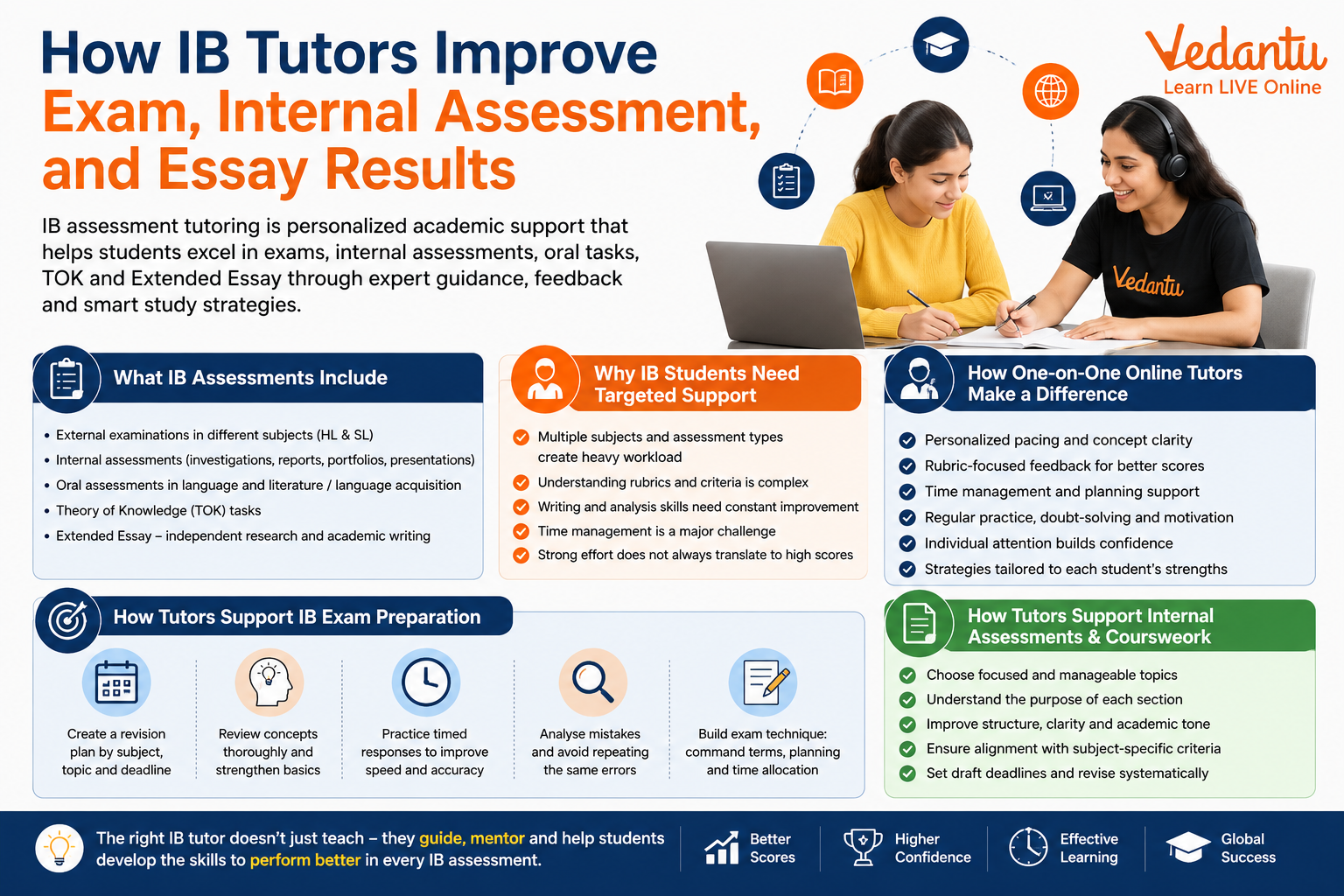
For many students and parents, the key question is simple: how can an IB online tutor actually improve results? The answer is through targeted feedback, flexible pacing, better rubric interpretation, and structured IB assessment preparation that fits the student’s strengths, gaps, and schedule.
What Is IB Assessment Tutoring?
IB assessment tutoring focuses on how students are evaluated in the IB Diploma Programme rather than only on finishing the syllabus. A tutor helps the student understand what examiners look for, how to respond to command terms, how to meet marking criteria, and how to balance revision with coursework deadlines.
This makes one-on-one IB tutoring especially useful for learners who feel they “know the topic” but still lose marks in practice. With individual support, students can turn vague effort into clear, measurable improvement in writing quality, problem-solving accuracy, and assessment strategy.
What IB Assessments Usually Include
IB students often prepare for several assessment formats at the same time.
- External examinations in different subjects at Higher Level (HL) and Standard Level (SL)
- Internal assessments such as investigations, commentaries, reports, portfolios, or presentations
- Oral assessments in language and literature or language acquisition courses
- Theory of Knowledge tasks requiring analysis, argument, and reflection
- The Extended Essay, which demands independent research, structure, and academic writing
| Assessment Type | What Students Need | How a Tutor Helps |
|---|---|---|
| External exams | Content mastery, timing, exam technique | Mock practice, error analysis, revision planning |
| Internal assessments | Research, structure, rubric alignment | Topic refinement, draft feedback, criteria guidance |
| Oral tasks | Speaking clarity, organization, textual support | Practice sessions, delivery feedback, structure coaching |
| TOK and Extended Essay | Critical thinking, argument, academic writing | Question framing, outline support, revision guidance |
Why IB Students Often Need Targeted Support
The IB Diploma Programme is demanding because students manage multiple subjects, different assessment formats, and overlapping deadlines at once. A student may be revising for exams while also finishing an internal assessment, preparing an oral, or refining an essay draft.
What makes this harder is that strong effort alone is not always enough. Students also need to interpret rubrics correctly, write in the expected style, choose relevant evidence, and avoid preventable mistakes. That is where personalized IB tutoring becomes especially effective.
How One-on-One Online Tutors Help
Personalized pacing and concept clarity
In self-study or large classes, students often move on before a weak area is fully fixed. A private tutor can slow down when needed, reteach a concept in a different way, and focus on the exact topic causing low performance. This is valuable in subjects where small conceptual gaps later create bigger scoring problems.
Because sessions are individual, students can ask detailed questions without waiting for others. That makes IB exam preparation more efficient and less stressful.
Rubric-focused feedback
One of the biggest benefits of one-on-one IB tutoring is feedback tied to assessment criteria. Instead of hearing that an answer is “good” or “needs work,” students can understand whether they lost marks for analysis, structure, justification, accuracy, or interpretation of the task.
This kind of feedback improves academic judgment. Over time, students begin to self-correct and produce work that is more closely aligned with examiner expectations.
Time management and planning support
An online tutor can help break large tasks into weekly milestones, making the workload feel more manageable. This is especially useful when a student is balancing HL subjects, internal deadlines, and revision for external papers.
Parents also often value this structure because it turns last-minute panic into a realistic schedule. For broader study support, students can also explore Vedantu articles on time management in online tuition and how to prepare a timetable for studying.
How Tutors Support IB Exam Preparation
A strong exam-focused tutoring plan usually includes the following.
- Creating a revision plan by subject, topic, and deadline
- Reviewing difficult concepts repeatedly until the student can apply them independently
- Practising timed responses to improve speed, structure, and confidence
- Analysing mistakes to identify patterns such as weak terminology, skipped steps, or incomplete evaluation
- Building exam technique for command terms, planning answers, and allocating time across sections
How Tutors Support Internal Assessments and Coursework
IB internal assessment help is different from exam tutoring because coursework often requires sustained planning across several stages. Students may understand their subject but still struggle with selecting a workable topic, narrowing the question, organizing evidence, or meeting formal criteria.
A tutor can support the process by helping students:
- choose focused and manageable topics
- understand the purpose of each section in the final submission
- improve structure, clarity, and academic tone
- check whether the work aligns with subject-specific criteria
- set draft deadlines and revise systematically instead of rushing at the end
Subject-Specific Benefits of Personalized IB Tutoring
| Subject Area | Common Challenge | Tutor Support |
|---|---|---|
| Mathematics | Concept gaps and stepwise errors | Method correction, guided practice, clear problem breakdown |
| Sciences | Application, data handling, lab-style reasoning | Concept reinforcement, analytical writing, assessment-focused practice |
| Humanities | Argument structure and evidence use | Essay planning, evaluation skills, feedback on analysis |
| Languages | Close reading, oral fluency, written response quality | Speaking practice, text interpretation, writing improvement |
Why the Online Format Works Well for Global IB Learners
Online learning can be especially practical for IB students studying across different countries and time zones.
- Flexible scheduling around school hours and coursework deadlines
- Access to tutors with subject-specific IB familiarity regardless of location
- Convenient doubt-solving without travel time
- Digital sharing of essays, notes, and worked solutions during live sessions
- A focused learning environment built around the student’s personal needs
Students who want to understand the wider value of digital learning can also read more on how e-learning has revolutionized the world and why personalized learning is important.
What to Look for in an IB Tutor
Before choosing a tutor, students and parents should look for a good academic fit.
- Familiarity with IB assessment formats and subject expectations
- Ability to explain marking criteria in simple language
- Experience supporting both HL and SL learners
- A clear method for planning revision and reviewing progress
- Constructive feedback that builds independence, not dependence
A tutor should not simply reteach lessons. The best personalized IB tutoring helps students become more self-aware, more organized, and more capable of meeting assessment demands on their own.
If you are exploring broader tutoring options, the Vedantu blog also offers useful reading on the benefits of one-on-one online tuition and related academic support topics at Vedantu’s blog.
Conclusion
One-on-one online tutoring can make IB preparation more focused, manageable, and effective by connecting subject learning with real assessment demands. Whether a student needs help with exams, internal assessments, or long-term planning, individual guidance can improve clarity, confidence, and consistency. The real value of IB assessment tutoring is not quick fixes, but steady support that helps students understand expectations, use time better, and perform with greater control across the IB Diploma Programme.
FAQs on How One-on-One Online Tutors Can Help You Master IB Assessments
1. What is IB assessment tutoring?
IB assessment tutoring is personalised academic support that prepares students for IB exams, internal assessments, oral tasks, Theory of Knowledge work, and the Extended Essay. It combines subject teaching with guidance on assessment criteria, command terms, time management, academic writing, and exam technique.
2. How can an IB online tutor improve a student’s results?
An IB online tutor can improve results by identifying individual learning gaps and connecting subject knowledge with IB assessment requirements.
- Explaining difficult concepts at the student’s pace
- Teaching students how to interpret rubrics and command terms
- Providing targeted feedback on practice responses
- Reviewing recurring errors and correcting weak techniques
- Creating a structured IB assessment preparation plan
3. Which IB assessments can a one-on-one tutor help with?
A one-on-one IB tutor can support preparation for most major assessment formats across Higher Level and Standard Level subjects.
- External examinations: content revision, timed practice, and exam strategy
- Internal assessments: topic development, planning, rubric interpretation, and feedback
- Oral assessments: structure, textual evidence, fluency, and delivery
- Theory of Knowledge: argument development, analysis, and reflection
- Extended Essay: research planning, organisation, citation, and academic writing
4. How does IB tutoring help with exam preparation?
IB exam preparation becomes more focused when tutoring combines topic revision with timed, assessment-style practice.
- Identify weak topics through diagnostic questions or past-paper practice.
- Review concepts and subject-specific methods.
- Practise responses using relevant command terms.
- Analyse errors in accuracy, reasoning, structure, and timing.
- Repeat targeted practice until the student can work independently.
5. Can an IB tutor help with internal assessments?
Yes, an IB tutor can provide IB internal assessment help by clarifying criteria and guiding the student through planning, research, structure, and revision. The tutor may offer feedback and teach relevant skills, but the student must make the final decisions and produce the submitted work independently in accordance with IB academic integrity requirements.
6. What is the difference between IB tutoring and regular subject tutoring?
IB tutoring addresses both subject knowledge and the way that knowledge must be demonstrated in IB assessments. Regular subject tutoring may concentrate mainly on understanding the syllabus, whereas assessment-focused support also covers marking criteria, command terms, response structure, evaluation, time allocation, and subject-specific assessment skills.
7. Is one-on-one IB tutoring suitable for both HL and SL students?
Yes, one-on-one IB tutoring can be adapted for both Higher Level and Standard Level students. The tutor should tailor lesson depth, question difficulty, assessment practice, and revision priorities to the student’s subject level, current performance, learning gaps, and target outcomes.
8. How often should an IB student take online tutoring sessions?
Most students benefit from a consistent schedule, but the appropriate frequency depends on their goals, deadlines, and learning gaps. One session per week may support regular progress, while additional sessions can be useful before examinations or major coursework milestones. Effective personalised IB tutoring should prioritise focused practice and independent study rather than session quantity alone.
9. What should students and parents look for in an IB tutor?
A suitable IB tutor should combine strong subject knowledge with familiarity with IB assessment expectations.
- Experience teaching the relevant subject and HL or SL level
- Ability to explain criteria and command terms clearly
- A structured method for diagnosing learning gaps
- Constructive, specific, and actionable feedback
- Respect for academic integrity in assessed coursework
- A teaching approach that builds student independence
10. Why is online tutoring effective for international IB students?
Online IB tutoring gives international students flexible access to subject-specific support regardless of location. Live digital sessions can accommodate different time zones, reduce travel time, and allow students to share essays, notes, data, and worked solutions for immediate discussion. This format also makes it easier to personalise lessons around school deadlines and individual assessment needs.



