




Why the Mandible Is the Only Movable Skull Bone and How It Functions
The skull is made up of 22 bones along with 6 auditory ossicles which makes the total number of bones in the skull to be 28. The cartilage and ligaments keep the skull together. These bones include our cranial and facial skeletal bones forming the skull. Out of the 28 bones, the number of movable bones in the skull is only one bone called the mandible or the jaw bone of the facial bones.
The article below gives us an insight into the mandible and other skull bones along with their structure and formation.
Skull Bones
The human skull is made up of 22 bones which are mostly joined together by ossified joints known as sutures. The braincase (neurocranium) and facial skeleton are separated by the skull (viscerocranium). Its primary function is to protect the brain, the most important organ in the human body.
The neurocranium almost completely encloses the brain, with the exception of the foramen magnum and other foramina at the base of the skull that serves as an entry and exit point for blood vessels and cranial nerves. In addition, the skull supports all the facial structures.
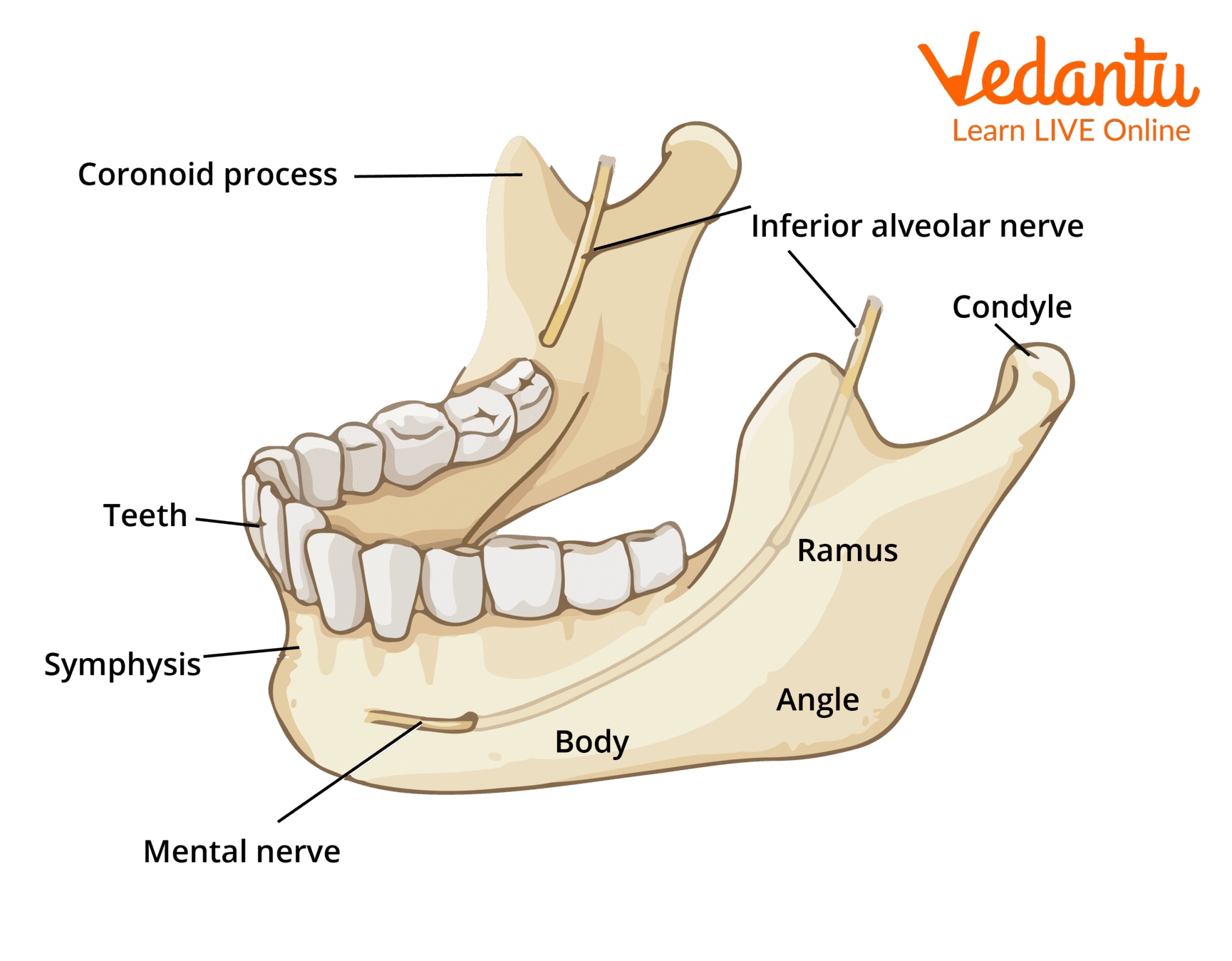
Mandible
The term “mandible” is derived from the Latin word “mandibula”, which means “one used for chewing”. This mandible bone forms the temporomandibular joint with the temporal bone which is a part of the cranial nerves.
Skull Parts: Anatomy
The skull bones are divided into two: the first one is the cranial bones which are limited in covering the brain and the eyes, and the second is the facial skeletal bones which comprise facial bones. These are 8 and 14 in number respectively.
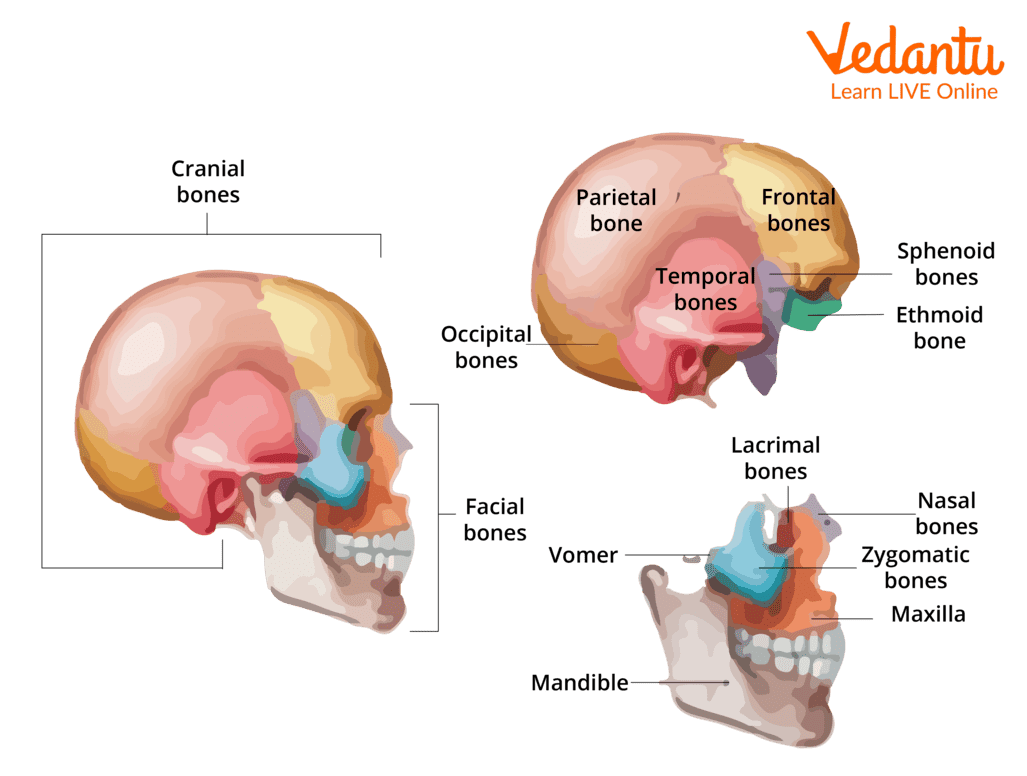
Skull Bone: Cranial and Facial Bones
Cranial Bones (8)
Ethmoid -1x
Frontal -1x
Occipital -1x
Parietal -2x
Sphenoid-1x
Temporal -2x
Facial Skeletal Bones (14)
Inferior nasal concha -2x
Lacrimal -2x
Mandible -1x
Maxilla -2x
Nasal -2x
Platine -2x
Vomer -1x
Zygomatic -2x
This makes the total number of skull bones to be 22 in number. Although, if the auditory ossicles (bones in the ears) are also included, then the number of bones in the skull reaches up to 28.
The 6 auditory ossicles include:
Incus -2x
Malleus -2x
Stapes -2x
Which of the Skull Bones is Movable?
The jaw bone name mandible is the only movable skull bone that is present in our facial skeletal bones. It is also considered one of the strongest and the largest bones in the facial skeleton. The mandible forms the lower jaw and is responsible for holding the lower teeth in place. The human body has a movable jaw because of the mandible bone. All the bones except the mandible are joined together.
The Skeletal System
The skeletal system forms the basic framework of the body around which the whole body is built and structured. All the bones and tissues along with the cartilages and the joints from the whole skeletal system. All of these parts are rigid and tough in nature and have a function of movement. The skeletal system's joints are crucial because they enable a variety of movements to occur at various points. The movements of the human body would not be visible if the bones lacked joints.
The human body would not have functioned as it does without the skeletal system. We would have been a lump of mass and muscle if there were no bones in the body. Some of the major functions of the skeletal system are described below:
1. Support
It provides the needed support to all the organs and the muscles which help them in moving efficiently. The whole skeletal system is based on a solid framework which safeguards the human body and its organs from the external environment. This also helps in maintaining the overall shape of the human body.
2. Protection
One of the major functions of the skeletal system includes protection. It plays a role in protecting our internal organs and other delicate body organs such as the brain, heart, lungs and spinal cord. Our cranium or the skull protects our brain and eyes, our ribs are meant to protect our heart and lungs and our vertebrae i.e. the spine/backbone protect our spinal cord.
3. Movement
Bones and joints work together to move different organs of our body. The muscles are attached to the bones to make them move and function properly. The attachment of bones and muscles is carried out by tendons which are tough inelastic bands.
4. Storage
The primary function of the bone matrix in the skeletal system is to store or preserve various kinds of vital minerals that are necessary for promoting the growth and repair of human cells and tissues. By storing and releasing calcium ions into the blood cell as needed, the cell matrix serves as our body's calcium bank.
5. Regulation of Endocrine Glands
The skeletal system's bone cells are crucial in releasing the hormones that have been generated by the corresponding endocrine glands, for use by the body in its various metabolic processes. In addition to these duties, the skeletal system also helps to control blood sugar.
Conclusion
The movable bone in the skull is called the mandible or the jaw bone that helps us in moving our jaw or mouth for tasks like chewing or talking. There are a total of 28 bones in our skull that also include the auditory ossicles. Out of this, only one is movable and all others give the skull a framework and support to be still and strong.


FAQs on Which Skull Bones Are Movable in the Human Skull
1. Which of the skull bones are movable?
The only movable bone of the human skull is the mandible (lower jaw). It forms a movable joint with the temporal bone called the temporomandibular joint (TMJ), which allows movements needed for chewing and speaking.
- All other skull bones are joined by immovable joints called sutures.
- The mandible moves up and down, side to side, and slightly forward and backward.
2. Why is the mandible the only movable skull bone?
The mandible is the only movable skull bone because it forms a synovial joint that allows movement. The temporomandibular joint (TMJ) is a flexible joint designed for:
- Mastication (chewing food)
- Speech articulation
- Opening and closing the mouth
3. What type of joint allows movement of the skull?
Movement in the skull is allowed by the temporomandibular joint (TMJ), which is a modified synovial joint. This joint:
- Connects the mandible to the temporal bone
- Contains an articular disc for smooth movement
- Permits hinge and slight gliding movements
4. Are the cranial bones movable?
No, the cranial bones are not movable in adults. They are fused together by immovable fibrous joints called sutures.
- Examples include the frontal, parietal, temporal, and occipital bones.
- Their immobility protects the brain from injury.
5. What is the function of the movable skull bone?
The function of the movable skull bone, the mandible, is to enable chewing, speaking, and swallowing. It plays a key role in:
- Mastication by grinding food with teeth
- Speech production by shaping sounds
- Facial expression and jaw movement
6. What is the temporomandibular joint (TMJ)?
The temporomandibular joint (TMJ) is the movable joint that connects the mandible to the temporal bone of the skull. It is a specialized synovial joint that:
- Allows opening and closing of the mouth
- Permits side-to-side grinding movements
- Contains cartilage and synovial fluid for smooth motion
7. Do babies have movable skull bones?
Yes, babies have flexible skull bones connected by soft areas called fontanelles, but these bones are not freely movable like the mandible. In infants:
- Sutures are not fully fused
- Fontanelles allow brain growth and easier childbirth
- The bones gradually fuse during development
8. How many bones in the skull are movable?
Only one bone in the human skull is movable—the mandible. The adult human skull consists of 22 bones:
- 8 cranial bones
- 14 facial bones
9. What is the difference between sutures and the temporomandibular joint?
The main difference is that sutures are immovable fibrous joints, while the temporomandibular joint (TMJ) is a movable synovial joint.
- Sutures: Join cranial bones; no movement; protect the brain.
- TMJ: Connects mandible to temporal bone; allows chewing and speech.
10. Can any skull bones move besides the mandible?
No, in humans the mandible is the only skull bone capable of true movement. All other skull bones are tightly connected by fibrous sutures that prevent motion.
- This rigidity protects the brain.
- It provides a stable structure for facial features.



