




What Is Single Circulation Definition Process Pathway and Diagram Explanation
Do you know what are gills used for? Are gills only present in fish or do some other organisms have gills? Gills are used for respiration and they are present in most aquatic organisms for breathing. Gills are also used in single circulation and serve all fish. Blood only passes through the heart once in a single circulatory system, completing a full circuit through the body of the fish. The exchange of gases occurs in the gills, where the blood goes from the heart (carbon dioxide is released and oxygen is absorbed). To know more about single circulation, continue reading this article!!
What is Single Circulation?
Fishes have a single circulatory system. In the hearts of fish, there are two chambers: an atrium and a ventricle. Deoxygenated blood from the tissues is pumped to the gills for purification, where it is then returned to the heart to be given to the various bodily tissues with oxygen. Blood that has been deoxygenated returns to the heart from tissues. As a result, solitary circulation refers to the flow of blood along a single circulatory channel. Single circulation is exhibited by many aquatic animals such as all fishes, exocomets, hippocampus, etc.
Single Circulation in Fishes
A single circulatory system serves all fish. Blood only passes through the heart once in a single circulatory system, completing a full circuit through the body of the fish. The exchange of gases occurs in the gills, where the blood goes from the heart (carbon dioxide is released and oxygen is absorbed). The body's numerous organs receive oxygenated blood from the gills, which then returns to the heart via these organs. In single circulation, blood flows through the heart only once.
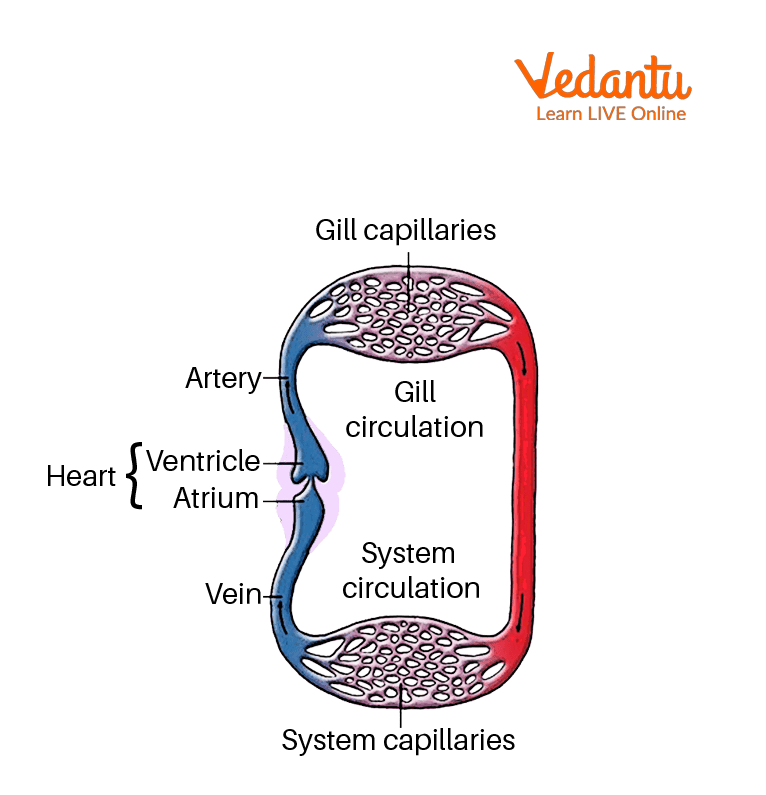
Single Circulation
Main Features of Single Circulation
The main features of single circulation are explained below.
In single circulation, blood only travels once to the heart for every circuit of the body.
A single circulatory system is present only in those animals who have two-chambered or three-chambered hearts.
Singles circulatory system present in aquatic organisms.
In single circulation, only deoxygenated blood goes to the heart.
Differences Between Single Circulation and Double Circulation
Single- and Double-Circulation Flow Diagrams
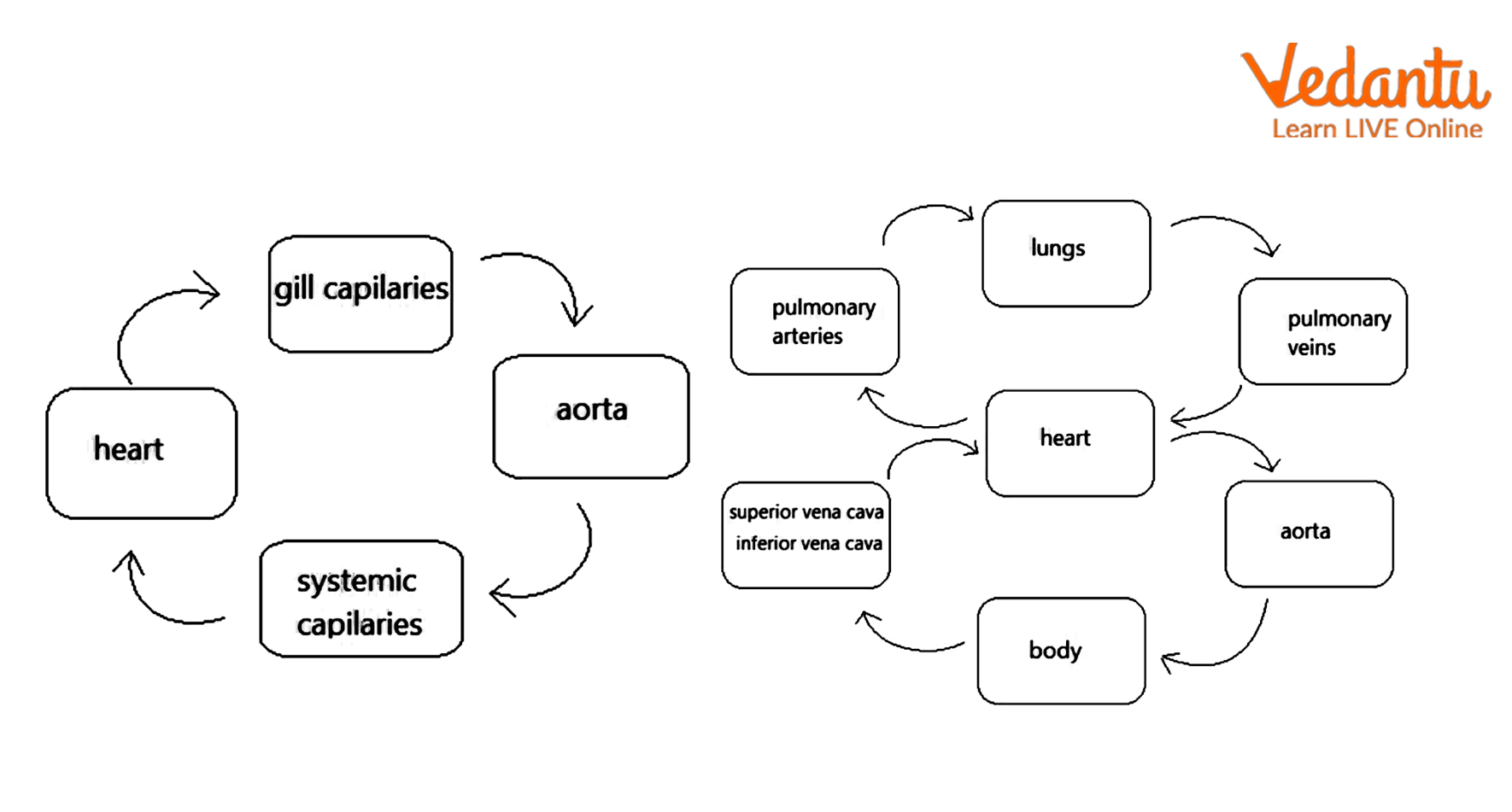
Single and Double Circulation Flow Diagram
Interesting Facts
About 100,000 km is the length of the circulatory system.
The RBCs have a size of 8 microns.
Heart rate is slower in larger mammals.
Outside of the body, the heart may beat for three to five minutes.
Blood comes in various red shades.
About 2.5 billion heartbeats have been recorded worldwide.
Important Questions
1. Do arteries carry only oxygenated blood?
Ans: Yes, all arteries carry oxygenated blood, but there is one exception: the pulmonary artery is the only artery that carries deoxygenated blood.
2. Write the names of organisms exhibiting single circulation?
Ans: Single circulation occurs in fishes, reptiles, and other organisms.
3. Is single circulation open or closed?
Ans: Single circulation is a closed type of circulation.
Practice Questions
Do all veins carry deoxygenated blood?
Why is the double circulatory system better than the single circulatory system?
What is single closed circulation?
Conclusion
When the heart pumps blood to the gills for oxygenation, the blood then circulates through the rest of the body before returning to the heart. This process is known as single circulation. It is well known that some animals, like fish, have a single circulatory system. Additionally, they have two chambers in their hearts rather than the usual one atrium and one ventricle. As a result, solitary circulation has a substantial drawback since it delivers oxygen slowly, which slows down metabolism. In the twofold circulatory system seen through humans, blood circulates in two separate circuits.


FAQs on Single Circulation in the Circulatory System
1. What is single circulation in biology?
Single circulation is a type of blood circulation in which blood passes through the heart only once during one complete cycle around the body. In this system:
- Blood flows from the heart to the respiratory organ (such as gills).
- It gets oxygenated in the respiratory surface.
- Oxygenated blood then flows directly to the body tissues before returning to the heart.
2. How does single circulation work step by step?
Single circulation works by moving blood in a single continuous loop through the heart, gills, and body tissues. The steps are:
- 1. The atrium receives deoxygenated blood from the body.
- 2. The ventricle pumps it to the gills.
- 3. Gas exchange occurs in the gill capillaries, and blood becomes oxygenated.
- 4. Oxygenated blood flows directly to the body tissues.
- 5. Deoxygenated blood returns to the heart.
3. Which animals have single circulation?
Single circulation is found mainly in fishes. Examples include:
- Bony fishes (e.g., rohu, salmon).
- Cartilaginous fishes (e.g., sharks, rays).
4. Why is single circulation seen in fishes?
Single circulation is seen in fishes because their aquatic lifestyle and gill-based respiration require a simple and efficient circulatory system. In fishes:
- The gills act as the respiratory surface.
- Blood pressure decreases after passing through gill capillaries.
- A single-loop system is sufficient to meet their metabolic needs.
5. What is the structure of the heart in single circulation?
The heart in single circulation is typically a two-chambered heart consisting of one atrium and one ventricle. Its main parts are:
- One atrium – receives deoxygenated blood.
- One ventricle – pumps blood to the gills.
6. What is the difference between single circulation and double circulation?
The main difference is that in single circulation blood passes through the heart once per cycle, while in double circulation it passes through the heart twice per cycle. Key differences include:
- Single circulation: One heart passage; seen in fishes; lower blood pressure after gills.
- Double circulation: Two heart passages; seen in amphibians, reptiles, birds, and mammals; maintains higher systemic blood pressure.
7. What are the advantages of single circulation?
The main advantage of single circulation is its simple structure and lower energy requirement. Advantages include:
- Simple two-chambered heart design.
- Less energy needed to pump blood.
- Efficient for organisms with lower metabolic demands.
8. What are the disadvantages of single circulation?
The main disadvantage of single circulation is reduced blood pressure after oxygenation, which slows oxygen delivery to tissues. This occurs because:
- Blood passes through gill capillaries, causing a drop in pressure.
- Oxygenated blood flows to the body at lower pressure.
9. How is oxygenated and deoxygenated blood handled in single circulation?
In single circulation, the heart handles only deoxygenated blood, while oxygenated blood flows directly from the gills to the body. The pathway is:
- Deoxygenated blood enters the heart.
- It is pumped to the gills for oxygenation.
- Oxygenated blood moves straight to systemic tissues without returning to the heart first.
10. Can you give an example of single circulation in a fish?
An example of single circulation is seen in the rohu fish, where blood completes one full circuit through the heart per cycle. In rohu:
- The atrium receives deoxygenated blood from the body.
- The ventricle pumps it to the gills.
- Oxygenated blood flows to the body tissues.
- Deoxygenated blood returns to the heart.



