




What Is the Scientific Name of Gaur and How Is It Classified
The single gaur animal is sold for 10 crores. Isn't it too expensive? But why? Do you know what a gaur animal is? Gaur belongs to the group of wild oxen. In this article, we are going to discuss the gaur animal, its characteristics, habitat, diet, and nutrition. We will also learn about gaur’s scientific name, taxonomy, followed by some interesting facts on gaur. To know more about gaur, continue reading the article.
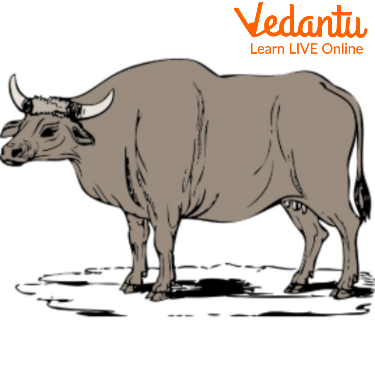
The Gaur Animal
What is a Gaur Animal?
Gaur is a mammal. It is one of a variety of wild cattle. It is also called Indian bison, native to Southeast and South Asia. It is the largest of all the wild battles.
Characteristics of Gaur
The characteristics of the gaur animal are given below:
The gaur is a massively built and powerful animal. The limbs of the gaur are very strong and large.
Both males and females have horns. The colours of horns are pale green or yellow-brown and have a slight inward curvature.
The head and body length are 250-330 cm long with a 70-105cm long tail, 140-220cm high from the ground.
The female’s colour is somewhat lighter in colour than the male gaur and the adult male's is dark brown.
These animals do not have a distinct dewlap on the chest and throat.
In young gaur, horns are generally smooth and polished, whereas in old gaurs horns are rugged and dented at the base.
The average weight of Indian male gaur animals is 840 kg and the female average weight is 700 kg.
Biggest Gaur
The largest and biggest gaur is the Southeast Asian Gaur. It is the biggest gaur among the wild categories. Different names are used in different areas. Such as seladang is the name used in Malaysia. In Myanmar, paying is the name used for gaur animals.
Habitat of Gaur
These animals are mostly found in South and Southeast Asia such as Vietnam, Laos, Thailand, Myanmar, and Bangladesh. Gaur animals may be found in deciduous forests but are mostly confined to semi-evergreen and evergreen forests.
They love to live in an undisturbed area or undisturbed forest or below the hilly landscape, with the availability of water, and an excess of forage in the form of herbs, shrubs, trees, and grasses.
Diet and Nutrition of Gaur
Gaur is an herbivorous animal. They are observed to eat only plants and plant parts. They mainly eat the upper parts of plants such as blades, stems, seeds, and flowers of grass species. They feed on 32 species of plants.
Scientific Classification and Scientific Name of Gaur
Gaur belongs to the animal kingdom, and Chordata is the phylum of gaur.
Mammalian is the class of gaur, Artiodactyla is the order, Bovidae is the family and Bovinae is the subfamily. Its Genus is Bos.So, the scientific name of the gaur isBos gaurus
Taxonomy of Gaur Animal
Taxonomy is the study of taxa or taxon.
The scientific name of gaur was discovered by Charles Hamilton Smith. In 1827, three subspecies of Bison were discovered. These are as follows:
B.g. gaurus
B.g. reader
B.g. hubbacki
The second species was discovered by Richard Lydekker in 1903 based on a specimen from Myanmar. Lydekker also discovered the third species of gaur in 1907.
Gaur in Culture
The gaur is the mascot of the 54th infantry division of the Indian Army. The state animal of Goa and Bihar is the gaur. Some brand energy drinks such as Krating Daeng feature the pair of charging red gaur bulls in the logo used on the licensed derivative of Red Bull.
Conservation
The gaur is a legally protected animal in most states as mentioned in CITES Appendix 1.
Interesting Facts about the Gaur
The gaur animal is also known as the Indian Bison.
Gaur is one of the largest land animals in the world.
The one gaur animal is being sold at the price of 10 crores.
The one semen of this gaur animal is sold for 5000 dollars and this semen is used to produce a new generation.
The horns of the Indian Bison are greater than the cow.
Important Questions
Q1. Is gaur bigger than bison?
Ans: Yes, gaur is bigger than bison. Gaur is the largest of all wild cattle. It is bigger than American Bison and wild water buffalo.
Q2. Can gaur be domesticated?
Ans: Gaur is one of the Indian Bison that have never been domesticated.
Q3. What is the difference between gaur and bison?
Ans: Both gaur and bison belong to the same subfamily but belong to a different genus. Gaur belongs to the Bos genus, whereas bison belongs to the genus Bison.
Important Questions
Q1. Which animal is gaur?
Q2. Is gaur a cow or buffalo?
Q3. Which is the biggest buffalo in the world?
Q4. Can gaur be domesticated?
Q5. What does gaur eat?


FAQs on Scientific Name of Gaur and Its Taxonomic Position
1. What is the scientific name of gaur?
The scientific name of gaur is Bos gaurus. It is the largest living species of wild cattle and belongs to the genus Bos in the family Bovidae. The gaur is native to South and Southeast Asia and is commonly referred to as the Indian bison, although it is not a true bison.
2. What is the common name of Bos gaurus?
The common name of Bos gaurus is gaur. It is also popularly known as the Indian bison, though it is scientifically classified as a wild cattle species. The gaur is recognized for its massive build, muscular body, and distinctive white “stocking” legs.
3. Which family does the gaur belong to?
The gaur belongs to the family Bovidae. This family includes hoofed, ruminant mammals such as:
- Cattle
- Buffalo
- Goats
- Sheep
- Antelopes
4. What is the genus of gaur?
The genus of gaur is Bos. The genus Bos includes several species of wild and domestic cattle, such as:
- Bos taurus (domestic cattle)
- Bos indicus (zebu cattle)
- Bos frontalis (gayal)
5. Is gaur the same as bison?
No, gaur is not the same as bison; gaur is scientifically classified as Bos gaurus, while true bison belong to the genus Bison. Key differences include:
- Gaur belongs to genus Bos, bison to genus Bison
- Bison have a large shoulder hump and shaggy forequarters
- Gaur have a muscular body with a prominent dorsal ridge
6. What are the main characteristics of Bos gaurus?
The main characteristics of Bos gaurus include its large size, muscular build, and curved horns. Important features are:
- Largest living wild cattle species
- Dark brown to black body color
- White lower legs (“stockings”)
- Strong, upward-curving horns in both sexes
- Herbivorous and ruminant digestive system
7. Where is the gaur found naturally?
The gaur is naturally found in South and Southeast Asia. Its distribution includes:
- India
- Nepal
- Bhutan
- Thailand
- Malaysia
8. What type of animal is Bos gaurus?
Bos gaurus is a large, herbivorous, terrestrial mammal belonging to the order Artiodactyla. As an even-toed ungulate, it has cloven hooves and a specialized ruminant digestive system with a four-chambered stomach for digesting plant material.
9. What is the conservation status of gaur?
The gaur is classified as Vulnerable on the IUCN Red List. Its population is threatened by:
- Habitat loss due to deforestation
- Poaching
- Disease transmission from domestic cattle
10. What is the difference between gaur and gayal?
The gaur (Bos gaurus) is a wild species, whereas the gayal (Bos frontalis) is a domesticated or semi-domesticated form derived from gaur. Key differences include:
- Gaur are fully wild forest animals
- Gayal are reared by tribal communities
- Gayal generally have a more docile temperament



