



In this article, we will learn about reproduction in plants through concept maps and discuss mind maps of living things and types of reproduction in plants. After reading this article, reader will be able to explain:
Reproduction in plants
Types of reproduction
What are Sexual and asexual reproduction

What Is Reproduction In Plants Types Process and Examples
Reproduction is one of the essential processes to continuing life on earth. Is there any difference between reproduction in plants or animals? Do you know what is the sexual reproductive unit of plants? You might be surprised that new plant material can be produced by leaves, roots, and stems in vegetative propagation. Sexual reproduction and asexuality in plants are explained through a concept map in this article. Androecium and gynoecium are the two reproductive structures found in a flower, some plants have both types of reproductive structure known as monoecious or bisexual plants, and some have only a single type of structure either androecium or gynoecium. To know more about the reproduction of plants, continue reading this article.
Reproduction in Plants Concept Map
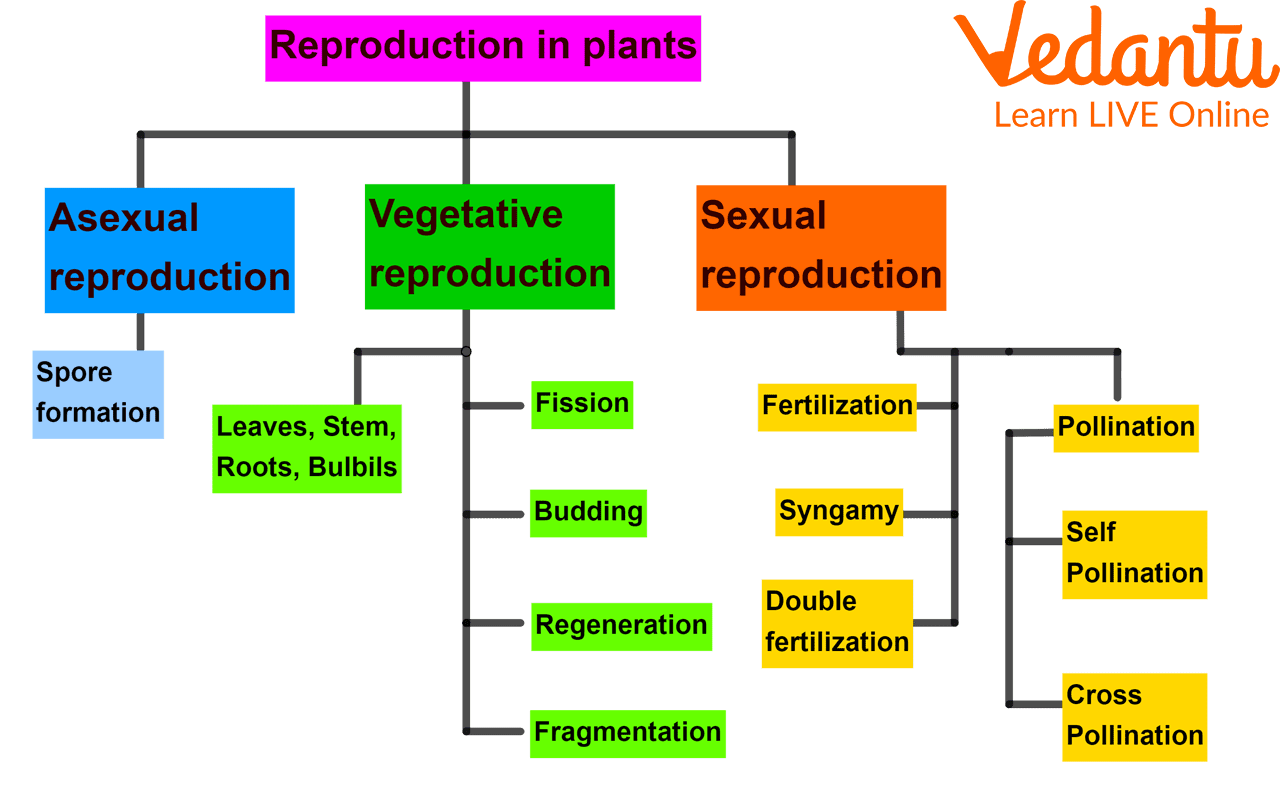
Types of Reproduction
Reproduction is already defined as a process of producing new plants from parent plants. There are many types of reproduction. Different plants use different methods of reproduction. Some of the methods are explained here. The vegetative method is sometimes involved in the asexual method, and reproduction occurs through a single parent. It involves fusion, budding fragmentation, vegetative propagation, spore formation, etc. Sexual reproduction occurs through the involvement of two parents, where fertilization occurs and the zygote forms. Then zygote is converted into a new plant.
Types of Reproduction in Plants
There are three types of reproduction in plants - Asexual, vegetative, and sexual reproduction. Asexual reproduction takes place through spores. Vegetative reproduction takes place through vegetative parts of plants, such as roots, stems, and leaves. Sexual reproduction takes place through a reproductive unit of plants which is flowers.
Asexual Reproduction Concept Map
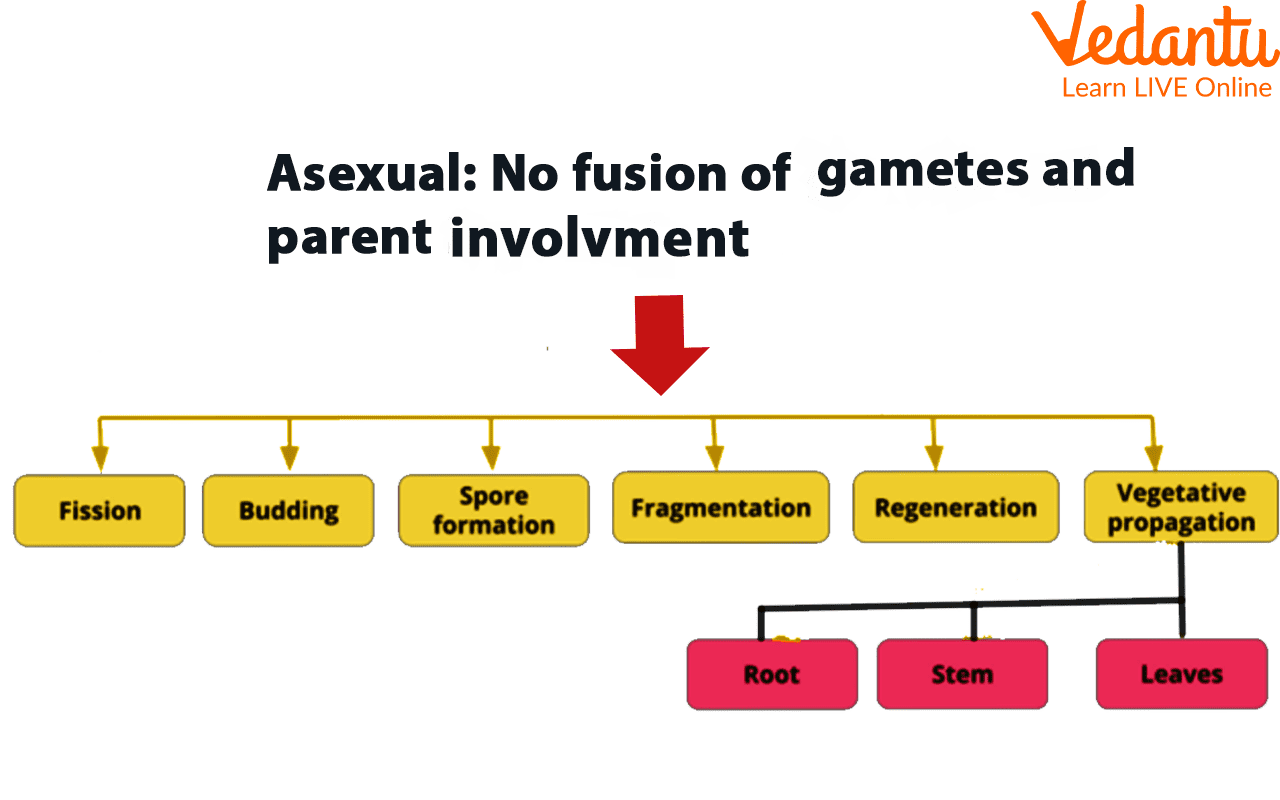
Types of Asexual Reproduction
Asexual reproduction in plants takes place through many methods. These methods are budding, spore formation, fragmentation, and vegetative propagation.
Sexual Reproduction Concept MAP
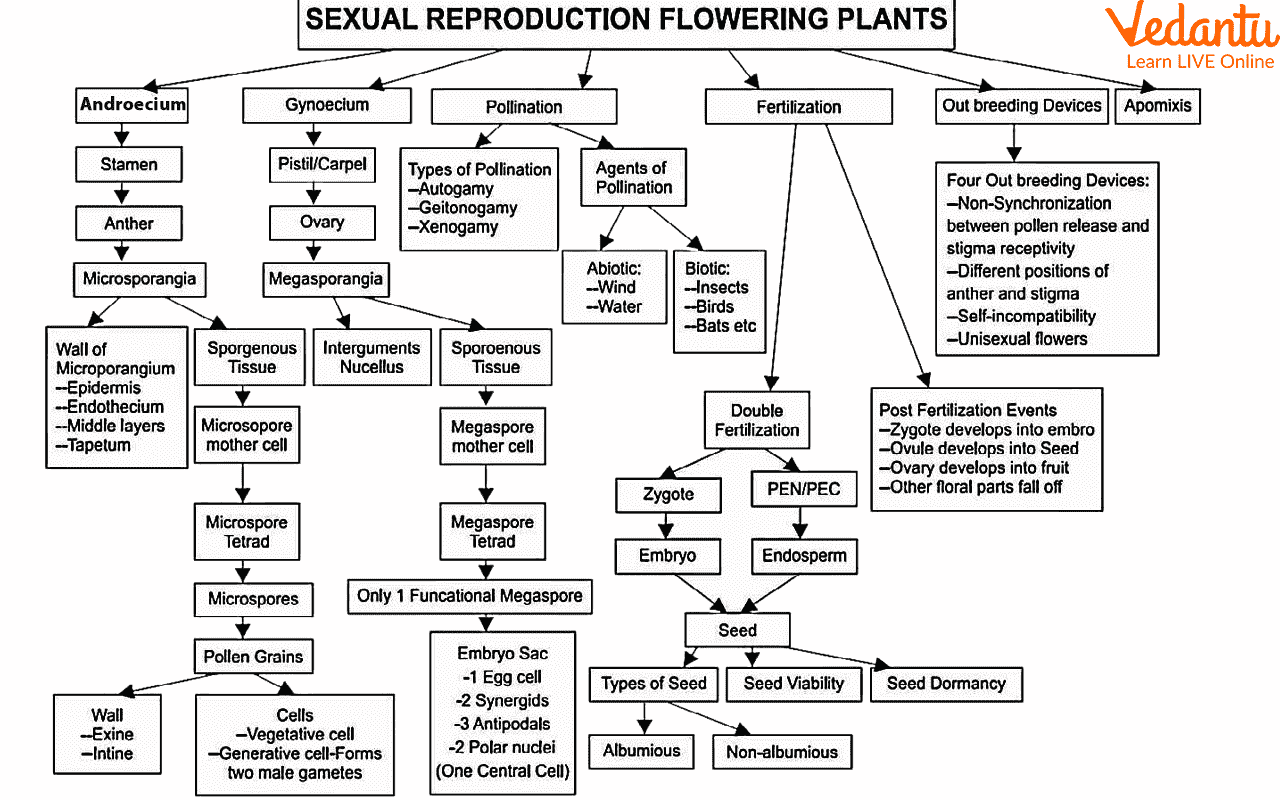
Concept Map of Sexual Reproduction in plants
As is already explained that in sexual reproduction, two parents are involved. One is a male parent, and the other is a female parent. Male parents form male gametes, whereas female parents form female gametes. The flower is the reproductive organ of plants. There are two main important reproductive parts in flowers- one is the male part which is the androecium, and the other is the female part which is the gynoecium. Now androecium is a bundle of stamen, and the gynoecium is a bundle of the pistil. There are two main parts of stamen- anther and filament. Pollen grains are the male gametophyte produced in other flowers. These pollen grains later divide into male gametes. Now carpel is the female reproductive part of a flower. It has three important parts- stigma, style, and ovary. In the ovary, there is a female gamete that is the ovum.
Now, most of the plant pollen grain lands on the stigma, where it forms a male gamete; the male gamete then reaches to ovary through style, where it fuses with the female gamete ovum, a process known as fertilization. The fusion of male and female gametes leads to the formation of a zygote which undergoes development to make the embryo process known as embryogenesis.
Important Questions
1. What factors affect plant reproduction?
The important factors which affect plant reproduction are - the intensity of light, duration, quality of light, temperature, etc.
2. What are the different purposes of reproduction in plants?
The important purpose of plant reproduction is to ensure species' continuity.
3. What are the different things plants need to grow?
Plants need various factors for growth. These factors are proper temperature, light, water, humidity, and nutrients.
Interesting Facts
Originally carrots were purple or white colored. Genetic mutations produce orange carrots.
One strawberry contains, on average, 200 seeds.
The bamboo tree is the fastest-growing plant; it can grow 1 inch per month
Snapdragon flower is the flower that resembles a snapdragon
Gingko is a gymnosperm and is the only plant that is still alive yet.
Practice Questions
1. Explain the life process mind map
2. What are the different modes of reproduction in plants?
3. What happened during plants reproduction
4. What are the benefits of reproduction?
5. What are the features of reproduction?
Key Features
In this article, we have discussed reproduction in a plants concept map
We have discussed types of reproduction in plants - there is a mainly sexual, asexual, and vegetative methods of reproduction in plants
An asexual reproduction concept map is also discussed in this article. Budding, fragmentation, and Vegetative propagation are important methods of asexual reproduction
Sexual reproduction involves gamete formation and fertilization.
The mind map of reproduction in plants is the same as the Concept Map of reproduction in plants


FAQs on Reproduction In Plants Complete Guide to Plant Life Cycles
1. What is reproduction in plants?
Reproduction in plants is the biological process by which plants produce new individuals of the same species. It ensures continuity of life and transfer of genetic information from one generation to the next.
- It can occur through sexual reproduction involving fusion of gametes.
- It can occur through asexual reproduction without gamete fusion.
- The outcome is the formation of new plants either by seeds or vegetative parts.
2. What are the different types of reproduction in plants?
The two main types of reproduction in plants are sexual reproduction and asexual reproduction. These methods differ in gamete involvement and genetic variation.
- Sexual reproduction: Involves male and female gametes, pollination, and fertilization.
- Asexual reproduction: Involves a single parent and no gamete fusion.
- Asexual methods include vegetative propagation, fragmentation, and spore formation.
3. How does sexual reproduction occur in flowering plants?
Sexual reproduction in flowering plants occurs through pollination followed by fertilization inside the flower. It results in the formation of seeds and fruits.
- Pollination: Transfer of pollen from anther to stigma.
- Fertilization: Fusion of male gamete with female gamete inside the ovule.
- Seed formation: Zygote develops into an embryo.
- Fruit formation: Ovary develops into fruit after fertilization.
4. What is pollination in plants?
Pollination is the transfer of pollen grains from the anther to the stigma of a flower. It is a crucial step before fertilization in plant reproduction.
- It may occur within the same flower or between different flowers.
- Agents include wind, water, insects, birds, and animals.
- Pollination enables the male gametes to reach the ovule.
5. What is the difference between self-pollination and cross-pollination?
The main difference between self-pollination and cross-pollination is whether pollen is transferred within the same plant or between different plants. This affects genetic variation.
- Self-pollination: Pollen is transferred to the stigma of the same flower or plant.
- Cross-pollination: Pollen is transferred to a flower on a different plant of the same species.
- Cross-pollination promotes greater genetic diversity than self-pollination.
6. What is fertilization in plants?
Fertilization in plants is the fusion of the male and female gametes to form a zygote. It occurs inside the ovule after pollination.
- The male gamete travels through the pollen tube.
- Fusion with the egg cell forms a diploid zygote.
- In flowering plants, double fertilization also forms endosperm.
7. What is vegetative propagation in plants?
Vegetative propagation is a type of asexual reproduction where new plants grow from vegetative parts like stems, roots, or leaves. It produces genetically identical offspring.
- Occurs naturally through tubers (potato), rhizomes (ginger), and bulbs (onion).
- Can be artificial through cutting, grafting, and layering.
- Results in rapid multiplication of plants.
8. What is double fertilization in flowering plants?
Double fertilization is a unique process in angiosperms where two fusion events occur inside the embryo sac. It is characteristic of flowering plants.
- One male gamete fuses with the egg to form the zygote.
- The other fuses with two polar nuclei to form the endosperm.
- Endosperm provides nourishment to the developing embryo.
9. Why is reproduction important in plants?
Reproduction is important in plants because it ensures survival, continuity, and genetic variation of species. Without reproduction, plant species would become extinct.
- Maintains population stability.
- Introduces genetic variation through sexual reproduction.
- Supports ecosystems by sustaining food chains and habitats.
10. What is seed formation in plants?
Seed formation in plants is the process by which the fertilized ovule develops into a seed containing an embryo. It occurs after fertilization in flowering plants.
- The zygote develops into an embryo.
- The ovule becomes the seed.
- The ovary develops into a fruit that protects the seed.
In this article, we will learn about reproduction in plants through concept maps and discuss mind maps of living things and types of reproduction in plants. After reading this article, reader will be able to explain:
Reproduction in plants
Types of reproduction
What are Sexual and asexual reproduction



