




What is the botanical name of pomegranate and its family details
Numerous studies have been conducted concerning the potential health benefits and nutritional value of pomegranate and its constituents. Encouraging findings have increased interest in this specific fruit over the past few years. Pomegranate, rich in bioactive compounds like polyphenols, has shown many health-related properties, such as antioxidant, anti-inflammatory and antihypertensive, through in vivo and in vitro studies.
The health-promoting properties of the fruit are considered to be due to the presence of punicalagin mainly and, to a lesser extent, to other metabolites, such as flavonols and anthocyanins. Several studies have brought up the potential contribution of pomegranate in treating cancer, diabetes and heart disease.
What is Pomegranate?
Pomegranate is a deciduous or evergreen tree or bush in the family Punicaceae developed for its palatable natural products. The pomegranate tree is extended and barbed with gleaming, weathered, oval to elongated leaves that fill in whorls of at least five on the branches. The tree creates radiant red blossoms separately at the tips of the branches and an adjusted hexagonal natural product with thick pink-red skin.
The organic product has a thick, rough skin which safeguards the pulp[ and seeds inside. The products are isolated into compartments by white elastic tissue. Every compartment contains seeds and mash. Every natural pomegranate product might contain upwards of 600 seeds.
Botanical Name of Pomegranate
The botanical name of pomegranate is Punica granatum.
Pomegranate Shrub
Pomegranate (Punica granatum) is a rub or little tree of the family Lythraceae and its natural product. The delicious arils of the natural product are eaten new, and the juice is the wellspring of grenadine syrup, utilised in flavourings and mixers. Pomegranate is high in dietary fibre, folic corrosive, L-ascorbic acid, and vitamin K. Therefore the pomegranate family is punica.
Pomegranate Life Span
Pomegranate trees can arrive at a level of 10 m (33 ft) and can be extremely seemingly perpetual, even though their financial life expectancy is typically somewhere in the range of 12 and 15 years. Pomegranate may likewise be alluded to as grenadine or Chinese apple and started in Central Asia, reasonably in Iran.
Uses
Pomegranate is fundamentally eaten as a new organic product by parting open the skin and consuming the seeds. The seeds might be utilised in plates of mixed greens. The natural product may likewise be utilised to create juice, either by eliminating and squeezing the seeds or by squeezing the entire organic product.
Pomegranate Diagram
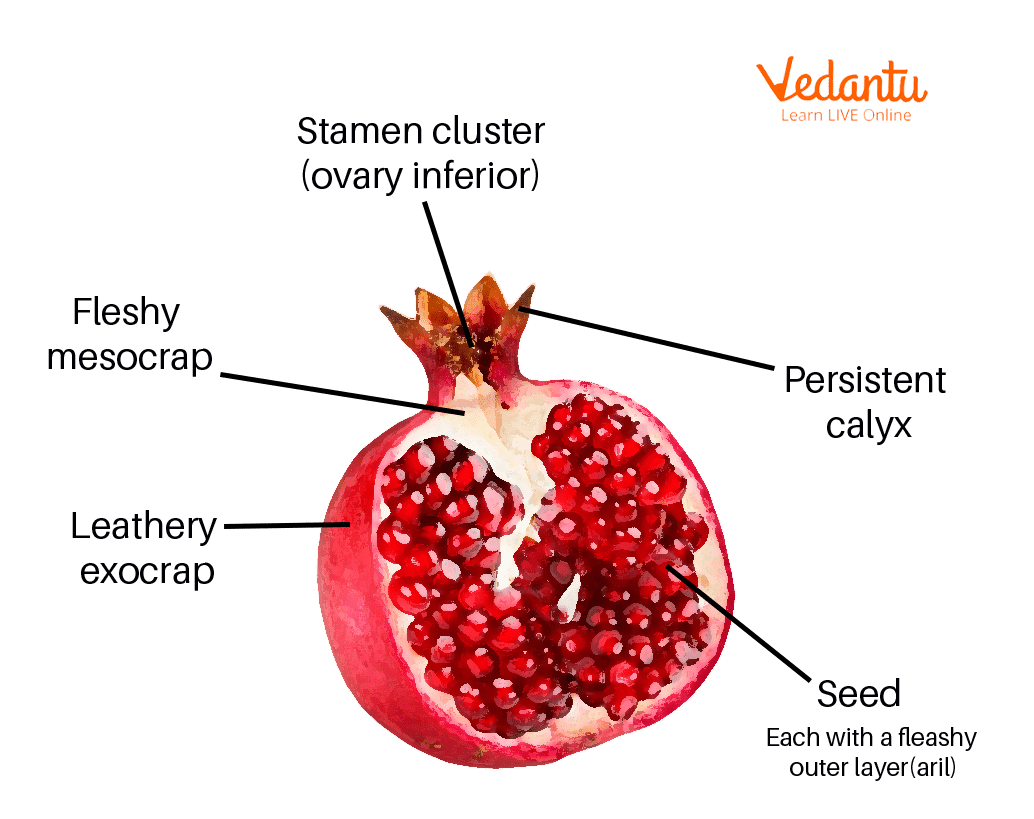
Labelling of Pomegranate
Interesting Facts
If you keep entire pomegranates in the cooler, they can be used even after two months. However, when you remove the pomegranate seeds from the organic product, they last around five to seven days with cold capacity in the cooler. Thus, to preserve the fruit for longer, freeze your pomegranate seeds for one year.
Important Questions
1. Where is the pomegranate cultivated?
Ans: Pomegranate is cultivated commercially only in Maharashtra. Small scale plantations are also seen in Gujarat, Rajasthan, Karnataka, Tamil Nadu , Andhra Pradesh, Uttar Pradesh, Punjab and Haryana. Fruit is consumed fresh or in the form of juice, jam, squash and syrup.
2. What phytochemicals are present in pomegranate?
Ans: The most abundant phytochemicals in pomegranate juice are polyphenols, including the hydrolysable tannins called ellagitannins formed when ellagic acid and gallic acid bind with a carbohydrate to form pomegranate ellagitannins, also known as punicalagins. The red colour of the juice is attributed to anthocyanins, such as delphinidin, cyanidin, and pelargonidin glycosides. Generally, an increase in juice pigmentation occurs during fruit ripening. The phenolic content of pomegranate juice is degraded by processing and pasteurisation techniques.
Pomegranate peel contains a high amount of polyphenols, condensed tannins, catechins, and pro delphinidins. The higher phenolic content of the peel yields extracts for use in dietary supplements and food preservatives. The pomegranate seed oil contains punicic acid (65%), palmitic acid (5%), stearic acid (2%), oleic acid (6%), and linoleic acid (7%).
Conclusion
Pomegranate is the most impressive natural product plentiful in cancer prevention agents, minerals and nutrients. Pomegranate can restore different sorts of malignant growth and cardiovascular illnesses. Subsequently, consuming pomegranates regularly can keep us soundly well.


FAQs on Pomegranate Botanical Name and Plant Classification
1. What is the botanical name of pomegranate?
The botanical name of pomegranate is Punica granatum. This scientific name follows binomial nomenclature and identifies the plant universally.
- Punica = Genus
- granatum = Species
- Family: Lythraceae
2. What family does Punica granatum belong to?
The species Punica granatum belongs to the family Lythraceae. This family includes flowering plants commonly known as the loosestrife family.
- Kingdom: Plantae
- Order: Myrtales
- Family: Lythraceae
3. Why is pomegranate called Punica granatum?
The name Punica granatum reflects its historical origin and fruit structure. The term Punica refers to Phoenicia (ancient region), while granatum means "seeded" in Latin.
- "Punica" = associated with Carthage/Phoenician region
- "granatum" = many-seeded fruit
- Highlights the fruit’s numerous edible seeds called arils
4. What is the scientific classification of pomegranate?
The scientific classification of pomegranate places it under the species Punica granatum in the plant kingdom.
- Kingdom: Plantae
- Clade: Angiosperms
- Clade: Eudicots
- Order: Myrtales
- Family: Lythraceae
- Genus: Punica
- Species: Punica granatum
5. Is Punica granatum a monocot or dicot?
Pomegranate (Punica granatum) is a dicotyledonous plant. It belongs to the group Eudicots within angiosperms.
- Has two cotyledons in the seed
- Leaves show reticulate venation
- Vascular bundles arranged in a ring
6. What type of fruit is Punica granatum?
The fruit of Punica granatum is a specialized berry known as a balausta. It develops from a single ovary of a flower.
- Has a tough outer rind (pericarp)
- Contains many seeds
- Each seed is surrounded by a juicy edible aril
7. What are the main botanical characteristics of Punica granatum?
The main botanical characteristics of Punica granatum include being a small deciduous shrub or tree with showy flowers and many-seeded fruits.
- Leaves: Simple, opposite, glossy
- Flowers: Bright red with thick calyx
- Ovary: Inferior
- Fruit: Many-seeded berry (balausta)
8. Are there other species in the genus Punica?
Yes, besides Punica granatum, another recognized species is Punica protopunica. This species is considered rare and endemic to Socotra Island.
- Punica granatum – cultivated pomegranate
- Punica protopunica – wild relative
9. What is the importance of using the botanical name Punica granatum?
Using the botanical name Punica granatum ensures universal scientific identification of pomegranate. Scientific names prevent confusion caused by regional common names.
- Follows binomial nomenclature
- Used in research, taxonomy, and agriculture
- Standardized by international botanical codes
10. How is Punica granatum classified among flowering plants?
Punica granatum is classified as a flowering plant under angiosperms because it produces flowers and enclosed seeds. It belongs to the eudicot group.
- Produces bisexual flowers
- Seeds enclosed within a fruit
- Shows typical dicot features like net venation



