




What Is Polyarthritis Definition Types and Diagnosis
Arthritis is the swelling and tenderness of one or additional joints. The inflammatory disease could be a general term, derived from the Greek words arthro-, which means “joint,” and -itis, which means “inflammation.” Polyarthritis could be a variety of inflammatory diseases that affect five or additional joints. Joint pain and inflammation are the most common symptoms of one or additional joints. The term describes the number of joints involved: poly suggests several. Polyarthritis could also be chronic or transient (temporary).

Polyarthritis
What is Polyarthritis?
Polyarthritis could be a term used once four or a lot of joints within the body become painful and inflamed. The condition is additionally called polyarthralgia, which suggests “many joint pains.” The name polyarthritis comes from 2 Greek words: “poly,” which means “many, much” and “arthron,” which means “joint”.
Polyarthritis affects as acute episodes or could become chronic, lasting for quite six weeks. Polyarthritis will follow several infectious agents. It's going to evolve into a particular sort of response disease, like atrophic arthritis, lupus, or Sjogren’s syndrome.
Diagnosis of Inflammatory Arthritis
The thought that inflammatory arthritis could occur in childhood was first recommended in 1864 by Cornil. 30 United Nations agencies delineated a 29-year-old girl who had had chronic inflammatory arthritis since the age of twelve. The inflammatory disease could be a grouping of the categories of arthritis involving the system.
It happens most frequently within the hands, wrists, and feet. Symptoms of inflammatory disease aren't localised to the broken joint: patients can also experience fever, weakness, and organ harm additionally with stiffness and pain within the joints. In rare cases, the disease that causes polyarthritis may also cause scarring within the lungs, dry eyes, skin rash, and carditis. Inflammatory diseases like atrophic arthritis, rheumatoid arthritis, autoimmune disease, or autoimmune disorder} is the commonest inflammatory polyarthritis. RA could be a downside to the system.
Diagnosis of RA is completed by a variety of ways or tests performed by doctors for its designation. A number of them include imaging tests like tomography, X-ray, blood tests like complete blood count, blood cell ESR, etc.
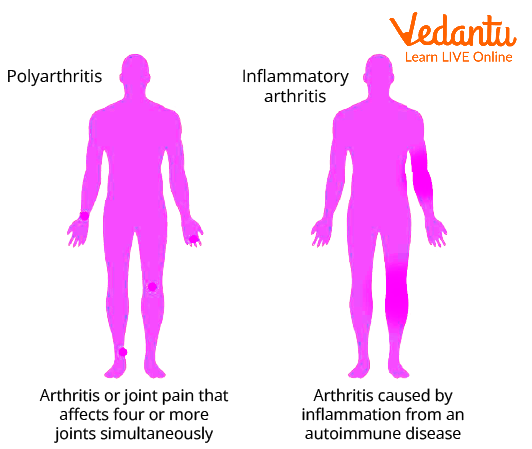
Difference Between Polyarthritis and Inflammatory Arthritis
Symptoms of Polyarthritis
Polyarthritis symptoms tend to be like those of arthritis which affect the joints. They'll develop suddenly or over several months. Some of the symptoms include:
Lack of craving
Rash
Sweating
Sore throat (pharyngitis)
Swollen lymph nodes
The temperature of a 104 degrees or more
Unexpected weight loss
fatigue or an absence of energy
In rare cases, the disease that causes polyarthritis may also cause scarring within the lungs, dry eyes, skin rash, and carditis.
Causes and Treatment of Polyarthritis
Causes for Polyarthritis
Polyarthritis will occur because of the results of genetic factors. Some people naturally have disease-destroying proteins in their bodies known as antibodies that build it easier for the condition to thrive.
Polyarthritis causes infections or unwellness, and it will be in the course of another condition. The viruses that cause epidemic roseola and epidemic parotitis conjointly activate the body’s system and may trigger an inflammatory reaction that ends up in somebody developing polyarthritis.
Risk Factors
The risk factors for polyarthritis include:
Family History - Some styles of inflammatory disease run in families. Thus, you will undoubtedly develop the inflammatory disease if your elders or siblings have the disorder.
Age - The danger of the many styles of inflammatory disease — together with degenerative arthritis, autoimmune disease, and gouty arthritis — will increase with age.
Your Sex - Girls have a higher chances than men to develop autoimmune disease, whereas most of those that have gouty arthritis, another form of inflammatory disease, are men.
Previous Joint Injury - Those that have battle-scarred a joint, maybe whereas enjoying a sport, are a bit doubtless to eventually develop the inflammatory disease in this jointPolyarthritis can occur as the result of genetic factors. Some people naturally have disease-destroying proteins in their bodies called antibodies that make it easier for the condition to thrive.
Treatment for Polyarthritis
While polyarthritis can not be cured, nevertheless, it can be treated with medication.
Current healthful polyarthritis’s treatments that are offered include:
Painkillers
Non-steroidal medicinal drug medicine (NSAIDs
Disease-modifying anti-rheumatic medicine (DMARDs)
Methotrexate could be a usually used DMARD that may cut back joint injury caused by polyarthritis.
Biological therapies
Steroids
Interesting Facts
Gout Might be a Type of Arthritis: Perennial flare-ups, pain and swelling are the results of acid, designed round the joints. This might be due to genetic predisposition, some diseases and consumption of excess meat, seafood, fructose-sweetened drinks or alcohol.
Climate Cannot Cure: Individuals have a thought that wet, cold climates cause disease rather than a warmer climate. Sadly, that's not the case. Bioscience confirmed identical frequency for each heat and cold climates. However, sore joints find a hot atmosphere and a lot of soothing.
Important Questions
1. How many joints can polyarthritis have?
2 joints
4 joints
Atleast 5 joints
None of the above
Ans. The correct answer is (c) atleast 5 joints.
Polyarthritis refers to a joint illness that involves a minimum of five joints. One or a lot of signs of inflammation, as well as pain, movement restriction, swelling, warmth, and redness, are seen among the joints concerned.
2. What is reactive polyarthritis?
Ans. Reactive polyarthiritis disease is joint pain and swelling triggered by an infection in another part of the body — most often the intestines, sex organ or urinary tract.
Key Features
Polyarthritis affects five or more joints, both large and small, though typically in a symmetric pattern.
Imaging methods such as ultrasonography and magnetic resonance may be helpful for the diagnosis of arthritis.
The treatment for the disease involves medication or medication-free strategies to reduce pain, promote healing, and allow the joints to continue to work properly.


FAQs on Polyarthritis Overview Causes Symptoms and Treatment
1. What is polyarthritis?
Polyarthritis is a medical condition characterized by inflammation of five or more joints at the same time. It commonly affects joints such as the hands, wrists, knees, and feet and may be acute or chronic. Polyarthritis is often associated with autoimmune diseases, infections, or systemic inflammatory disorders. Persistent joint swelling, pain, and stiffness are hallmark features.
2. What causes polyarthritis?
Polyarthritis is most commonly caused by autoimmune disorders, infections, or systemic inflammatory diseases. Major causes include:
- Rheumatoid arthritis (autoimmune attack on synovial joints)
- Systemic lupus erythematosus (SLE)
- Viral infections such as parvovirus or hepatitis
- Psoriatic arthritis
- Crystal-induced arthritis (e.g., gout in multiple joints)
3. What are the main symptoms of polyarthritis?
The main symptoms of polyarthritis are joint pain, swelling, and stiffness affecting multiple joints simultaneously. Common clinical features include:
- Morning stiffness lasting more than 30 minutes
- Warmth and redness over joints
- Reduced range of motion
- Fatigue and low-grade fever (in inflammatory causes)
4. How is polyarthritis different from rheumatoid arthritis?
Polyarthritis refers to inflammation of multiple joints, while rheumatoid arthritis (RA) is a specific autoimmune disease that often causes polyarthritis. The key differences are:
- Polyarthritis is a descriptive term based on the number of affected joints.
- Rheumatoid arthritis is a chronic systemic autoimmune disorder.
- RA typically presents with symmetrical joint involvement and positive autoimmune markers.
5. What is the pathophysiology of polyarthritis?
The pathophysiology of polyarthritis involves inflammation of the synovial membrane leading to joint damage. The process typically includes:
- Activation of immune cells in the synovium
- Release of inflammatory cytokines such as TNF-α and interleukins
- Synovial thickening and pannus formation
- Cartilage destruction and bone erosion
6. Is polyarthritis an autoimmune disease?
Polyarthritis itself is not a single disease but is often caused by autoimmune disorders. Conditions like rheumatoid arthritis and systemic lupus erythematosus trigger immune-mediated joint inflammation. However, polyarthritis can also result from infections or metabolic conditions, so it is a clinical pattern rather than a diagnosis.
7. How is polyarthritis diagnosed?
Polyarthritis is diagnosed through clinical evaluation, blood tests, and imaging studies. Diagnostic steps include:
- Physical examination of affected joints
- Blood tests for rheumatoid factor (RF), anti-CCP antibodies, and inflammatory markers (ESR, CRP)
- X-rays or ultrasound to assess joint damage
- Joint fluid analysis if infection is suspected
8. What joints are most commonly affected in polyarthritis?
Polyarthritis most commonly affects small joints of the hands and feet in a symmetrical pattern. Frequently involved joints include:
- Metacarpophalangeal (MCP) joints
- Proximal interphalangeal (PIP) joints
- Wrists
- Knees and ankles
9. Can polyarthritis be cured?
Polyarthritis can often be managed but is not always curable, especially in chronic autoimmune cases. Treatment aims to:
- Reduce inflammation with NSAIDs or corticosteroids
- Suppress immune activity using DMARDs (e.g., methotrexate)
- Prevent joint damage
- Maintain mobility through physiotherapy
10. What is the difference between polyarthritis and oligoarthritis?
The difference between polyarthritis and oligoarthritis lies in the number of affected joints. Polyarthritis involves five or more joints, while oligoarthritis affects fewer than five joints. Oligoarthritis is often seen in certain types of juvenile idiopathic arthritis, whereas polyarthritis is more common in systemic autoimmune diseases.



