




What Are Living Organisms and Their Surroundings Definition Habitat and Biotic and Abiotic Factors
There are many things around us; some may be living or some may be nonliving. Living beings have special characteristics and perform various life processes like respiration, transportation, reproduction etc. and are called living organisms. These organisms are adapted to certain places in their surroundings, these are called habitats. Besides air, food and water, every animal needs a certain type of habitat or surrounding where it can live and flourish. Habitats mainly are of 2 types: terrestrial and aquatic.
Living Organisms: Definition
Living organisms are independent organic entities that are composed of cells. These are involved in certain activities which are necessary for living, these are known as life processes.
Characteristics of Living Things or Living Organisms
some special characteristics are found in all living organisms; these are as follows:
Cellular Organisation: All living things are composed of cells. These cells are the structural and functional units of living organisms.
Nutrition: Food is important for all living things. But why do organisms need to take food? They need it to obtain energy. This energy can be utilised to perform various day-to-day activities and also helps in body growth and development as well as in maintenance and repair.
Respiration: All living beings respire, i.e., they breathe in oxygen from the air and release carbon dioxide.
Growth: Growth is a permanent, irreversible process that shows different patterns for different organisms. In this, all living beings grow from a single cell into an adult organism made up of millions of cells.
Excretion: Accumulation of waste materials is harmful to the body. Thus, waste materials are needed to be removed from the body. The process through which the removal of waste matter occurs is known as excretion.
Reproduction: All living organisms possess the ability to produce young ones of their kind, this ability is known as reproduction. For example, a dog produces puppies who grow into adult dogs. A seed develops into a young seedling and then into a tree.
Movement: Living things show movement. A change in position is called locomotion. Animals show locomotion but plants do not. Plants show movements only.
Response to Stimuli: Living beings respond to changes (stimuli) in their surroundings. For example, if any of our body parts touch a hot object, we respond by quickly withdrawing it. A plant root moves towards water (hydrotropic).
Classification of Living Organisms
Living organisms are classified into the following groups based on their similarities and dissimilarities, namely, Kingdom, Phylum, Class, Order, Family, Genus and Species.
But the question emerges “Why are living organisms classified?” The answer is classification makes it easier for scientists to study whole living organisms. Each living organism has several characteristics, thus grouping organisms based on cellular organisation, nutrition, mode of reproduction etc. makes the study easy.
Living Organisms and Their Surroundings
Living beings can survive only under certain conditions. The surrounding where the living being resides is called the habitat.
Organisms depend on their habitat for their food, water, shelter and other requirements.
The three main types of habitat are as follows:
1. Terrestrial Habitat: Land, mountains, forests and deserts are called terrestrial habitats. Living organisms that live on land are called terrestrial organisms. For example, man, lion, trees etc.
Forests: Large areas covered with trees and plants. Wildlife in the forest includes both plants and animals. Different types of forests are tropical forests, temperate forests and boreal forests.

Forest Habitat
Grasslands: These are mainly covered by long, thick green grasses. Temperature ranges between -20oC and 30oC and the annual rainfall varies between 50 cm and 90cm.
Deserts: These are the areas that receive very low rainfall. These are dry and completely covered with sand. There can be cold or hot deserts. Annual rainfall in deserts is less than 25 cm.
Mountains: These regions are rocky and dry. Sometimes water may be present as flowing streams. As the altitude increases, temperatures fall. Winds are dry and cold.
Polar Region: These are covered with high snowy peaks.
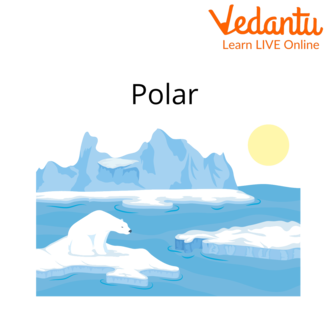
Polar Habitat
2. Aquatic Habitat: Oceans, lakes, rivers, ponds etc. are called aquatic habitats or water habitats. Organisms that live and reproduce in water are called aquatic organisms.
Freshwater Habitat: These are the water bodies filled with fresh water such as rivers, lakes, ponds, streams etc.
Marine Habitat: Oceans and seas are referred to as marine habitats. These have a high concentration of salt within them.
Coastal Habitat: This region presents the place where land meets the sea.

Coastal Habitat
3. Aerial or Arboreal Habitat: Tropical forests are known as aerial or arboreal habitats.
Living Organisms Examples with Their Habitats
Plants in Our Surroundings
There are abundant varieties of plants we see around us in parks, forests and in the surroundings in which we live. These plants help to maintain ecological balance and keep the environment stable. The common plants seen in our surroundings include herbs like grasses, mint, cilantro etc. The shrubs are seen in gardens like roses and orchids. The road's sides are planted with plants that can absorb pollution and make it reasonable. Examples of such plants are Neem, Mahua, Indian rosewood etc.
Interesting Facts
Every organism has special features which enable them to survive and reproduce in certain environmental conditions. This occurs naturally and it is called adaptation.
Growth is a feature of living beings but nonliving organisms can also show growth through the accumulation of external materials.
Plants in our surroundings are the main source of food on this Earth.
Key Features
Living organisms are organic systems made up of cells.
Living beings perform nutrition, respiration, excretion, reproduction, movement and response to stimuli.
Living beings are adapted to various habitats and depend on these habitats for food, shelter and other needs.
These habitats can be either terrestrial, aquatic or arboreal.


FAQs on Living Organisms and Their Surroundings in Biology
1. What are living organisms and their surroundings?
Living organisms and their surroundings refer to all living beings and the environment in which they live and interact. Living organisms include plants, animals, and microorganisms, while their surroundings include both living and non-living components.
- Biotic components: Plants, animals, fungi, bacteria.
- Abiotic components: Air, water, soil, temperature, light.
- All these together form an ecosystem, where organisms depend on each other and their environment for survival.
2. What is an ecosystem in biology?
An ecosystem is a functional unit where living organisms interact with each other and with their physical environment. It includes both biotic and abiotic components working together as a system.
- Examples: Forest, pond, desert, grassland.
- Energy flows through food chains and food webs.
- Nutrients cycle between organisms and the environment.
3. What are biotic and abiotic factors?
Biotic factors are the living components of an ecosystem, while abiotic factors are the non-living physical and chemical components. Both are essential for maintaining ecological balance.
- Biotic factors: Plants, animals, microorganisms.
- Abiotic factors: Sunlight, water, soil, temperature, minerals.
- Changes in abiotic factors directly affect living organisms.
4. How do living organisms depend on their surroundings?
Living organisms depend on their surroundings for food, shelter, protection, and reproduction. The environment provides essential resources required for survival.
- Plants depend on sunlight, water, and carbon dioxide for photosynthesis.
- Animals depend on plants or other animals for food.
- All organisms rely on suitable temperature and habitat conditions.
5. What is a habitat?
A habitat is the natural place where an organism lives and grows. It provides all the basic needs required for survival.
- Includes food, water, shelter, and space.
- Examples: Desert for camels, pond for frogs, forest for tigers.
- Different habitats support different types of organisms.
6. What are the different types of habitats?
Habitats are mainly classified into terrestrial and aquatic habitats based on where organisms live. Each type has unique environmental conditions.
- Terrestrial habitats: Forests, deserts, mountains, grasslands.
- Aquatic habitats: Freshwater (ponds, rivers) and marine (oceans, seas).
- Organisms show special adaptations to survive in each habitat.
7. What is adaptation in living organisms?
Adaptation is a structural, functional, or behavioral feature that helps an organism survive in its environment. These traits develop over generations through natural selection.
- Structural adaptations: Thick fur in polar bears.
- Behavioral adaptations: Migration in birds.
- Physiological adaptations: Water conservation in desert plants.
8. What is the difference between a habitat and an ecosystem?
A habitat is the specific place where an organism lives, while an ecosystem includes all living and non-living components interacting in a particular area. A habitat is part of an ecosystem.
- Habitat: Home of a particular species.
- Ecosystem: Community of organisms plus abiotic environment.
- Example: A pond is an ecosystem; the muddy bottom is a habitat for worms.
9. How do plants and animals interact in an ecosystem?
Plants and animals interact mainly through feeding relationships and gas exchange in an ecosystem. These interactions maintain ecological balance.
- Plants produce food by photosynthesis.
- Animals consume plants or other animals in a food chain.
- Plants release oxygen, and animals release carbon dioxide.
10. Why is the study of living organisms and their surroundings important?
The study of living organisms and their surroundings is important because it helps us understand ecological balance and environmental conservation. It explains how life survives and interacts on Earth.
- Helps in protecting biodiversity.
- Promotes sustainable use of natural resources.
- Raises awareness about environmental issues like pollution and climate change.



