




Hydrilla Structure Reproduction Methods and Ecological Adaptations
Hydrilla is a water plant that can become invasive. This plant lives in water. Hydrilla verticillata is the scientific name of hydrilla plant. H. verticillata is a monoecious or dioecious perennial plant that grows in the water. It has branching stems. The sessile leaves form whorls at the nodes, with 3-8, and occasionally up to 12 leaves per whorl. It comes from the Indian subcontinent. It is a dense mat-forming submerged perennial plant. Hydrilla can develop in practically every freshwater environment.
Hydrilla Classification
Kingdom: Plantae
Order: Alismatales
Family: Hydrocharitaceae
Genus: Hydrilla
Species: Hydrilla verticillata
Hydrilla is a member of the plantae kingdom because it has similar features as plants such as leaves, stems, roots, and fruits. It is placed in the family hydrocharitaceae (hydrophytes) because it has adapted to survive in water and aquatic life.
Hydrilla Plant Features
H. verticillata is a monoecious or dioecious perennial plant that grows in the water. It has branching stems. The leaves are 7-40 mm long and have a linear to lanceolate form. The vein on the lower side of the leaves has strongly serrated borders and spines. These leaf traits are frequently used to differentiate H. verticillata from other Hydrocharitaceae submerged plants, such as Egeria and Elodea spp.
The plant is rooted in the waterbed and has long stems that branch out at the water's surface, where it grows horizontally and forms dense mats. Hydrilla stems can reach a maximum height of 25 feet. Their stems are growing at a rate of one inch every day. Fragments, turions (axillary buds), and subterranean tubers are used to proliferate. Hydrilla can grow in saline water, although the salinity level should be around 7%.
Hydrilla is a plant was first introduced to Florida as an aquarium plant. In the early 1950s, it was imported as an aquarium plant from Southern Asia. It's grown in canals and rivers and harvested for aquariums in pet stores.
Hydrilla Diagram
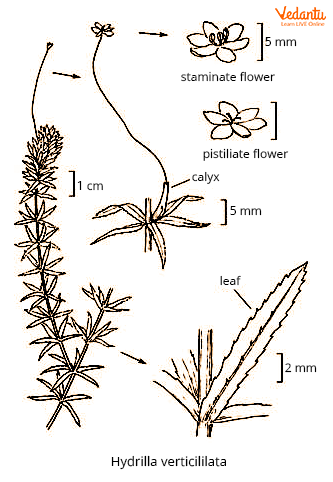
Image: Hydrilla plant
Aquatic Adaptation of Hydrilla
Plants and animals have adaptations that help them thrive in the environment they live in. Every species has its unique strategy for surviving. The aquatic plants are known as hydrophytes. Hydrilla is an aquatic plant.
Adaptations in aquatic plants - Hydrophytes are aquatic plants that float or live beneath water. They have hollow stems and specialised roots. Some have huge flat, floating leaves with a waxy coating on the underside. On the upper surface, there are stomata. Air sacs in the hollow stems of aquatic plants assist the plant stay afloat. They have specialised roots that assist aquatic plants to stay afloat or keep their position. These roots also aid in the plant's oxygen absorption.
In Hydrilla, thin ribbon-like leaves are present that make it easier for the plant to move around in the water. Hydrilla is a submerged plant (Rooted plants that remain hidden under the water's surface are known as submerged plants) with no stomata and a waxy cuticle on the leaves. The cuticle helps in preventing the plant from getting wet. Small, hollow stems enable these plants to float upright in the water and reduce water resistance. Hydrophytes either have very simple roots or none at all.
The presence of hairy and fibrous roots allows water to capture air and be absorbed directly into the plant. It doesn't need roots for stability because the nearby water's buoyancy allows it to float and stay erect in water. Epidermis, hypodermis, aerenchyma, and endodermis layers are present in the stem. The aerenchyma layer has air sacs that help in the floating and buoyancy of the plant.
Hydrilla Experiment
Hydrilla is a frequent ingredient in lab research. The Hydrilla plant is commonly used in practical work to demonstrate that oxygen is produced throughout photosynthesis. The Hydrilla Experiment is carried out in order to demonstrate the significance of sunlight in the genesis of oxygen. Sunlight provides the energy required for photosynthesis to make oxygen. Hydrilla plant is used in this experiment because it is a little plant, it's easily manageable, and it's an aquatic plant, which means it can breathe in water whereas land plants can't.
The Steps in the Hydrilla Experiment are as Follows:
Place hydrilla twigs in a short-stemmed funnel and maintain it in a water-filled beaker.
Place a test tube full of water over the funnel's stem.
Allow the device to sit in the sun for at least two hours.
After some time has passed, examine the device.
The Outcome and Observation are Discovered.
At the end of the test tube, gas bubbles of oxygen are formed, and these bubbles are removed.
Insert a blazing incense stick into the test tube, which will explode into flames, indicating the presence of oxygen.
This experiment helps to detect the oxygen production by the plants. It has been established that in the presence of sunlight, oxygen is released throughout photosynthesis.
Conclusion
Hydrilla is a small aquatic plant used for experiments. It has some adaptations that help it to remain alive in the water. The pollinating agent of Hydrilla is water. It requires less light for photosynthesis and grows very well in low light conditions like early morning and sunset. The experiments in the above article provide the necessary information about Hydrilla plants. This topic is helpful to clear doubts about hydrilla plants.


FAQs on Hydrilla and Its Morphology Reproduction and Importance
1. What is Hydrilla?
Hydrilla is a submerged aquatic plant scientifically known as Hydrilla verticillata that grows in freshwater bodies. It belongs to the family Hydrocharitaceae and is commonly found in ponds, lakes, rivers, and reservoirs. Key features include:
- Completely submerged habit
- Slender, branched stems
- Leaves arranged in whorls around the stem
- Ability to reproduce rapidly and spread aggressively
Hydrilla is often studied in biology for its role in photosynthesis experiments and aquatic ecosystems.
2. What type of plant is Hydrilla?
Hydrilla is a submerged aquatic perennial herb that lives entirely underwater in freshwater habitats. It is classified as:
- Kingdom: Plantae
- Division: Angiosperms (flowering plants)
- Class: Monocotyledonae
Unlike floating plants like water hyacinth, Hydrilla remains rooted in the soil while its entire plant body stays submerged.
3. What are the main characteristics of Hydrilla?
The main characteristics of Hydrilla include its submerged growth habit, whorled leaves, and rapid vegetative reproduction. Important features are:
- Long, slender, branched stems
- Leaves in whorls of 3–8 at each node
- Small, translucent leaves with serrated margins
- Presence of tubers and fragments for reproduction
- Highly efficient photosynthesis under water
These traits make Hydrilla highly adaptable and often invasive.
4. How does Hydrilla reproduce?
Hydrilla reproduces mainly by vegetative propagation, although it can also reproduce sexually through flowers. Its methods include:
- Fragmentation – broken stem pieces grow into new plants
- Tubers – underground storage structures that sprout new shoots
- Turions – dormant buds that detach and develop
- Occasional sexual reproduction via male and female flowers
Vegetative reproduction allows Hydrilla to spread quickly in freshwater ecosystems.
5. Why is Hydrilla used in photosynthesis experiments?
Hydrilla is used in photosynthesis experiments because it releases visible oxygen bubbles during photosynthesis under water. In laboratory setups:
- The plant is placed in water with a light source.
- Oxygen bubbles are observed emerging from cut stems.
- The rate of bubble formation indicates the rate of photosynthesis.
This makes Hydrilla ideal for demonstrating the effect of light intensity and carbon dioxide on photosynthesis.
6. What is the habitat of Hydrilla?
Hydrilla naturally grows in freshwater habitats such as ponds, lakes, canals, and slow-moving rivers. It prefers:
- Still or slow-flowing water
- Soft, muddy substrates for rooting
- Moderate to high light availability
It can tolerate a wide range of temperatures and nutrient conditions, which contributes to its invasive potential.
7. Is Hydrilla an invasive species?
Yes, Hydrilla is considered a highly invasive aquatic plant in many parts of the world. It becomes invasive because:
- It grows rapidly and forms dense mats.
- It reproduces efficiently through fragments and tubers.
- It competes with native aquatic plants for light and nutrients.
Dense Hydrilla growth can reduce biodiversity and interfere with fishing, boating, and water flow.
8. What is the function of tubers in Hydrilla?
The function of tubers in Hydrilla is to act as storage and perennation structures that help the plant survive unfavorable conditions. Tubers:
- Store nutrients underground
- Remain dormant during harsh seasons
- Sprout into new plants when conditions improve
This adaptation ensures long-term survival and rapid regrowth of Hydrilla populations.
9. What is the difference between Hydrilla and Vallisneria?
The main difference between Hydrilla and Vallisneria is in their leaf arrangement and growth pattern. Key differences include:
- Hydrilla: Leaves arranged in whorls around a branched stem.
- Vallisneria: Long ribbon-like leaves arising from the base (rosette form).
- Hydrilla has branched stems; Vallisneria does not show prominent branching.
Both are submerged aquatic plants but differ in structure and morphology.
10. What is the ecological importance of Hydrilla?
Hydrilla plays an ecological role by providing oxygen and habitat in freshwater ecosystems, although excessive growth can be harmful. Its importance includes:
- Releasing oxygen during photosynthesis
- Providing shelter for small aquatic organisms
- Serving as food for some herbivorous fish and invertebrates
However, uncontrolled Hydrilla growth can disrupt aquatic biodiversity and ecosystem balance.



